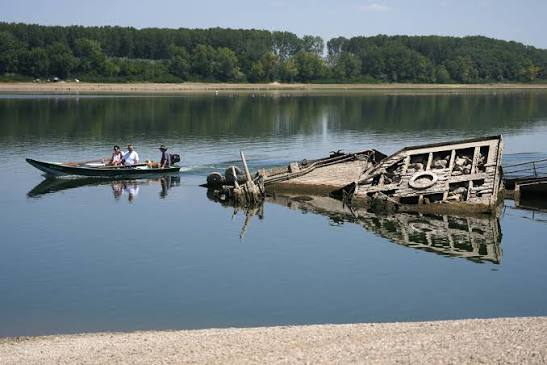
Record-low water on Europe’s second-longest river has exposed dozens of scuttled World War II warships near the Serbian port of Prahovo.
Water levels on the Danube River have fallen so low during the current drought that the hulks of dozens of World War II German warships are rising back into view. The ships have surfaced near the Serbian port of Prahovo, on the stretch of river separating Serbia and Romania, according to the Associated Press.
At the site, a rusty hull now stands above the waterline, along with a broken mast where the Nazi flag once flew. Some of the wrecks still carry weapons. The vessels belonged to Nazi Germany’s Black Sea fleet.
The exposed ships are only one visible sign of a wider drought gripping the region. The Danube’s record-low levels have pushed power plants close to shutting down, and governments across Central and Eastern Europe have begun taking steps to conserve electricity.
Why the Danube Warships Were Scuttled Near Prahovo
The ships have a specific history. Historians say up to 200 German warships were scuttled in September 1944 near Prahovo, in the Danube gorge, as they came under Soviet fire. The vessels belonged to Germany’s Black Sea fleet, and the Germans sank them deliberately as they retreated from Romania and Soviet forces advanced deeper into Europe.
The aim of the deliberate sinking was to slow the Soviet advance in the Balkans. Nazi Germany surrendered months later, in May 1945. The wrecks have remained on the riverbed ever since.
Some of the ships were later removed from the river by Communist Yugoslav authorities. Most stayed where they sank because of the explosives they carried. The Serbian government, with European Union financial support, has long been working to deal with them. Many of the hulks still contain ammunition and explosives, which makes their removal slow and hazardous.
Danube Drought Disrupts River Traffic and Power Supply
The low water is now causing practical problems along the river. Authorities are trying to keep traffic moving on the Danube, which runs through 10 nations, as the falling levels create dangerous conditions for shipping.
The wrecks add to that difficulty. When water levels drop, the hulks narrow the navigable channel, and some stretches near Prahovo have been reduced sharply as a result. Local residents say the effect on river traffic has been severe. Krsta Brandic, a Prahovo resident, said the low water has almost stopped ship movement, noting that large ships can no longer pass.
The drop has been dramatic close to shore. Radovan Segrt, a houseboat owner who runs river excursions, told the Associated Press that the water had withdrawn some 15 to 20 metres, roughly 50 to 65 feet, from the bank. He said the summer season was effectively over as far as boat rides were concerned.
The warships are not the only thing the retreating water has uncovered. Along the same river, the remains of an ancient woolly mammoth have also emerged. Experts have linked the unusually hot weather to global warming and other factors.
Wrecks of WW2 German ships emerge from 2nd-longest river in Europe
Danube river dropping to record low after dry summer weather pic.twitter.com/faf9gAuZA3
— RT Intl (@RT_on_X) August 5, 2026The Danube Ships Have Surfaced Before
This is not the first time the wrecks have reappeared. In 2024, a group of sunken Nazi ships, still fitted with explosives, emerged in the Danube after a severe summer drought. Similar exposures occurred in earlier drought years, when the river fell to some of its lowest points in almost a century.
Each time the water recedes far enough, the same stretch near Prahovo reveals the scale of what lies beneath. Some of the ships still show turrets, command bridges, broken masts and twisted hulls. Others remain mostly buried under sand banks, visible only in outline.
The Danube stretches from the Black Forest in southwestern Germany to the Black Sea in eastern Romania, making it the second-longest river in Europe. Along its course, the combination of record heat and prolonged drought has repeatedly turned a working waterway into an open-air record of the war that ended eight decades ago. As the current drought continues, the wrecks near Prahovo remain exposed, and authorities continue their efforts to keep the river open to traffic.