

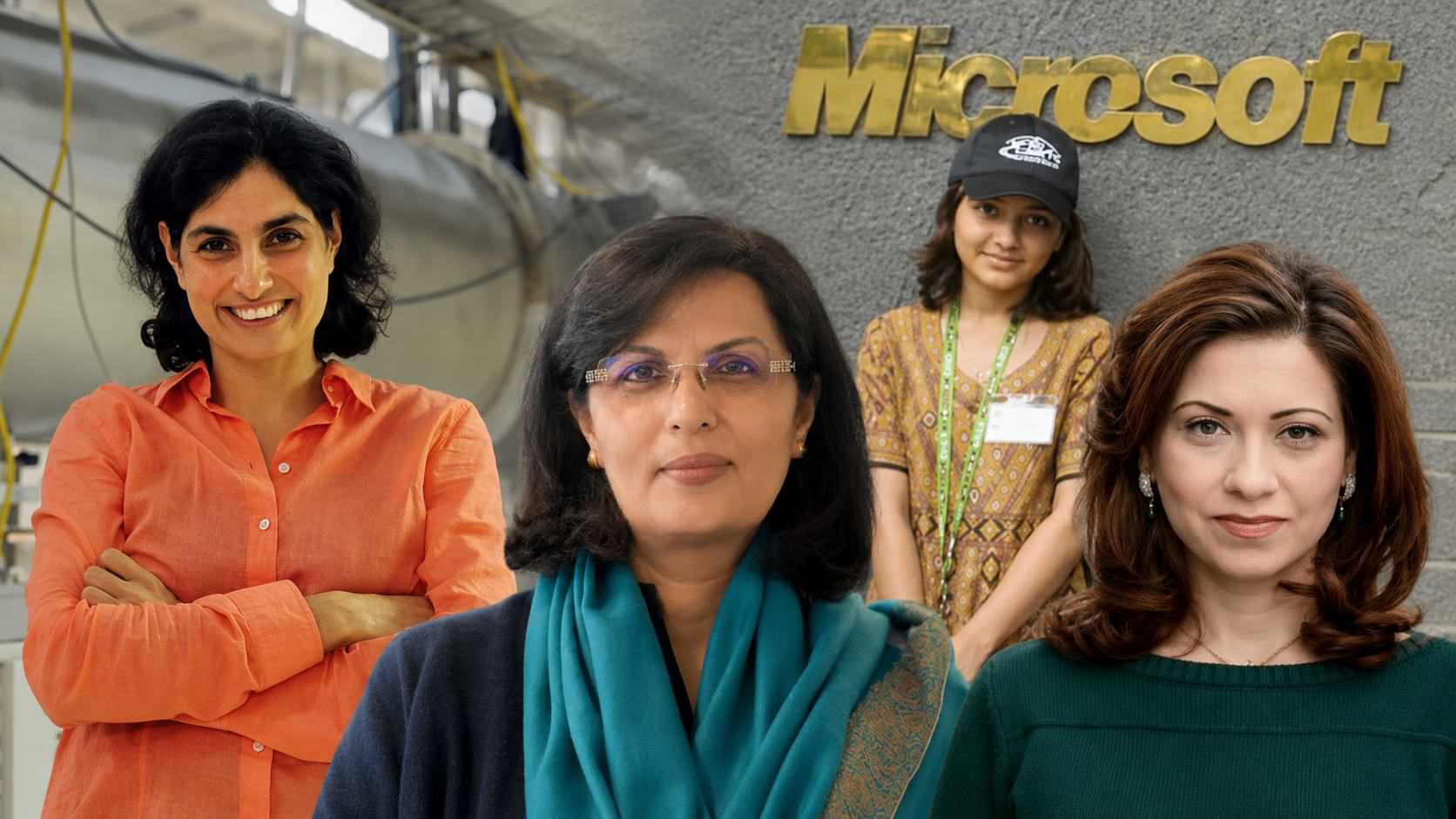
Pakistani women are reshaping the global scientific landscape. From detecting ripples in spacetime to reforming the architecture of global public health, these trailblazers have broken cultural and systemic barriers to carve out their places in history. Here are four Pakistani women whose groundbreaking work continues to inspire generations.
Dr. Nergis Mavalvala: Unlocking the Secrets of the Universe
Dr. Nergis Mavalvala is a world-renowned astrophysicist and the Dean of the MIT School of Science. She played a pivotal role in the historic first detection of gravitational waves in 2015 with the Laser Interferometer Gravitational-Wave Observatory (LIGO) — a discovery that confirmed a century-old prediction from Einstein’s General Theory of Relativity and opened an entirely new window onto the universe. Her pioneering work in quantum measurement science earned her a MacArthur “Genius” Fellowship in 2010. Born in Lahore and raised in Karachi, Mavalvala went on to become the first woman ever to lead MIT’s School of Science, and today she remains one of the most prominent voices for women and minorities in physics anywhere in the world.
Dr. Sania Nishtar: A Global Voice for Public Health
Dr. Sania Nishtar is a physician, cardiologist, and global health leader whose career spans three decades of reform. She founded Heartfile, an influential health-policy think tank in Pakistan, and served as Special Assistant to the Prime Minister on Social Protection and Poverty Alleviation, where she designed and launched the landmark Ehsaas program — one of the largest social safety-net initiatives in Pakistan’s history. She has held leadership roles across the World Health Organization’s advisory commissions and independent panels on global health, and today serves as Chief Executive Officer of Gavi, the Vaccine Alliance, an organization that has helped immunize more than a billion children worldwide. It is one of the most consequential leadership posts in global health, and Nishtar is the first person of Pakistani origin to hold it.
Dr. Tasneem Zehra Husain: Deciphering String Theory
Pakistan’s first female theoretical physicist to specialize in string theory, Dr. Tasneem Zehra Husain earned her PhD from Stockholm University at just twenty-six and went on to conduct postdoctoral research at Harvard University. Her scholarship probes the fundamental structure of the universe — the strange, elegant mathematics that may underlie all matter and force. But her impact reaches well beyond the lab: through public talks, science journalism, and a popular-science novel praised for capturing “the passion of its practitioners,” she has spent years demystifying physics for students who might never otherwise see themselves in the field, inspiring a new generation of young Pakistani women to pursue science.
Arfa Karim: A Prodigy Who Inspired a Nation
Arfa Karim Randhawa became a global sensation in 2004 when, at just nine years old, she became the world’s youngest Microsoft Certified Professional. She went on to represent Pakistan at international technology forums, and her extraordinary talent caught the attention of Bill Gates, who personally invited her to Microsoft’s headquarters in the United States. Arfa passed away in 2012 at the age of sixteen, but her legacy has only grown in the years since — Lahore’s largest technology park was renamed in her honor, and she remains a touchstone for what young Pakistani talent can achieve on the world stage.
The Lasting Impact
Together, these four women tell a story bigger than any one field or discovery. A girl from Karachi helped humanity hear the universe for the first time. A physician turned a nation’s poorest villages into the frontline of a global health revolution. A home schooled student from Lahore chased the deepest questions in physics all the way to Stockholm and Harvard, then came home to open that door for others. And a nine-year-old proved to the world that genius does not wait for permission. Each of them carried Pakistan’s name into rooms it had never entered before — and left it there, etched into the record. Their journeys are not just proof of what is possible; they are an inheritance, a standing invitation to every young girl watching from Lahore to Lyari, Quetta to Karachi: this is your legacy too, and it is only just beginning.