

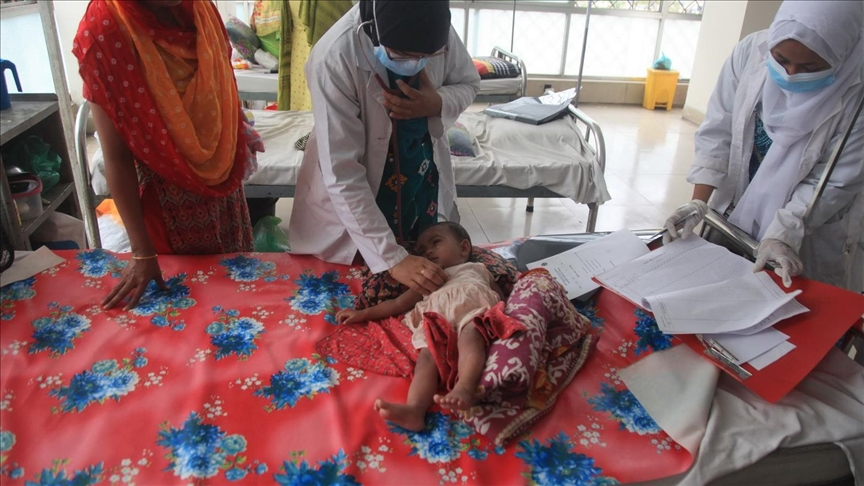

A suspected measles outbreak has killed more than 100 children in Bangladesh in less than a month, prompting an emergency vaccination drive across 18 high-risk districts.
Bangladesh is facing its worst measles crisis in years. More than 100 children have died from suspected measles since mid-March, according to the country’s Directorate General of Health Services. Hospitals across the South Asian nation of 170 million people are reporting a surge in infections, with the outbreak now spanning 56 of Bangladesh’s 64 districts.
The Ministry of Health and Family Welfare reported that the number of children aged six months to five years showing suspected measles symptoms had reached over 7,500. Of those, 17 deaths have been officially confirmed through testing, while more than 100 additional deaths are suspected to be measles-related. Health officials say many patients die before testing can be carried out. In 2025, Bangladesh recorded just 125 measles cases for the entire year, according to UPI.
Bangladesh Measles Vaccination Gaps Behind Deadly Child Health Crisis
Health authorities have traced the outbreak to gaps in the country’s immunization program. Bangladesh had planned a nationwide measles vaccination campaign for June 2024, but the drive was derailed by the mass uprising that toppled Prime Minister Sheikh Hasina that summer. A special vaccination campaign typically takes place every four years, and the last one was carried out in 2020.
The political disruption did not end there. Hasina’s ouster led to an interim government under Nobel laureate Muhammad Yunus, which eventually handed power to an elected government following elections in February 2026. Health Minister Sardar Mohammed Sakhawat Husain told Parliament on Monday that both the Hasina government and the Yunus-led interim administration failed to properly manage vaccine stockpiles, leading to shortages that affected measles and six other diseases.
Halimur Rashid, director at the Communicable Disease Control division, told AFP that the surge had “multifactorial causes, including a shortage of vaccines.” Most children in Bangladesh receive their first measles vaccine at nine months, but many of those infected in the current outbreak were just six months old, below the routine vaccination age. Doctors at Bangladesh Shishu Hospital and Institute have reported an unusual number of patients younger than six months, according to The Daily Star.
Bangladesh launched its Expanded Programme on Immunisation in the late 1970s and raised the share of fully immunized children from 2 percent to over 81 percent, according to UNICEF. But the WHO says 95 percent coverage is needed to stop measles from spreading. Bangladesh’s National Verification Committee of Measles and Rubella had committed to eliminating cases by December 2025, a target it did not meet.
Emergency Measles-Rubella Vaccination Drive Targets 1.2 Million Bangladesh Children
On April 5, the government launched an emergency measles-rubella vaccination campaign with support from UNICEF, the WHO and Gavi, the Vaccine Alliance. The initial phase targets more than 1.2 million children aged six months to five years across 30 upazilas in 18 high-risk districts. The drive will expand to four City Corporations from April 12, then go nationwide from May 3.
Prime Minister Tarique Rahman lowered the vaccination age from nine months to six months and directed two senior ministers to travel across the country to assess the crisis. The campaign is focusing heavily on Dhaka’s densely populated neighborhoods and Cox’s Bazar, home to crowded Rohingya refugee camps where the risk of transmission is especially high.
The WHO’s representative to Bangladesh, Dr. Ahmed Jamsheed Mohamed, said the outbreak would likely continue to spread in the coming days but should be curtailed once the vaccination campaign gains momentum. UNICEF Representative Rana Flowers called the situation alarming, noting that infections among infants under nine months highlight dangerous immunity gaps among unvaccinated and “zero-dose” children.
Measles is one of the world’s most contagious diseases, transmitted through coughs and sneezes. It can cause severe complications including brain swelling and breathing problems, particularly in young children. The WHO estimates roughly 95,000 measles deaths occur globally each year, mostly among unvaccinated children under five. There is no specific treatment once the disease is contracted.
Hospitals in several high-burden regions are already overcrowded. Officials are urging parents to bring children with high fevers to medical facilities rather than relying on over-the-counter medicine from local shops.