


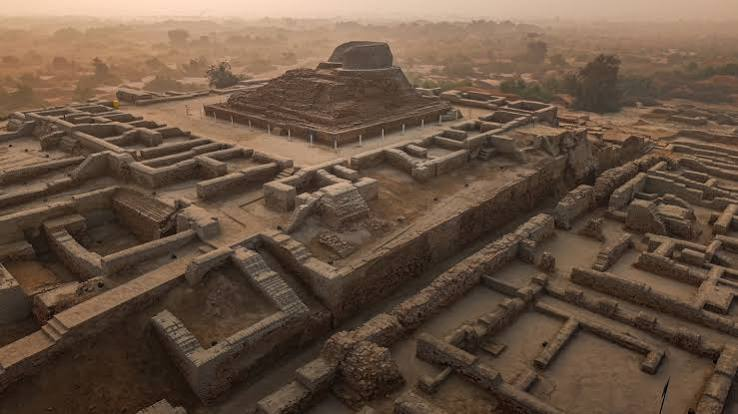
Two Pakistani filmmakers used a drone to capture the ancient Indus Valley city like never before.
Long before the world had a name for civilization, there was a city that already lived by one. Mohenjo Daro rose nearly 5,000 years ago on the banks of the Indus, a place of straight streets, running water and quiet order, built by people who understood how to live well together before almost anyone else on Earth did. It is one of Pakistan’s oldest treasures and one of humanity’s greatest, a site that asks you to stand still and feel just how far back we go. That such a city rests on Pakistani soil is a matter of deep and rightful pride for the locals.
Now that pride has a new set of images to carry it. Pakistani filmmakers Haya Fatima Iqbal and Nadir Siddiqui have documented Mohenjo Daro from the air for National Geographic, capturing the ancient city in a level of detail rarely seen before.
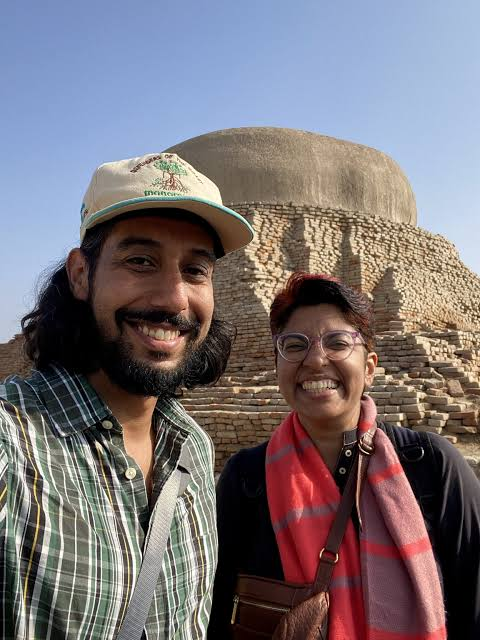
Pakistani filmmakers Haya Fatima Iqbal and Nadir Siddiqui (Source: Nat Geo)
The pair spent three days at the site with a drone, and their footage anchors the magazine’s May 2026 feature on one of the oldest planned cities in the world.
A still frame from Siddiqui’s aerial video was chosen to open the print story. His image also ran on the cover of two of the magazine’s local-language editions. It was the first Nat Geo assignment for both filmmakers, who are better known for hard-hitting documentary work, including the Oscar-winning short “A Girl in the River.”
Filming Mohenjo Daro from the sky
Mohenjo Daro is not a single monument. It is a full city, spread across more than a square mile in Pakistan’s southern province of Sindh, near the Larkana district. That scale is what makes it hard to shoot. One wall tells you nothing. The whole point is the grid, the neat right-angled streets laid out by people who understood city planning, zoning and drainage before most of the ancient world had figured out how to stack bricks properly. From the ground, as Siddiqui described it, the site first looks like a pile of bricks. The intelligence of the place only shows up from above.
That is why the drone mattered so much. Siddiqui flew a DJI Air 3S and knew what he wanted to avoid. Not a flat overhead map. Not the dated 3D reconstructions older TV pieces relied on. Not the amateur tourist clips already online. He wanted the angle between a ground-level photo and a straight-down satellite view, the one where a broken, knee-high wall stops looking like rubble and starts to suggest a room, a lane, a house.
According to the filmmakers, light did most of the work. The summer sky in the region turns a hazy white that flattens everything, so the team went in winter and got up before dawn to catch the low sun. Long shadows carve depth back into structures that centuries of collapse have worn nearly flat. There were practical headaches too, a nearby airport to plan around, weak WiFi and power cuts.
The Indus River that moved away
One shot summed up the strangeness of the place. Siddiqui wanted a single clean move from the Indus River to the ruins, a simple way to show this was a river valley civilization built on the water that fed it. The river had other plans. Over 5,000 years the Indus has drifted about two miles away, and a whole modern town now fills the gap. Iqbal messaged him from the field to say the shot, at normal speed, would run more than five minutes. The landscape that gave Mohenjo Daro its life has physically moved on from it.
The city earns the effort. At its peak between roughly 2600 and 1900 BCE it was the largest city of the Indus, or Harappan, civilization, a Bronze Age contemporary of Egypt and Mesopotamia that likely housed tens of thousands of people. Residents built with standardized baked bricks, laid streets on a grid, and ran a covered drainage and sewage system, with private household bathrooms, that much of the world would not match for thousands of years.
Above the residential Lower Town sits the Citadel and the Great Bath, a watertight public tank whose exact purpose is still debated. The Harappan script, pressed into thousands of seals, has never been deciphered, so we can see how these people managed their water but cannot read a word of what they believed.
Why documenting Mohenjo Daro matters now
The assignment did not begin as a celebration. It began as a warning. The 2022 monsoon floods dumped more than 1,400mm of rain on the area in a single week, damaging the site’s protective covering and pushing it close to the World Heritage in-danger list. The contrast was striking. While nearby Larkana sat under four feet of water, Mohenjo Daro’s own 5,000-year-old drainage system is credited with keeping standing water on the site to under a foot. The people who built it engineered for floods. Their descendants, facing a harsher climate-driven version of the same threat, are still learning from them.
That is what makes filming it from the air a form of record-keeping, a sharp archive of a fragile place at a moment when its survival is an open question. Both filmmakers came away asking for the same things: more excavation, more attention, and a tourism future that stays ethical and respectful of a site this old.
For Siddiqui, the job closed a loop that began in childhood, paging through National Geographic with his grandfather and running toward these same ruins on his first school trip.
As for Iqbal, filming a night-sky timelapse over the Citadel became something close to spiritual, sitting under the stars beside a city built by people who, in the end, felt like family.


