

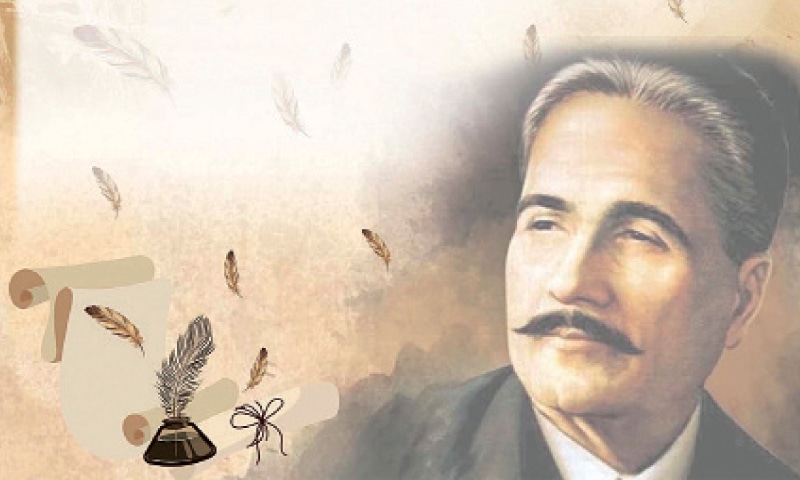
Long before Pakistan appeared on the map in 1947, Muhammad Iqbal was already giving Muslim India a language of self-belief. Two texts capture that vision at its clearest: the poem Tarana-e-Milli (circa 1910) and the Allahabad Address of December 29, 1930. Together they trace one continuous argument — first sung, then argued — about a community’s right to imagine its own future.
Tarana-e-Hindi and its undoing
Iqbal’s earlier Tarana-e-Hindi (“Saare Jahan Se Achha”) had celebrated a shared Indian homeland, religious identity folded into common soil. Tarana-e-Milli answers it, deliberately, in the same metre:
چین و عرب ہمارا، ہندوستاں ہمارا مسلم ہیں ہم، وطن ہے سارا جہاں ہمارا
China and Arabia are ours, Hindustan is ours; We are Muslims, and the whole world is our homeland.
Where the earlier poem said “we are of Hind,” this one says “we are Muslims.” The claim is not a rejection of India but an expansion beyond it — Muslim identity, Iqbal insists, is too vast, too historically rich, to be bound by any single territory.
The depth of the Tarana
The next couplet turns pride into permanence:
توحید کی امانت سینوں میں ہے ہمارے آساں نہیں مٹانا نام و نشاں ہمارا
The trust of divine unity lives safe within our hearts; Our name and mark are not so easily erased.
This is Iqbal at his most defiant. A people who lost political power with the fall of Mughal rule are told, in effect: your identity was never on loan from the state — it cannot be legislated away. The poem then reaches for Andalusia and the Tigris, not as nostalgia but as proof — evidence that Muslims had once led a civilisation of real intellectual and political weight. Memory becomes obligation. Decline, Iqbal insists, is a condition, not a verdict. The refrain of hamara — ours, ours, ours — builds a rolling, unbroken claim of belonging that owes nothing to borders and everything to conviction.
The Allahabad Address: from sentiment to statecraft
Twenty years later, with the Simon Commission’s report and the Nehru Report both having sidelined Muslim political concerns, Iqbal took the presidential chair at the Muslim League’s Allahabad session and turned that same conviction into constitutional argument.
His first move was to reject the idea that Muslims were merely a religious minority to be managed with reserved seats. He argued instead that they formed a distinct political community — a qaum — with its own civilisational foundations, deserving self-government rather than protection.
His second move was concrete: the consolidation of Punjab, the North-West Frontier Province, Sindh and Balochistan into a single self-governing Muslim unit within a reformed Indian federation. It was a bold, precise proposal, grounded as much in sound governance as in identity — Iqbal argued such a unit would reduce communal friction and allow genuine self-rule to take root.
Where the poem and the address meet
The thread connecting both texts is millat — a nation defined by shared belief rather than by lines on a map. Tarana-e-Milli gave that nation its self-image: proud, unbroken, larger than any one territory. The Allahabad Address gave it an institutional demand. The poem supplied the conviction; the address supplied the plan.
Beyond the “Poet of Pakistan” label
It is tempting to read Iqbal’s career as a straight line from Tarana-e-Milli to Allahabad to 1947. But his enduring achievement was something larger than any single blueprint: he gave Indian Muslims a vocabulary of self-respect — the sense that they were a people with the standing to shape their own destiny, not a minority waiting on concessions. That reframing, sung before it was argued, remains Iqbal’s most powerful legacy.