Before Abdur Rahman Chughtai’s celebrated set arrived, the young nation kept its mail moving with a clever, humble stopgap.
When a country is born, it needs more than a flag and an anthem to announce itself to the world. It needs the small, everyday symbols of nationhood, the kind that travel quietly in pockets and on envelopes and cross borders without fanfare. For Pakistan in 1947, one of those symbols was the humble postage stamp, and the story of how the first ones came to be is a small but charming chapter of the country’s earliest days.
A brand-new government has countless urgent matters to attend to. Ministries to set up, a capital to organise, essential services to keep running. Producing a full set of original postage stamps was understandably not the first priority. Yet the mail still had to move, and so Pakistan reached for a practical, resourceful solution to carry it through those opening months.
Pakistan’s First Postage Stamps: A Resourceful Start
The earliest stamps put into use were a stopgap, and a smart one. Stamps already in circulation were overprinted with the word “Pakistan” and pressed straight into service, so that letters and parcels could keep flowing while the young nation found its feet. They went into use from October 1947, just weeks after independence.
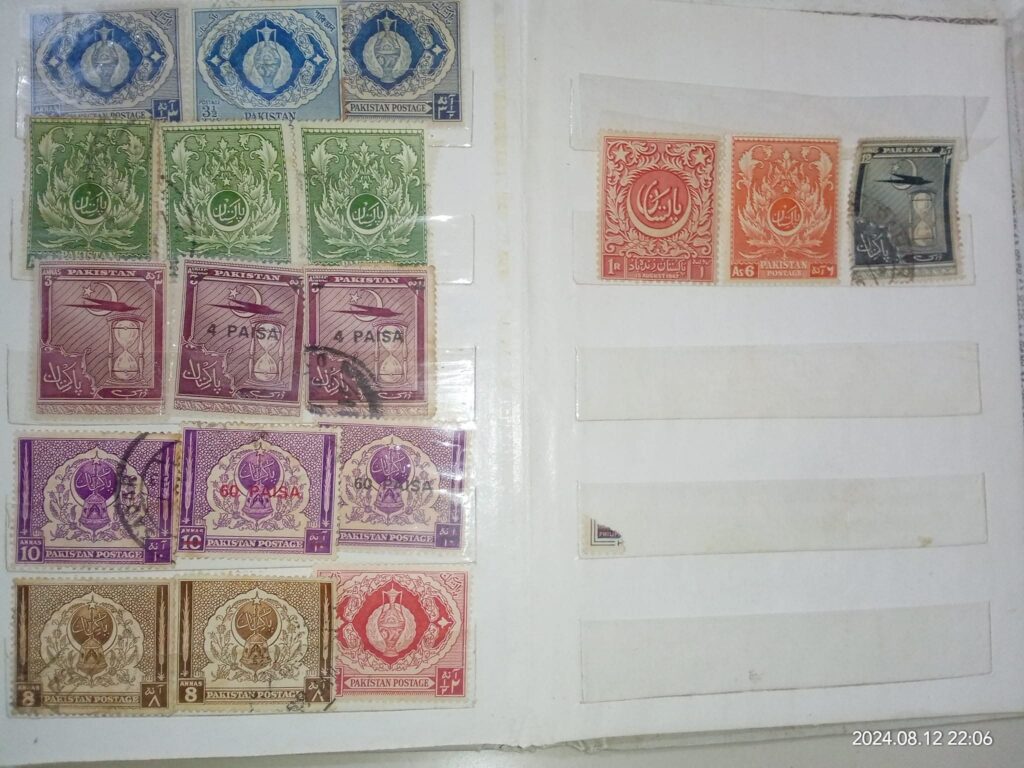
It was a modest beginning, but a telling one. A brand-new state, still organising itself, made sure its post kept running by adapting what was to hand. Those overprinted stamps are now cherished pieces of history, small artefacts from the very first weeks of the country’s existence, and collectors treasure them precisely because they capture a moment in time. Pakistan’s reach even stretched beyond its own borders in those early days, with post offices as far afield as Dubai and Muscat served through the Karachi General Post Office for a period, carrying those same overprinted stamps. For a country only months old, that was no small footprint.
Abdur Rahman Chughtai and the First Original Set
The overprints were only ever meant to be temporary. What the nation really wanted was a set of its own, designed from scratch to reflect who Pakistanis were and what they hoped to become. That set arrived on 9 July 1948, and it was worth the wait.
The design was entrusted to one of the subcontinent’s most celebrated artists, Abdur Rahman Chughtai, whose flowing, unmistakable style had already earned him wide renown. His hand lent the stamps a real artistry, lifting them from mere postage into small works of national expression. The first original series carried motifs close to the country’s heart, the crescent moon and five-rayed star chief among them, set against elegant, carefully composed designs. One stamp bore an inscription in Urdu that captured the spirit of the moment perfectly, “Pakistan Zindabad,” or “Long Live Pakistan.” Every letter that carried one was, in its own quiet way, sending those words out across cities, countries and continents.
Why Pakistan’s Early Stamps Still Matter
There is something poetic in the whole arc of it. In under a year, Pakistan went from borrowing overprinted stamps to keep its mail moving, to issuing beautifully designed originals from the hand of a master artist, stamped with a declaration of pride. That journey, from practical improvisation to confident self-expression, mirrors the larger story of those founding years.
Today these early stamps are prized by collectors and historians alike, both for their beauty and for what they stand for. Each is a tiny time capsule from the dawn of the country, a reminder of the care and creativity poured into even the smallest emblems of nationhood. As Pakistan marks another Independence Day, the story of its first stamps is a lovely reminder that a nation is built not only in grand gestures, but in small, thoughtful details. A crescent, a star, a few words of Urdu, and an artist’s hand, together carrying the name of a young country proudly out into the world.