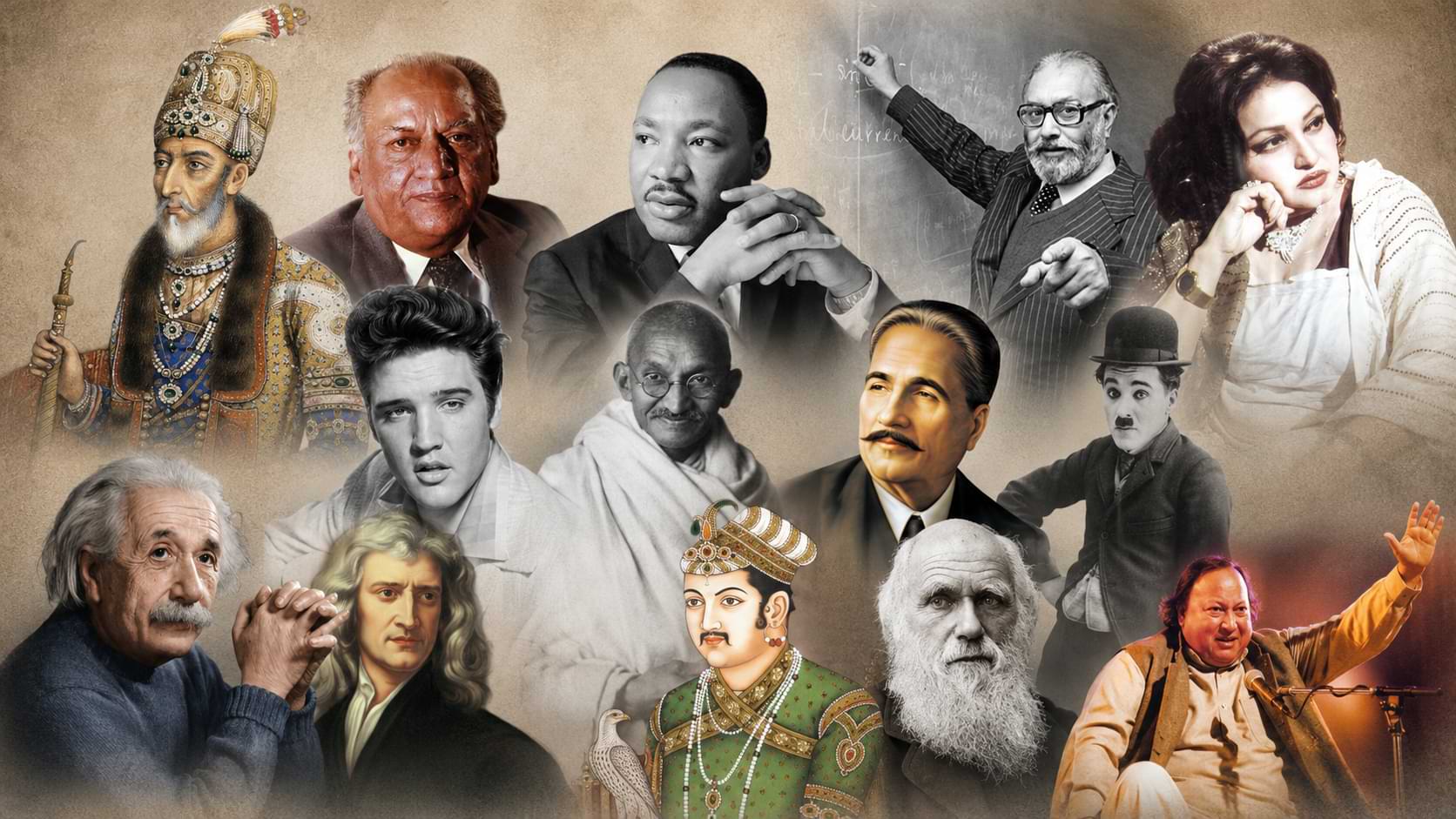
We tend to picture history as a series of separate chapters — the Renaissance here, the Mughal Empire there, the Industrial Revolution somewhere else, each sealed off in its own era. But peel back the textbook timeline and a more interesting picture appears: many of history’s most celebrated rulers, scientists, artists, and thinkers were alive at the very same time, quietly shaping different corners of the world in parallel.
Babur and Leonardo da Vinci
While Babur (1483–1530) was laying the foundations of what would become the Mughal Empire, Leonardo da Vinci (1452–1519) was completing masterpieces like the Mona Lisa and sketching flying machines and military inventions centuries ahead of their time. One reshaped the political map of South Asia; the other redefined art and science in Europe.
Akbar and William Shakespeare
Emperor Akbar (1542–1605) and William Shakespeare (1564–1616) were contemporaries — a pairing few people ever stop to consider. As Akbar expanded one of the era’s most prosperous empires and championed religious tolerance, Shakespeare was writing the plays that would become the bedrock of English literature.
Aurangzeb and Isaac Newton
Under Aurangzeb (1618–1707), the Mughal Empire reached its greatest territorial extent. At the same time, on the other side of the world, Isaac Newton (1642–1727) was transforming science with his work on motion, optics, and universal gravitation.
Bahadur Shah Zafar and Charles Darwin
The last Mughal emperor, Bahadur Shah Zafar (1775–1862), lived to see the empire’s end following the 1857 uprising. Meanwhile, Charles Darwin (1809–1882) was upending centuries of scientific thought with his theory of evolution — one era closing just as another reshaped humanity’s understanding of life itself.
Muhammad Ali Jinnah and Albert Einstein
Muhammad Ali Jinnah (1876–1948) and Albert Einstein (1879–1955) lived through one of history’s most transformative stretches. As Jinnah led the movement that culminated in the creation of Pakistan, Einstein was rewriting the rules of modern physics with his theory of relativity.
Allama Iqbal and Nikola Tesla
Allama Muhammad Iqbal (1877–1938) was stirring generations with his poetry and philosophy at the same time Nikola Tesla (1856–1943) was pioneering the electrical technologies that still power the modern world. Different fields entirely, yet both left legacies that continue to shape millions of lives.
Faiz Ahmed Faiz and Martin Luther King Jr.
Faiz Ahmed Faiz (1911–1984)‘s poetry became a language of hope and resistance around the same time Martin Luther King Jr. (1929–1968) was leading America’s civil rights movement. Separated by continents, both gave people a reason to imagine a fairer world.
Dr. Abdus Salam and Neil Armstrong
Pakistan’s Nobel Prize–winning physicist Abdus Salam (1926–1996) spent his career advancing theoretical physics, while Neil Armstrong (1930–2012) became the first person to walk on the Moon in 1969. Together, their achievements captured the extraordinary scientific leaps of the twentieth century.
Noor Jehan and Elvis Presley
Noor Jehan (1926–2000) became one of South Asia’s most beloved playback singers and cultural icons, while Elvis Presley (1935–1977) was reshaping popular music in the West. Each redefined music for their part of the world — and influenced generations of performers who followed.
Mahatma Gandhi and Charlie Chaplin
One of history’s most unexpected crossovers: Gandhi and Charlie Chaplin (1889–1977) weren’t just contemporaries — they actually met, in London’s East End on September 22, 1931. Chaplin, drawn to Gandhi’s politics, questioned him on his opposition to machinery; Gandhi, initially unaware of who Chaplin even was, came away impressed by his concern for ordinary working people. It remains one of history’s most memorable meetings of minds.
Nusrat Fateh Ali Khan and Freddie Mercury
Two of the twentieth century’s greatest vocalists, Nusrat Fateh Ali Khan (1948–1997) and Freddie Mercury (1946–1991), belonged to the same era. One mastered the devotional art of qawwali; the other became a global rock icon. Both possessed a vocal range and stage presence that still inspire musicians today.
History rarely unfolds as neatly as textbooks suggest. While one civilization was building empires, another was producing scientific breakthroughs, literary masterpieces, or musical revolutions — often at exactly the same moment. These overlaps are a reminder that the world’s greatest minds and leaders were frequently living side by side in time, even when oceans separated them. Sometimes understanding history is just a matter of reading the timeline sideways instead of straight down.