

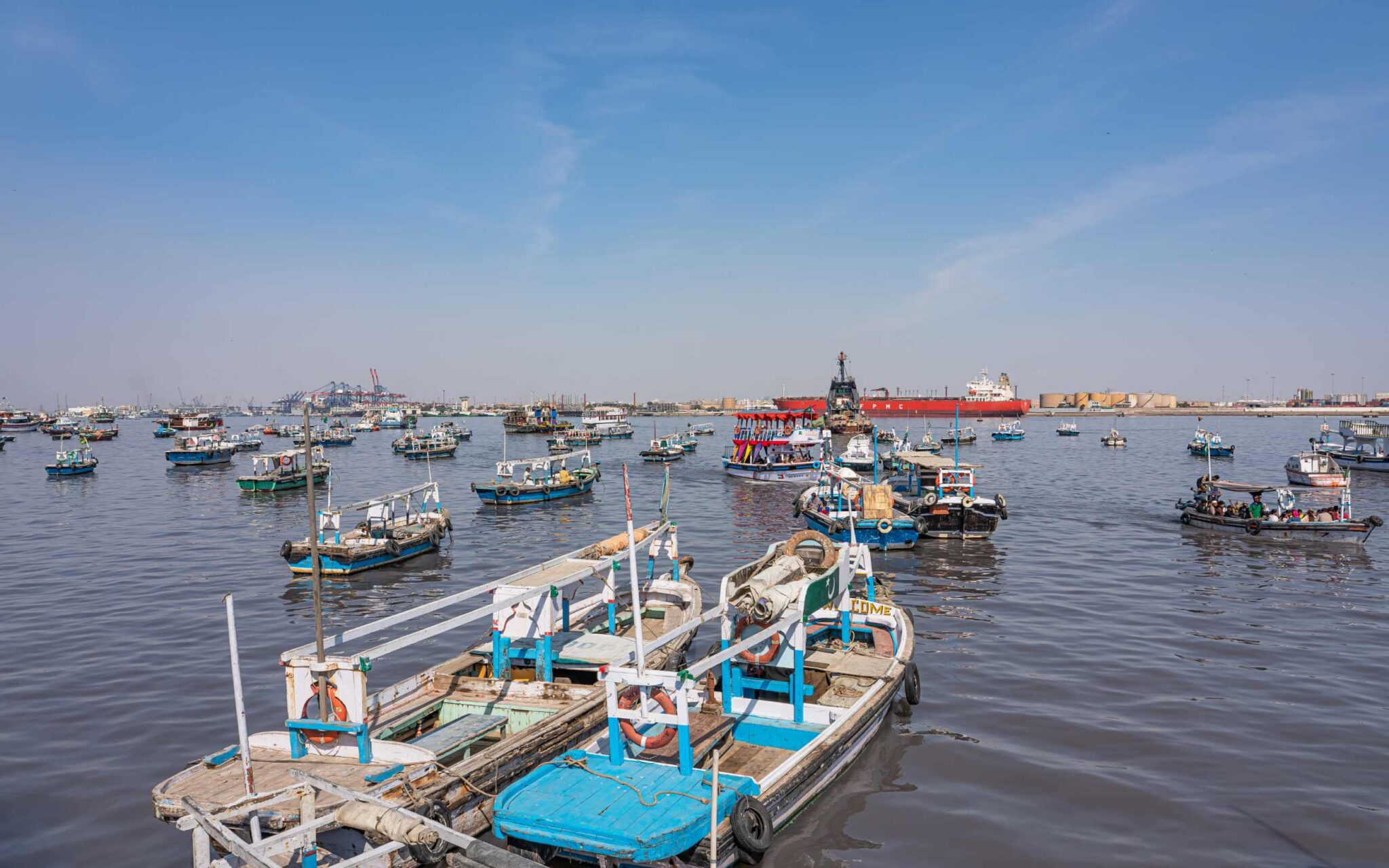
Karachi was a fishing village three hundred years ago and the East’s largest wheat port by 1899.
Karachi is a city of over twenty million people and the port that moves most of what Pakistan buys and sells. Three hundred years ago it was a cluster of huts on a creek, and the people living there caught fish.
The distance between those two things was covered in less than a century, and almost none of it was planned by the people who lived there.
The coast itself was never empty. The Greeks knew it as Krokola, the place where Alexander’s fleet gathered before sailing west, and the island now called Manora appears in their accounts as Morontobara. An Ottoman admiral, Seydi Ali Reis, passed through in the 1550s and wrote the harbor into his book. Ships kept finding this shore. None of them built a city on it.
The city that did grow began with a story, and Karachi has never let go of it. A Baloch fisherwoman named Mai Kolachi settled on the shore and raised a family, and the settlement that spread out around her became Kolachi-jo-Goth, the village of Kolachi. Her name is still on a road that runs along the water, driven down every day by people who have no idea they are saying her name.
The Fishing Village of Kolachi and Its Two Gates
What turned the village into a town was silt. The old port of Kharak Bandar was choking on it, and around 1729 its traders gave up and moved down the coast, settling on the left bank of the Lyari River. Within a few years the little harbor was sending boats to Muscat and across the Arabian Sea to the Gulf.
Money followed, and so did the need to protect it. A small fort went up, armed with cannons brought in from Muscat. It had two gateways. One faced the open sea and was called the brackish gate, Khara Darwaza. The other faced the sweet water of the Lyari and was called Mitha Darwaza.
Kharadar and Mithadar. Still on the map. Still crowded, still selling everything, and almost nobody pushing through those lanes on a Saturday is thinking about the walls that used to stand there or the cannons that came by boat from Oman.
In 1795 the Talpur Mirs took Karachi from the Khan of Kalat, and in 1797 they raised a mud fort on Manora to guard the harbor mouth. The population was somewhere around 14,000. A walled town, a fort, and fish.
How the British Captured Karachi in 1839
The East India Company had been eyeing the harbor for decades. A small trading factory opened in 1799 and shut within a year.
Then, on February 1, 1839, a British warship called HMS Wellesley anchored off Manora and turned its guns on the fort. By February 3 the fort had surrendered. Not a shot had been fired back.
Four years later Charles Napier took the rest of Sindh, and Karachi was folded into the Bombay Presidency. Napier governed it from 1843 to 1847, and he saw immediately what he had been handed. A natural harbor, sheltered from the monsoon, sitting at the mouth of the Indus with an entire river valley behind it waiting to be shipped somewhere. On leaving, he is said to have remarked that he wished he could come back one day and see the city in its grandeur.
He got his wish, in a way he never saw. The change came fast. A river steamer began running up to Multan in 1843. Municipal income went from 6,000 rupees in 1848 to 27,000 by 1850. Merchants poured in from Bombay, Goa and Kutch, because there was space and weather and opportunity, and because word travels.
Cotton, Wheat and the Making of Karachi Port
Real construction began in 1854. The main channel was dredged and a mole was thrown across the water to link the harbor to the city. Keamari, the jetties, the Napier Mole bridge all came out of that one decision.
Then the timing turned lucky. In 1861 the railway reached Kotri, 108 miles up the Indus. In 1864 a telegraph line connected Karachi straight to London. The American Civil War cut cotton off from the mills of Britain, and Sindh cotton went out through Karachi to fill the gap. The Suez Canal opened in 1869 and pulled Europe closer. In 1878 the railway pushed on to Multan, and suddenly all of Punjab was a hinterland with a port attached.
The city built itself to match. Frere Hall in 1865. Trams by 1885. The Karachi Port Trust in 1886. Empress Market in 1890. Jinnah was born here in 1876, in a town that already had courthouses, paved streets and a working harbor.
By 1899 Karachi was the largest wheat exporting port in the East. The population had crossed 100,000, and it was a real mix. Sindhis, Baloch, Muslims, Hindus, Parsis, Jews, Goans, Lebanese, Iranians, European traders, all working the same waterfront.
The fishing village was gone by then, buried under the wharves and the warehouses and the rail yards.
Karachi became the capital of a new country in 1947 and handed the title to Islamabad in 1959. What it never handed over was the harbor. Everything the city is now, for better and for worse, still traces back to a creek some traders picked because the last port had filled up with sand.