


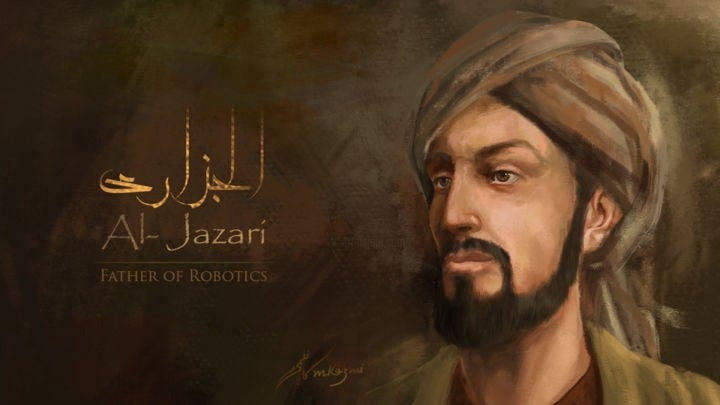
More than 800 years ago, a Muslim engineer was building programmable robots that served drinks and played music.
Centuries before anyone imagined a machine that could follow instructions on its own, a Muslim engineer was already building them. Ismail al-Jazari, working in the region of Diyarbakir in what is now southeastern Turkey, designed automated machines that poured drinks, played music, and told time with a precision that startled everyone who saw them. Today he is often called the father of robotics.
Al-Jazari served as chief engineer at the Artuqid court, where he spent roughly 25 years designing and building mechanical devices for the palace. In 1206, near the end of his career, he compiled everything he had made into a single volume titled The Book of Knowledge of Ingenious Mechanical Devices. It catalogued around 50 inventions, each one accompanied by detailed diagrams and step-by-step instructions for how to build and operate it.
That book is now regarded as one of the most important engineering texts of the medieval world. What set it apart wasn’t just the cleverness of the machines but the way al-Jazari documented them. He wrote for craftsmen as much as scholars, laying out his designs so clearly that modern engineers have been able to reconstruct several of his devices from the pages alone.
The Machines That Worked Like Early Robots
Some of al-Jazari’s creations map surprisingly well onto what people now think of as robots. One of his most famous was a floating musical band, a boat carrying four mechanical musicians that drifted across a lake to entertain guests at royal gatherings. The figures played drums, a harp, and a flute, and the rhythm they produced could be changed.
That last detail is what makes historians take notice. The percussion was driven by a rotating drum studded with pegs that struck small levers, and by moving the pegs, the operator could alter the beats the machine played. Professor Noel Sharkey, a robotics expert, has argued this was very likely an early programmable machine, essentially a mechanical drum sequencer built more than 800 years ago.
Al-Jazari built humanoid devices too. One was a mechanical servant that could serve drinks automatically, releasing liquid in timed stages. Another was a hand-washing machine shaped like a figure that offered a towel and refilled water on its own, an early example of a machine designed to interact directly with a human user.
The Elephant Clock and the Ideas Behind It
Perhaps his best-known invention was the elephant clock, an elaborate water-powered timepiece built into the form of an elephant. It combined mechanical figures from several cultures, a design that reflected the mix of civilizations al-Jazari drew on, and it marked the passing of time with moving parts that released a ball and struck a sound at set intervals.
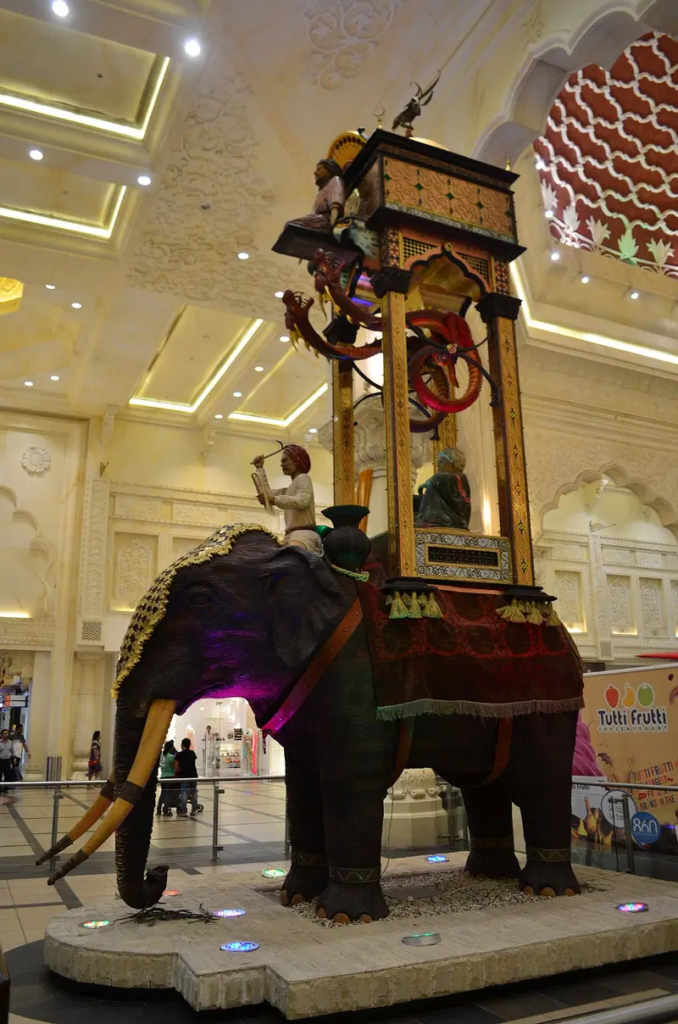
Al-Jazari Dubai Elephant clock – photo by Darafsh / Wikimedia Commons
Behind the spectacle sat real engineering breakthroughs. To power his automata, al-Jazari made pioneering use of the camshaft and the crankshaft, mechanical components that convert one kind of motion into another. These same parts would not be used so effectively in Europe until the Industrial Revolution, more than 500 years later.
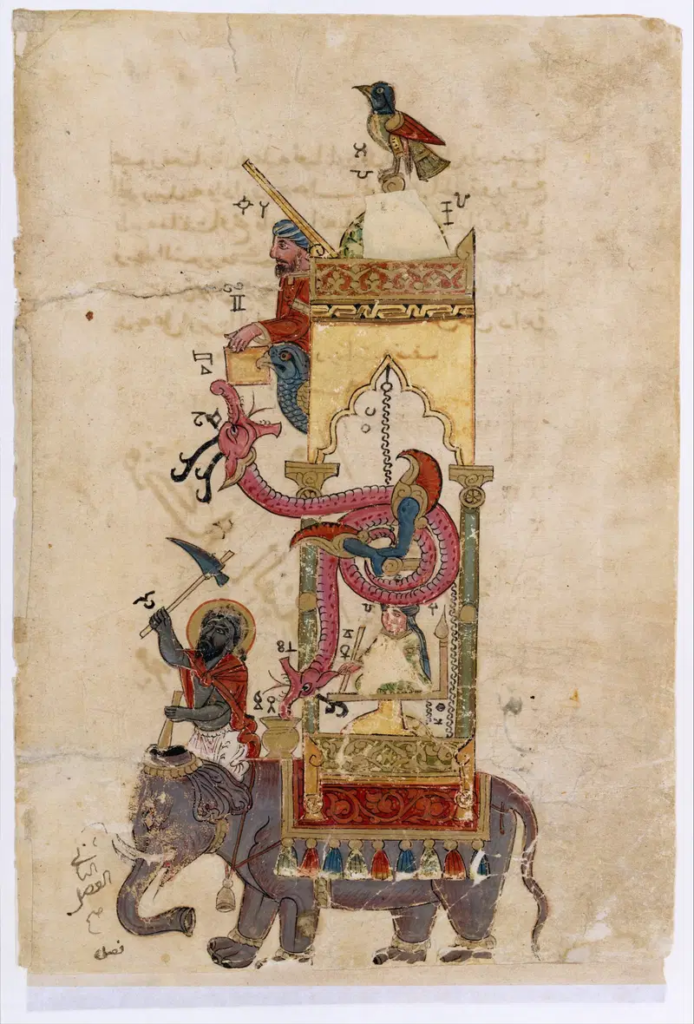
“The Elephant Clock”, Folio from a Book of the Knowledge of Ingenious Mechanical Devices by al-Jazari MET 57.51.23
He also developed early control systems, mechanisms that adjusted a machine’s behavior automatically as it ran. The principles behind them, involving feedback and timed sequences, are the same ones that underpin modern robotics and automation, even though the mathematics to describe them formally would not arrive for another seven centuries.
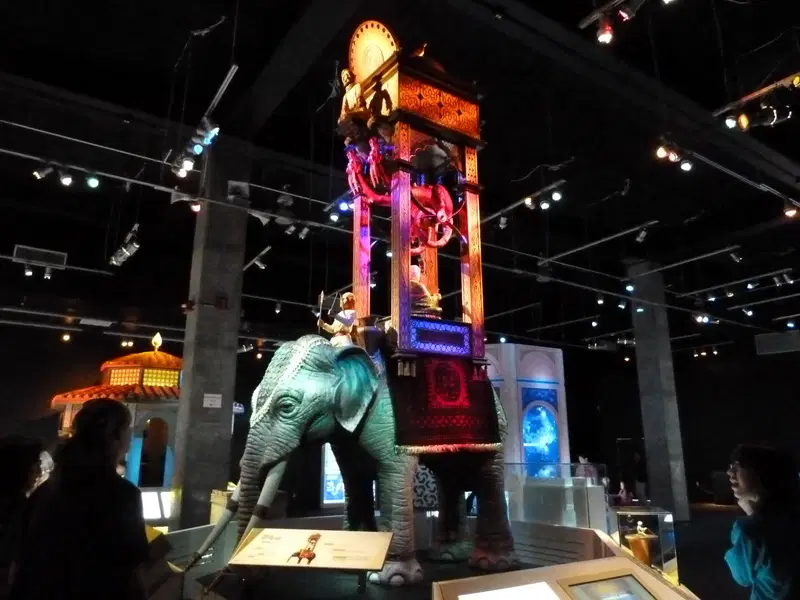
Elephant clock replica at the “1001 Inventions” exhibtion – photo by Takashi Yamamiya / Wikimedia Commons
A Legacy That Reached Far Beyond His Time
Al-Jazari did not invent automata from nothing. He built on the work of earlier scholars, including the ninth-century Banu Musa brothers of Baghdad, whose own Book of Ingenious Devices described mechanical wonders of their era. But al-Jazari took the field further, systematizing it and pushing it toward machines that could carry out sequences on their own.
His only surviving major work spread through the Islamic world in hand-copied manuscripts and later reached Europe in translation. Some historians have suggested that Renaissance inventors, possibly even Leonardo da Vinci, may have encountered ideas that trace back to his designs, though the exact lines of influence are hard to prove.
What is clear is that the concepts al-Jazari worked with, programmable movement, human-machine interaction, and automated control, are now central to the technology that surrounds daily life. Machines that follow instructions and mimic human tasks are everywhere today. One of the earliest people to imagine and build them was an engineer working in a medieval palace, sketching robots by hand more than 800 years ago.
Follow us for more interesting updates!


