

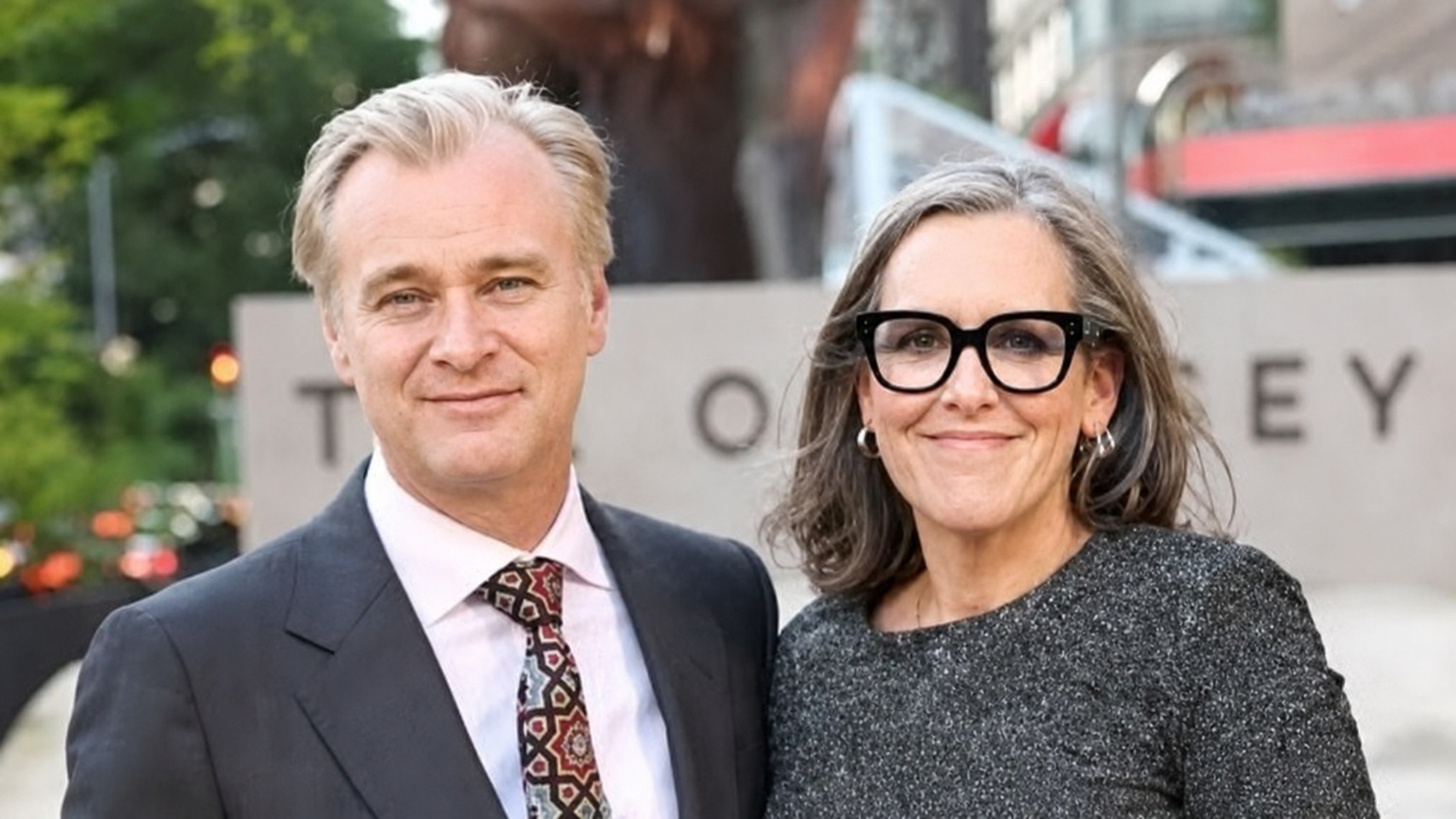
Christopher Nolan turned heads at the New York premiere of The Odyssey—not only for unveiling one of Hollywood’s most anticipated films, but also for wearing a custom Ajrak silk tie designed by Ahaan Tandon. The celebrated filmmaker’s choice of accessory quietly placed one of Pakistan’s oldest textile traditions on one of the world’s biggest cultural stages. From Louis Vuitton to Abu Jani Sandeep Khosla, Ajrak has long inspired the global fashion conversation, appearing in luxury collections, runway shows and designer collaborations. Nolan’s appearance is the latest reminder that this centuries-old craft continues to transcend borders. For Pakistan, however, Ajrak is far more than a fashion statement—it is a living symbol of Sindh’s cultural identity, craftsmanship and artistic heritage dating back thousands of years.
As photographs from the New York premiere circulated online, many noticed the distinctive geometric patterns adorning Nolan’s tie. Inspired by the timeless Ajrak motif, the accessory sparked renewed global interest in a textile synonymous with Sindh and one of the oldest surviving block-printing traditions in the world. For Pakistanis, it was a proud reminder that a craft rooted in the Indus Valley had found its place on one of cinema’s grandest stages.
A Tradition Born in Ancient Pakistan
Ajrak is widely recognised as indigenous to Sindh and is regarded as one of Pakistan’s oldest living textile traditions. Historians trace its origins back nearly 5,000 years to the Indus Valley Civilization. The clearest thread connecting Ajrak to that ancient world is the celebrated “Priest-King” steatite sculpture unearthed at Mohenjo-daro, dated to roughly 2000–1900 BCE. The small figure was found during excavations of the ruined Bronze Age city of Mohenjo-daro in Sindh and is considered the most famous stone sculpture of the Indus Valley Civilization. Draped over its shoulder is a carved shawl bearing a trefoil pattern interspersed with circles—a design many scholars read as a fusion of three sun-disks representing the gods of earth, water and the sun.
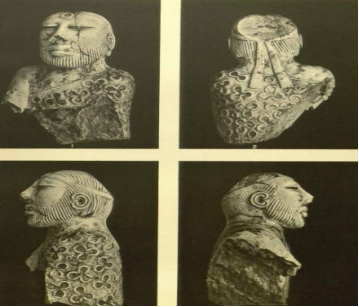
– King Priest statue from different angles
Ajrak artisans themselves have long identified this same trefoil as kakar, their traditional cloud motif, and traces of red pigment recovered from the carving point to early use of madder, the same plant-based dye still used in Ajrak printing today. Archaeological consensus does not go further than that resemblance, though — no scholar has established a direct, unbroken line from the stone-carved cloak to the woven and block-printed textile made today. It remains a striking visual echo rather than proven continuity.
For centuries, Sindhi artisans—particularly members of the Khatri community—have preserved this painstaking art through generations. Producing a single authentic Ajrak involves numerous stages of washing, resist printing, natural dyeing and drying, often taking several weeks to complete. Natural indigo, madder and other plant-based dyes create its iconic deep blue, crimson and black palette, while each motif is meticulously hand-printed using carved wooden blocks. Every piece is unique, reflecting a tradition that continues to thrive despite the passage of time.
The Meaning and Story of Ajrak
The origins of the word “Ajrak” are as layered as the textile itself. The most widely accepted explanation derives it from the Arabic word “Azrak,” meaning “blue,” a reference to the rich indigo colour that dominates traditional Ajrak designs.
Another interpretation links the name to the Sanskrit expression “A-jharat,” meaning “that which never fades,” symbolising the enduring beauty and timeless appeal of the fabric.
Sindhi folklore offers a third, more intimate explanation. According to popular tradition, the word evolved from the phrase “aaj ke din rakh” (“keep it for today”), reflecting the belief that Ajrak was considered so precious it was reserved for important occasions rather than everyday wear. Regardless of which explanation is accepted, each highlights the deep cultural value attached to the textile across generations.
Sindh’s Muslim rulers folded Ajrak into a courtly custom of honour: much as earlier rulers awarded an expensive ceremonial gown known as “Khilat” to recognise loyal service, Sindhi rulers are said to have awarded Ajrak itself in recognition of outstanding service and achievement. A textile born of dye and wood blocks became, in this telling, a currency of respect.
More Than a Textile
For the people of Sindh, Ajrak represents far more than clothing. It is a symbol of honour, dignity and hospitality, often draped over distinguished guests as a gesture of respect. Its symmetrical geometric patterns are inspired by nature, the stars and the cosmos, while the repeated motifs reflect harmony and balance—values deeply embedded in Sindhi culture. Ajrak is woven into Sindhi life quite literally from cradle to grave, serving as a hammock for infants, headgear for girls, a bridal accessory, a turban, a shawl, a bed cover, a tablecloth and a gift of respect for honoured guests.
That devotion has its own annual stage. Every year Sindhis around the world mark Sindhi Cultural Day, decorating towns with Ajrak and exchanging it as a gift alongside the traditional Sindhi cap, or topi. The pairing of Ajrak and topi has become so central to Sindhi identity that it appears in folk songs celebrating the province, and it is common to see Pakistani officials and visiting dignitaries alike draped in Ajrak as a gesture of solidarity with Sindh.
Although the craft later spread to neighbouring regions such as Kutch and Barmer, where distinct local styles developed, its historical roots remain firmly embedded in Sindh. Today, Ajrak continues to serve as one of Pakistan’s most recognisable cultural emblems, proudly representing the country’s artistic and civilizational heritage around the world.
Christopher Nolan’s choice to wear an Ajrak silk tie may have been a subtle style statement, but it carried a much deeper significance. As The Odyssey captures global attention, one of Pakistan’s oldest artistic traditions quietly shared the international spotlight.
For Pakistan, the moment was more than a red-carpet fashion choice—it was a celebration of a heritage that has endured for five millennia. From the ancient streets of Mohenjo-daro to the premiere of one of Hollywood’s biggest films, Ajrak continues to prove that Pakistan’s cultural legacy remains timeless, inspiring the worlds of fashion, art and storytelling across generations.