

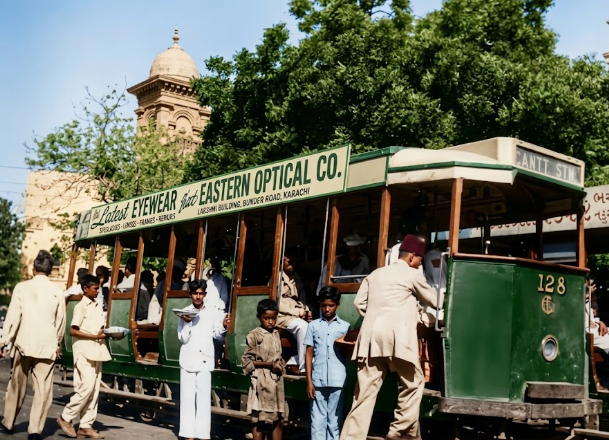
Karachi ran trams for 90 years before the city shut them down in 1975.
Ask anyone who lived in Karachi before 1975 and the trams come up fast. They rattled through Saddar, past Empress Market, down to Keamari. They cost almost nothing. Then one day they stopped, and the tracks sat rusting in the roads for another decade before they disappeared too.
The Karachi tramway ran for 90 years. What ended it was never one clean decision. It was congestion, aging machinery, and a replacement project that never arrived.
The idea belonged to James Strachan, the city’s municipal secretary and engineer. He floated it in 1881. That same year Edward Mathews of London put in the tender to build it, and then the plan sat in the slow machinery of colonial administration for two years. A tramway plan was finally drawn up on February 8, 1883, with permission to run the cars on steam. Construction began in October 1884 under chief engineer John Brunton.
The line opened on April 20, 1885. The ceremony was held near St Andrew’s Church, at what is now the intersection of Abdullah Haroon Road and Shahrah-e-Liaquat. Dignitaries were carried down to Keamari and back on the very track they had come to inaugurate. The first line ran from the Napier Mole bridge, today’s Jinnah bridge, out to the port. The gauge was an unusual four feet.
Steam did not last. Karachi hated the noise. The engines came through busy stretches every 15 minutes and the city complained. Worse, the coke that fired them had to be shipped from England, and nobody wanted to keep paying for it. Within a year the steam cars were gone and horses were pulling the trams instead.
The East India Tramways Company Limited took over in 1902. Petrol trams appeared by March 1905, and by 1909 the whole fleet ran on petrol. Europe was going electric. Karachi went the other way, and that 1909 conversion is often cited as the world’s first full petrol tram service. Each car carried 46 passengers and topped out around 18 miles per hour.
The network crept outward through the city center. Saddar to Keamari first, then Lawrence Road, now Nishtar Road. Frere Street, now Dr. Daud Pota Road. Soldier Bazaar via Mansfield Street, now Syedna Burhanuddin Road. Chakiwara came in October 1928. The following year the Soldier Bazaar line was swung across to Bunder Road, which Karachiites know as M.A. Jinnah Road. For decades it was the cheapest way across town.
In 1949 the East India Tramways Company sold the network to the Mohamedali Tramways Company, owned by Sheikh Mohammad Ali. By 1955, when the operation marked its 70th anniversary, 64 cars were running.
Why Karachi Trams Closed Down in 1975
The trams stopped on April 30, 1975.
The reasons stack up rather than stand alone. Saddar had grown congested. Cars, buses and minibuses filled roads that the trams still shared, and accidents involving tramcars kept happening. The rolling stock was decades old and harder to keep running every year. Spare parts for a petrol fleet that no other city in the world operated had become a problem in themselves.
There is a second explanation that has stuck around. The trams, some say, were cleared out of the way for an underground railway planned for the 1970s and 1980s. That railway was never built. The Karachi Circular Railway had opened in 1969 and was pulling passengers, but nothing ever replaced the trams inside the city center itself.
So the tracks came up, or were simply left. Sections of rail stayed embedded in Saddar’s roads into the 1980s, rusting where the cars used to run. Photographs from the 1960s show tramcars turning through Saddar with the Empress Market clock tower behind them. Those photographs are close to all that survives. Where the cars themselves went is not recorded anywhere reliable.
Karachi Tram Revival Plans and the Saddar Proposal
The trams have never quite left the conversation.
A plan in 2014 proposed turning Empress Market and the surrounding Saddar area into a pedestrian zone with a tram running through it, along with restored heritage buildings and a museum of the city’s history. The paperwork went up to the provincial planning department.
Another Saddar rehabilitation plan surfaced in 2017, this one from architect Hafeez Habibi, with trams, a pedestrian trail and cycle tracks. Saddar had once been a destination, he told the session, and had become a thoroughfare.
In 2018 the Supreme Court ordered a tram service restored in Saddar for tourism, tied to the anti-encroachment drive. In 2019 the Sindh government went looking for Austrian expertise, raising old Karachi’s trams in a meeting with Pakistan’s ambassador in Vienna. Vienna built its own tram network in 1865 and still runs it.
None of it has produced a tram.
Karachi got the Green Line instead, and the Circular Railway remains a recurring promise. The trams stay where they have been since 1975, in photographs and in the memory of everyone old enough to have paid the fare.