

Southeast Asia’s fastest-growing digital economy is pouring money into clean power to feed rising demand.
The Philippines is making one of its biggest bets yet on renewable energy, channeling billions of dollars into hydropower, pumped-storage facilities, and grid-scale battery systems. The push comes as the country’s fast-growing digital economy strains an aging electricity network, with data centers and artificial intelligence driving a sharp rise in power demand. The investments aim to modernize the grid while reducing the country’s heavy reliance on imported fossil fuels.
The scale of new spending is significant. As of June 2026, the Board of Investments certified 13 renewable energy projects worth 344.62 billion pesos, around 5.63 billion dollars, dominated by solar with battery storage, hydropower, and wind. The projects form part of President Ferdinand Marcos Jr.’s drive for energy security and the country’s target of raising renewables to half of installed capacity by 2030.
AI data centers and Philippine power demand
Electricity demand in the Philippines is climbing, and AI is a growing part of the reason. According to the International Energy Agency, artificial intelligence is expected to significantly increase electricity consumption by data centers over the coming decade, making them one of the fastest-growing sources of power demand worldwide. The IEA projects global electricity demand to grow by an average of 3.6 percent a year from 2026 to 2030, adding around 1,100 terawatt-hours annually, about 50 percent more than the previous decade.
The Philippines is already feeling the pressure on its grid. The National Grid Corporation of the Philippines reported that Luzon’s peak demand reached 12,467 megawatts in early March 2025, while the Department of Energy forecast a 2025 Luzon peak of 14,769 megawatts, about 5.4 percent higher than the year before. Data centers add heavy, concentrated load. A single planned data center campus in the Metro Manila suburb of Fairview is expected to draw up to 124 megawatts, an amount comparable to electrifying several of the country’s poorest provinces.
Philippine hydropower and solar investments
The country’s renewable strategy leans on a combination of solar, hydropower, and storage. Solar suits the Philippines because it receives some of the highest levels of solar irradiance in Southeast Asia. Large-scale solar farms are being developed across Luzon, Visayas, and Mindanao, often paired with batteries to manage the intermittency of sunlight.
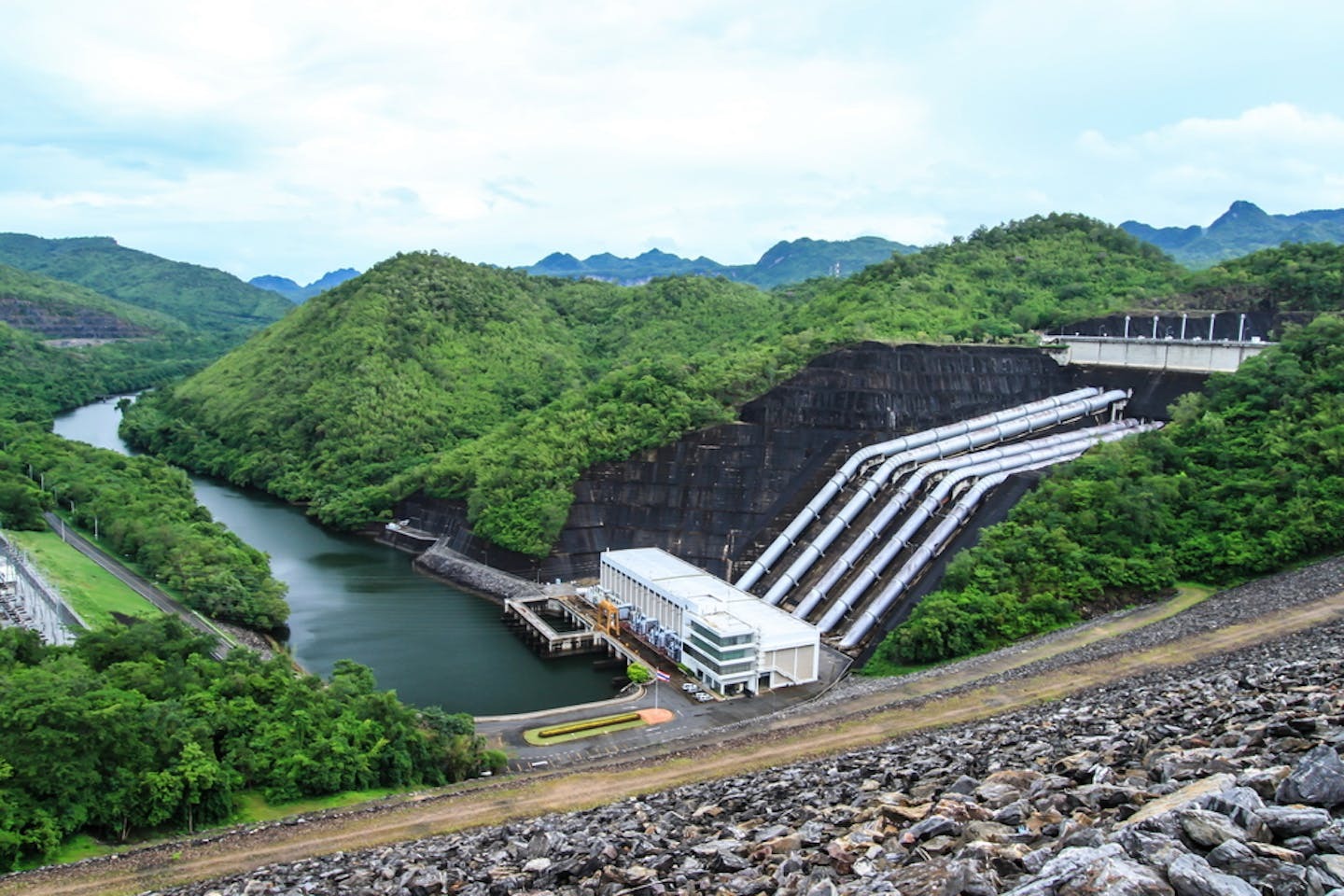
Pumped-storage hydropower has become central to the plan. Unlike conventional hydropower plants that generate electricity from flowing water, pumped-storage facilities work like giant rechargeable batteries. When demand is low or when solar and wind produce excess power, the facilities pump water uphill into a reservoir. When demand surges, the stored water is released back through turbines to generate electricity within minutes. The technology has become increasingly important worldwide as countries add more intermittent renewable energy to their grids.
Several major projects illustrate the shift. First Gen’s board approved a 61.87 billion peso investment for a 33 percent stake in two pumped-storage projects developed by Prime Infra. The MTerra Solar and Battery Storage Project, estimated at 3.4 billion dollars, is set to produce 3,500 megawatts of solar with 4,500 megawatt-hours of battery storage, enough to power around 2.4 million households. Smaller run-of-river plants are also coming online, including Alternergy’s 5-megawatt Dupinga plant in Nueva Ecija, which supplies about 158,000 households.
Philippine clean energy challenges
The transition faces real obstacles. Despite the investment surge, fossil fuels still supply about three-quarters of the country’s electricity, with coal alone providing close to 60 percent. Renewables, including hydropower, geothermal, solar, and wind, account for roughly a quarter of the mix. Hydropower leads the clean segment at around 11 percent, followed by geothermal at about 8 percent and solar at approximately 4 percent.
Cost is another concern. The Philippines has among the highest power rates in Southeast Asia, and its reliance on imported fossil fuels contributes to volatile electricity prices. Some consumer groups and researchers have raised concerns that rising data center demand could add strain to the grid and to household bills, particularly for low-income families already spending a large share of income on electricity.
The government has framed the renewable buildout as a way to address both energy security and grid reliability. It has allowed 100 percent foreign ownership in renewable energy projects, drawing international investment, including a 600 million dollar commitment from UK-based Actis into the MTerra project.
For decades hydropower was viewed mainly as a source of renewable electricity. It is now increasingly valued as infrastructure that stores energy and balances the grid as the country adds more solar and wind. The projects underway are scheduled to come online through 2027 and 2028.