

Pakistan has selected Hanging by a Wire, directed by Mo Naqvi, as its official Academy Awards submission. The film will now enter the long process of being considered alongside submissions from around the world, with the Academy eventually deciding which films make the shortlist and, later, the final nominations.
Of course, there is no guarantee Pakistan will make it that far. Over the past 13 years, every film submitted by Pakistan’s Academy Selection Committee has been deemed promising, but aside from Saim Sadiq’s Joyland in 2022, none have advanced to the December shortlists.
Yes, Zinda Bhaag was a novel experience, as were Dukhtar, Moor, and Mah e Mir. Saawan and In Flames had good ideas behind them but were unlikely to advance because they weren’t even good films. Asim Abbasi’s Cake had all the qualities to reach the next level, as did Laal Kabootar, but neither did. Usman Riaz’s The Glass Worker could have made Pakistanis proud, but the writer-director chose to make the characters more Western than Eastern, which, in my view, was a poor decision.
If the animated feature film had been set in Pakistan rather than in Europe, it might have done well by showcasing Pakistan’s culture to the world. As for Sarmad Khoosat’s Zindagi Tamasha, it was considered controversial at the time of its release, and I blame the editor for that. Had he been a little more aware of his environment, he would have kept the religious angle out of the trailer, but since it was included, the film couldn’t pass the censors. Even though it was submitted, it didn’t advance to the next stage, which brings us to Hanging by a Wire.
The question isn’t whether Hanging by a Wire will make it to the final submissions; the answer is a confident yes. The question is why it is Pakistan’s best bid for an Oscar for Best International Feature Film. And the reasons have very little to do with the Oscars themselves. They have to do with the story.
When ordinary people became superheroes
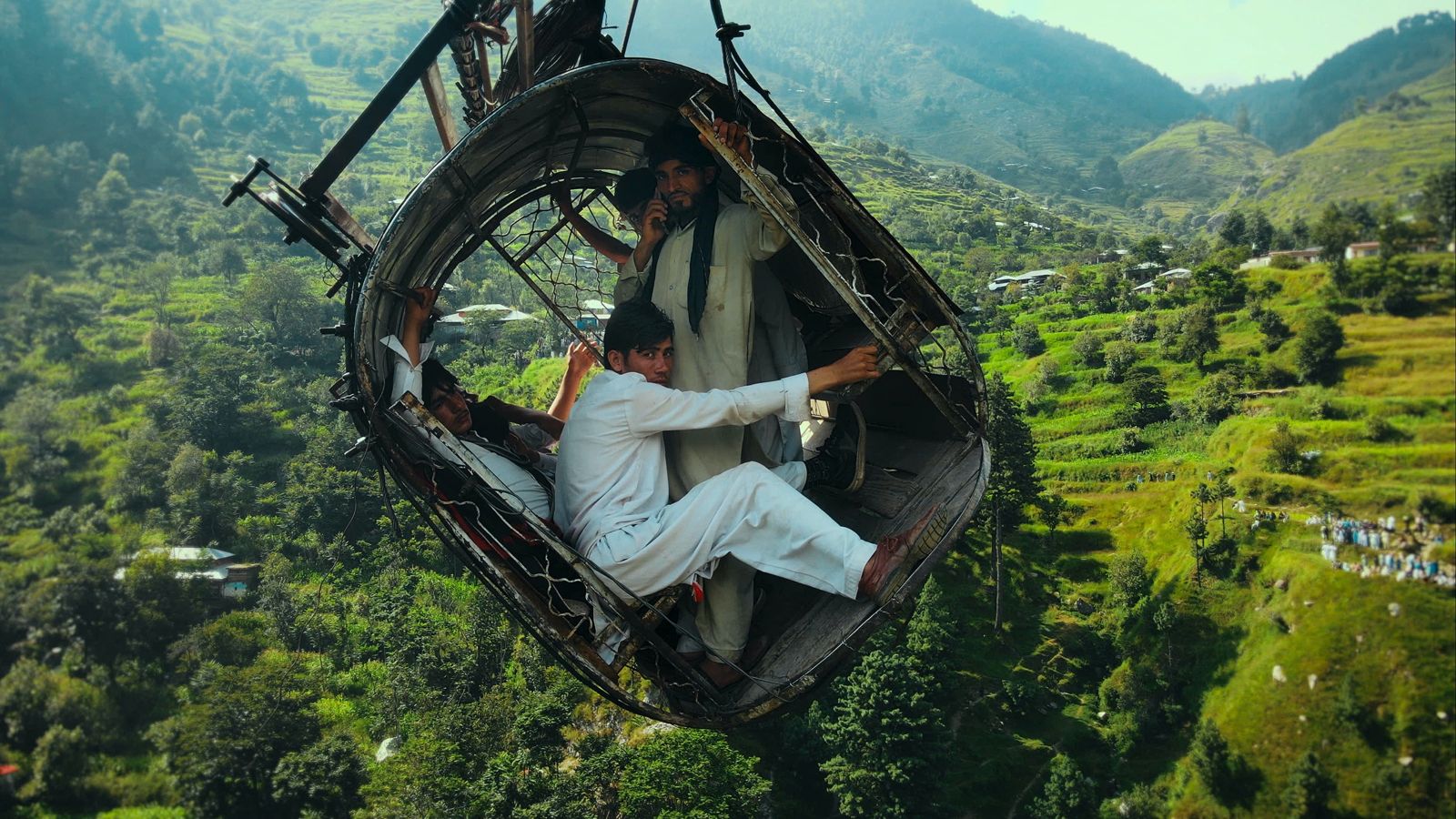
In August 2023, eight people, including six children, were trapped in a cable car in Battagram, hundreds of feet above the ground, after one of its cables snapped. The children were on their way to school. What should have been an ordinary trip suddenly became a fight for survival.
The rescue operation captured the nation’s attention. A military helicopter eventually rescued one child, while others remained suspended above the valley. Local rescuers then risked their lives to reach the stranded passengers and bring them to safety.
It sounds like a thriller, but it actually happened. That is the first reason Hanging by a Wire works so well as Pakistan’s Oscar submission. It is a story in which ordinary Pakistanis became superheroes without ever intending to.
Bilal Sami, who wrote and produced the film with Naqvi, says that was central to their approach.
“I kept in mind throughout the writing process that this is a film about heroes, not a critique of the system or its people,” he says.
That distinction matters because the filmmakers could have explored many issues. Why was the cable car operating in the first place? Why did the children have to rely on it to get to school? Why did it take so long to rescue them?
All of those are legitimate questions. But Hanging by a Wire tells us something else. It shows us what people did after the worst had already happened.
A different Pakistan
For international audiences, this may be even more important. Pakistan has often been portrayed abroad through stories of terrorism, political instability, poverty, conflict, and social problems. Those stories are real, but they hardly tell the whole story. Hanging by a Wire offers another perspective.
Here is a Pakistan where an impossible situation brings out extraordinary courage. A Pakistan where people risk their lives for strangers. A Pakistan where the story isn’t about what went wrong but about what people did when everything fell apart.
That is a Pakistan many of us recognize, and one international audiences deserve to see. The beauty of the story is that you don’t need to understand Pakistani politics, history, or culture to grasp what is happening.
You see children trapped in the air. You see people trying to save them. You understand their fear. You understand their courage. You want them to survive. That is universal cinema.
It doesn’t preach
Perhaps the most impressive aspect of Hanging by a Wire is its restraint. The filmmakers could have easily turned the incident into an investigation into the system’s failures. Instead, they focus on the people at the center of the story.
From those trapped inside the cable car to those who facilitated their return, the documentary interviewed everyone involved. Footage from all available on-location cameras, including personal mobile phones and drone footage, was incorporated in a way that gave the documentary the aura of a thriller.
Sami says that bringing together the various people connected to the incident was one of the biggest challenges in making the film.
“A lot of people had to put their faith in us and trust us with their side of the story and their perspective,” he says.
That trust appears to have shaped the film. It doesn’t tell audiences what to think about Pakistan. It doesn’t explain Pakistan to the world. It simply tells a remarkable story set in Pakistan. That may make it more powerful.
There is something refreshing about a Pakistani film going global and saying, “This happened here, these people did this, and you should know them.”
A film everyone can be proud of
The fourth reason may be the most important. Hanging by a Wire is the kind of film that can make Pakistanis proud, whether or not they have any connection to the film industry.
You don’t need to be a film buff to care about this story. You don’t need to know who Mo Naqvi is. You don’t need to have seen a Pakistani independent film before. You simply need to remember the images from Battagram.
That gives the film something many Oscar submissions lack: an emotional connection that exists before the audience even presses play. For the filmmakers themselves, the film has been a remarkably collaborative experience.
Sami describes the project as a partnership between the people who experienced the incident and the professionals responsible for telling their story.
The team included Pakistani filmmakers and professionals from the UK and the US, including editor Will, cinematographer Brendon, and composer Sven.
“The film also belongs to them,” Sami says about the team that worked on it.
That sense of collective ownership feels appropriate because this isn’t only a film about eight people trapped in a cable car. It is about the people who refused to let them stay trapped there.
Even the filmmakers weren’t expecting it
Was the team expecting Hanging by a Wire to be Pakistan’s Oscar submission? Sami’s answer is refreshingly candid.
“No. You hope, but you never expect it to happen.”
The film had already received recognition at Sundance and Tribeca and had a theatrical release, so the team knew audiences were connecting with it.
“But being chosen to represent the country is a different kind of recognition,” he says.
And it is. An Oscar submission doesn’t guarantee anything. The Academy considers films from around the world, but only a small number make the shortlist.
But Pakistan has something unusually compelling to offer this time. A true story. A gripping story. A distinctly Pakistani story. And, most importantly, a human story.
Pakistan’s best chance in years?
Perhaps that is why Hanging by a Wire feels different. It doesn’t ask the world to pity Pakistan. It doesn’t present Pakistan as a problem that needs explaining. It doesn’t try too hard to prove that Pakistani cinema can compete internationally.
It simply tells a story so extraordinary that the facts do most of the work. Eight people were hanging hundreds of feet above the ground. Ordinary people stepped forward, risking their lives, and brought them home. It is a story worth telling anywhere in the world.
And if the Academy sees what audiences have already seen, Hanging by a Wire could give Pakistan its best Oscar opportunity in years. Not because it is the most fashionable film or because it tells the world what Pakistan should look like. But because, for once, it offers the world a chance to see Pakistan through the courage of its people.