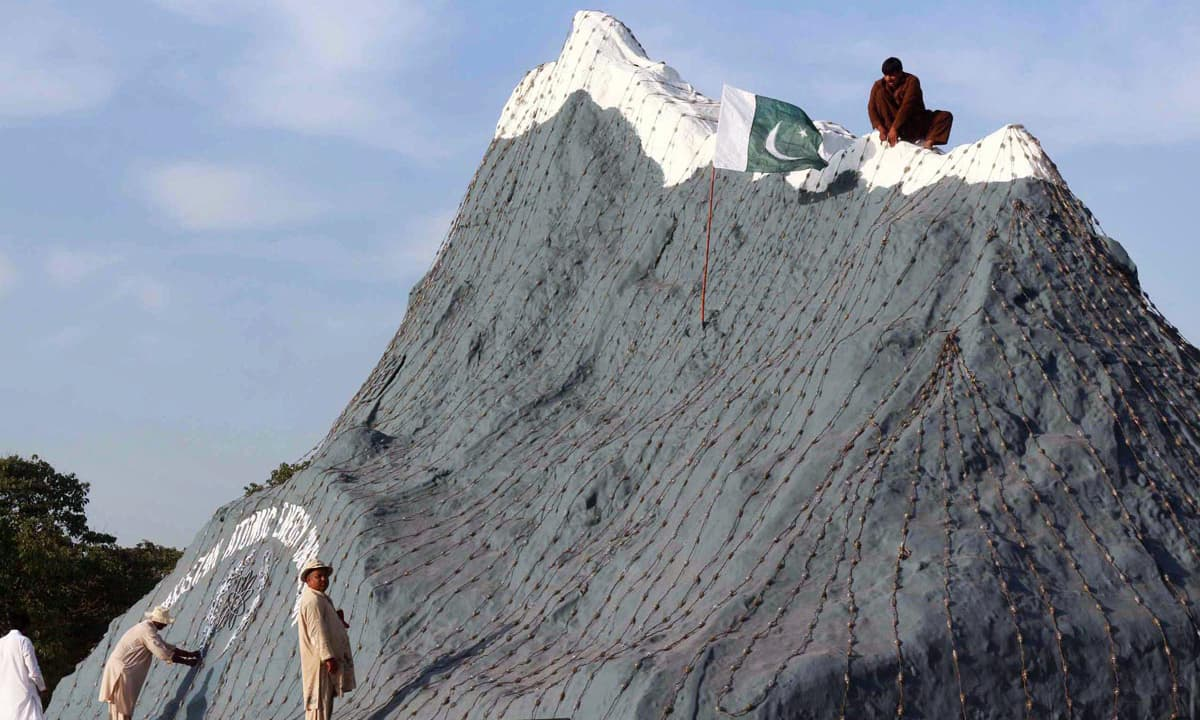
Every May 28, Pakistan marks the day it became a nuclear power and what that decision still means today.
Every year on May 28, Pakistan observes Youm-e-Takbeer. The name translates as the Day of Greatness. It marks the date in 1998 when the country conducted its first nuclear weapons tests and became the seventh nation in the world, and the first Muslim-majority country, to publicly test such weapons.
For most Pakistanis, the day is more than a historical marker. It speaks to how the country sees itself, as a state that secured its own survival and earned a seat at tables it might otherwise have been shut out of. That matters today, when Pakistan is playing an active part in a shifting geopolitical landscape and holding working relationships with major powers and leading nations of the world.
Understanding why May 28 carries that weight means looking at what happened in 1998 and the long road that led there.
Youm-e-Takbeer: Why Pakistan Conducted the 1998 Nuclear Tests
The trigger came from across the border. India carried out its Pokhran-II nuclear tests on May 11 and 13, 1998. The tests included five devices and shifted the strategic balance in South Asia. Inside Pakistan, the response was immediate concern.
Prime Minister Nawaz Sharif cut short a foreign visit and returned home. He convened the Defence Committee of the Cabinet to weigh the country’s options. According to accounts of that period, scientist Dr. Samar Mubarakmand told the Prime Minister that the Pakistan Atomic Energy Commission needed only about ten days to prepare and conduct a test.
Pakistan waited seventeen days after India’s tests before acting. On May 28, 1998, at 3:15 PM, the PAEC detonated five nuclear devices simultaneously in the Ras Koh Hills of the Chagai district in Balochistan. The operation was codenamed Chagai-I. A young technician, Muhammad Arshad, pushed the firing button. Two days later, on May 30, a sixth device was detonated in the Kharan Desert in a test codenamed Chagai-II.
Estimates of the explosive yield differ. Pakistani official figures place the combined Chagai-I yield in the range of 35 to 40 kilotons. Independent Western seismologists have offered lower estimates. The first tests used uranium-based devices, while the May 30 test used weapons-grade plutonium.
Clinton’s Calls and the Economic Pressure on Pakistan
The decision was not made in calm conditions. Pakistan faced heavy international and economic pressure to hold back. United States President Bill Clinton telephoned Nawaz Sharif on five separate occasions, urging him not to test. This account was later confirmed by Karl Inderfurth, then the US Assistant Secretary of State for South Asian Affairs. Sharif has since said that Clinton offered around five billion dollars in incentives to abandon the test. By Sharif’s own account, he told the American president that Pakistan’s self-respect did not carry a price tag.
The economic picture made the choice harder. Pakistan’s foreign exchange reserves had fallen to roughly 600 million dollars against an external debt of about 38 billion dollars. The country was close to default once sanctions were imposed. Saudi Arabia helped ease the strain by agreeing to a three-year arrangement to accept deferred oil payments. By some accounts, the Saudis later effectively wrote those payments off. Once the tests were carried out, the United States imposed sanctions and the UN Security Council passed Resolution 1172.
From Bhutto’s Multan Meeting to the Kahuta Strike Plan
The roots of the program run deep. It traces back to the 1971 war and the loss of East Pakistan, which exposed the country’s conventional military weakness. Prime Minister Zulfikar Ali Bhutto formally launched the weapons effort at a meeting in Multan in January 1972 and appointed Munir Ahmad Khan to lead the PAEC. India’s 1974 nuclear test added urgency.
The program advanced through the 1980s under President Zia-ul-Haq, and Pakistan came to view its enrichment facility at Kahuta as a possible target. According to a report carried by Dawn, drawing on the book Deception by investigative journalists Adrian Levy and Catherine Scott-Clark, India and Israel had secretly planned a strike on Kahuta around 1983 and 1984. The same account states that the plan was shelved after the CIA tipped off President Zia and the US State Department warned New Delhi against pressing ahead. The episode underlined how exposed the program was, and it was guarded closely as a result.
The effort drew on a generation of scientists and engineers. Munir Ahmad Khan led the PAEC for two decades. Abdul Qadeer Khan headed the uranium enrichment work at Kahuta. Sultan Bashiruddin Mahmood, an early PAEC engineer who worked on enrichment and reactor projects, was among the figures involved in building the country’s nuclear infrastructure. Dr. Samar Mubarakmand led the team that carried out the 1998 tests. Through the 1980s and 1990s, the PAEC conducted a series of cold tests in the Kirana Hills to refine its weapon designs before the country was ready for a full test.
What May 28 Means for Pakistan Today
The 1998 tests gave Pakistan a distinction it still holds today. It remains the only Muslim-majority country with a declared nuclear weapons capability, a status widely seen within Pakistan as a source of national pride and standing in the wider Muslim world.
For Pakistanis, May 28 is understood as the moment the country secured what it views as a credible deterrent. The official position has long held that the capability is defensive, intended to preserve a strategic balance rather than to project force. Supporters point to the absence of full-scale war between Pakistan and India since 1998, despite tensions such as Kargil in 1999 and the Pulwama-Balakot episode in 2019, as evidence that deterrence has held.
Pakistan’s regional weight today is also visible in its diplomacy. In 2026, Islamabad took on a central mediating role between the United States and Iran, hosting talks and carrying proposals between the two sides. That role rested on Pakistan’s geography and its close ties with both Tehran and the Gulf states.
The day also carries a message about resolve. Pakistan tested while its economy was fragile and while major powers were pressing it to stop. That is why Youm-e-Takbeer is often described in terms of unity and determination rather than only scientific achievement.
For many Pakistanis, that is the lasting meaning of May 28, a day to recognize the scientists, engineers, soldiers, and decision-makers behind the program, and the choices that shaped the country’s place in the region.
Stay tuned for more updates and news!