June 3, 2026 — A decade ago, the world lost a man who was far more than a boxer. It lost a greatest humanitarian and a living proof that courage has no weight class.
Muhammad Ali was born Cassius Marcellus Clay, Jr., on January 17, 1942, in Louisville, Kentucky, a Black child in the segregated American South, navigating a world that had already decided what it thought of him. He would spend his entire life proving it wrong.
The extraordinary chapter of Cassius Clay’s life began not with a championship, but with a stolen bicycle. At the age of twelve, his red Schwinn was stolen outside the annual Louisville Home Show. Reporting the theft to a nearby policeman named Joe Martin, he expressed a fierce desire to confront the culprit. Martin, who trained young boxers suggested the boy learn how to fight first. It was the most consequential piece of advice in the history of boxing.
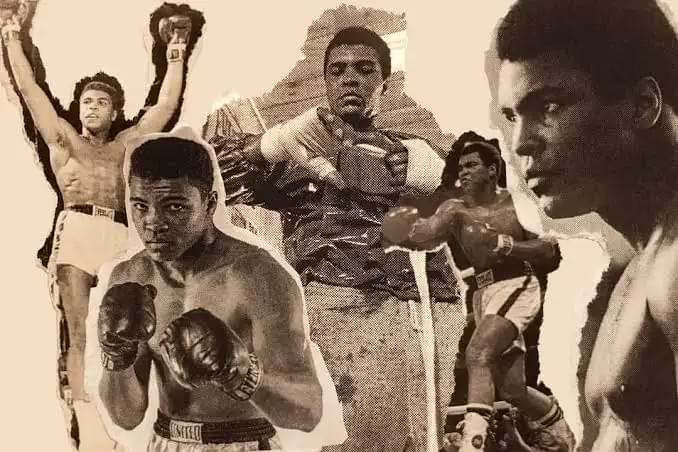
Young Cassius took to the sport with an obsession that bordered on the divine. He trained relentlessly, sacrificed willingly, and developed a style that would one day be described as unlike anything the sport had ever seen. A heavyweight who floated, who danced, who saw punches before they were thrown and moved before they arrived.
His amateur record was extraordinary: 134 wins against only 7 losses. He collected golden gloves, national titles, and regional championships as other boys collected baseball cards. Louisville, and then the nation, began to take notice of this young man who spoke in rhymes and fought in poetry.
His professional ascent was relentless. In 1964, a 22-year-old Clay — a 7-to-1 underdog — shocked the world by defeating the fearsome Sonny Liston to become heavyweight champion. The morning after, he announced his conversion to Islam and his new name: Muhammad Ali. The world was never the same.
His faith was not a headline — it was a transformation. First drawn to the Nation of Islam as a teenager, he later embraced Sunni Islam, and his spirituality matured into a universal love for all people. Nine days after September 11, he stood in New York City and declared plainly: “Islam is a religion of peace.”
In 1967, at the peak of his powers, he refused military induction on grounds of faith and conscience. He was stripped of his titles and banned from boxing, missing more than three prime years of his career. He paid the price without flinching, and history vindicated him completely.
He became the first man to win the world heavyweight championship three separate times, defending the title nineteen times in all. His professional record stands at 56 wins — 37 by knockout — across 61 fights. He defeated Liston, Frazier, Foreman, Patterson, and Norton. He gave us the Fight of the Century and the Rumble in the Jungle. He gave us rope-a-dope. He gave us poetry before, during, and after every bell.
In 1996, trembling from Parkinson’s disease, he lit the Olympic flame in Atlanta. The world saw not weakness, it saw grace.
Ten years after his passing, what endures is not the record, extraordinary as it is. It is the example. A man who refused to be defined by other’s expectations and became the greatest version of himself. Who fought for faith, for justice, and for dignity with the same ferocity inside the ring and outside.
He floated like a butterfly. He stung like a bee. He lived like a lion.