

“In aankhon ki masti ke, mastane hazaaron hain.”
If that line has been living rent-free in your head for years, you’re not alone. Asha Bhosle had that effect on people. Across borders, across generations, across languages. The legendary Indian playback singer, who recorded over 12,000 songs in a career spanning eight decades, passed away on April 12 in Mumbai at 92. And the tributes haven’t stopped since.
From Indian Prime Minister Narendra Modi to Shah Rukh Khan, from IPL stadiums observing silence to Pakistani artists posting emotional messages online, the outpouring of grief has been enormous. Modi called her one of India’s most iconic and versatile voices. Khan said her voice was one of the pillars of Indian cinema. In the IPL, both Mumbai Indians and Royal Challengers Bengaluru wore black armbands before their match on Sunday.
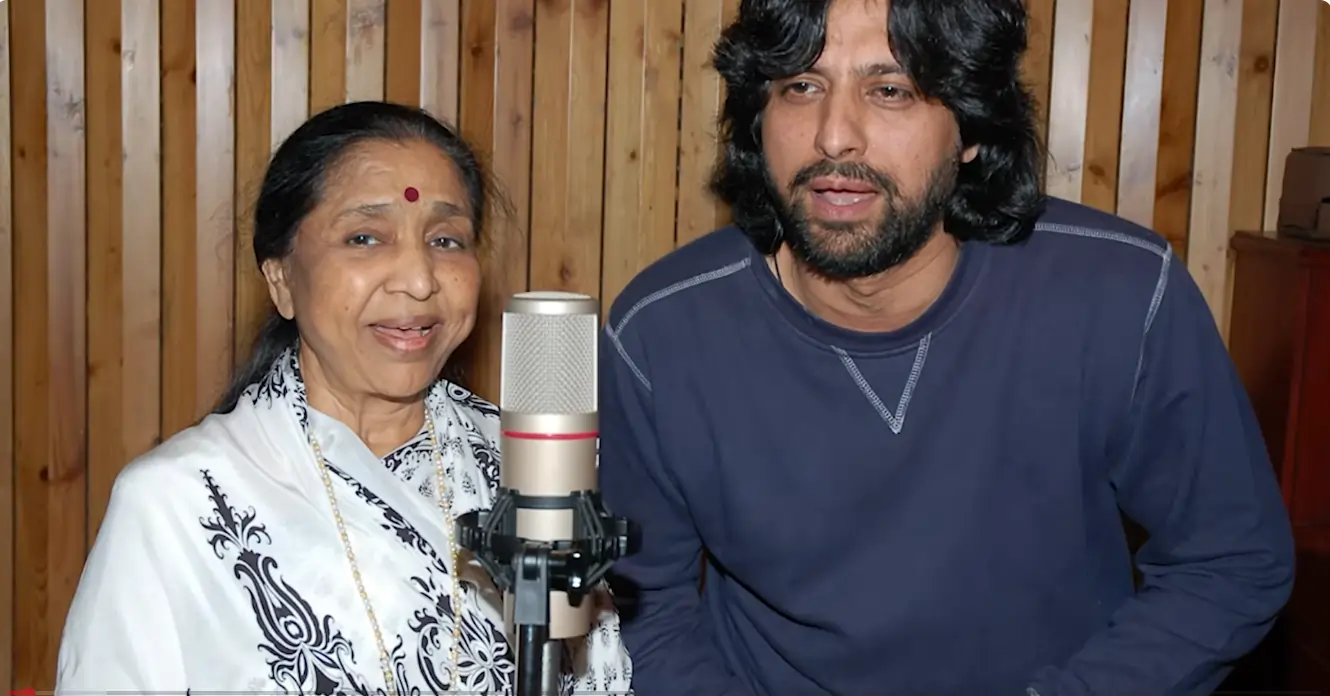
Across the border, Pakistani singer Jawad Ahmed shared a deeply personal tribute on X. Ahmed had a unique connection with Bhosle. In 2006, the two recorded a duet together for the Pakistani film “Mein Ek Din Laut Kay Aaaonga.” The song was called “Dil Key Taar Bajey.” Ahmed composed the melody, wrote the lyrics, and sang it alongside Bhosle. The track became widely popular and charted across the region.
Jawad Ahmed remembers Asha Bhosle and their 2006 duet
In his post, Ahmed expressed deep sorrow over Bhosle’s passing:
“Today I am very saddened and grieved by the passing of Asha Bhosle sahiba. She was one of the greatest singers in the history of the India-Pakistan subcontinent. In 2006, as a music director and singer, I composed the music for a film called ‘Mein Ek Din Laut Kay Aaaonga,’ in which I recorded a duet song with her, ‘Dil Key Taar Bajey.’ The melody and lyrics were both my own. Tomorrow I will also share the video so that a tribute can be paid to her from all of Pakistan and from me personally. Without a doubt, she was an important asset of the music industry of the entire world.”
Ahmed was among several Pakistani celebrities who paid tribute. Actor Ahsan Khan called her passing the end of an era. Singer Ali Zafar described her as an extraordinary artist whose work will inspire generations. Actor Adnan Siddiqui said her voice had a way of filling even the quietest moments with something deeply human.
Asha Bhosle’s legacy across eight decades of music
Bhosle started singing at the age of 10. She was the younger sister of Lata Mangeshkar, widely known as the Nightingale of India. While Mangeshkar became famous for singing for the chaste, virtuous heroines of Hindi cinema, Bhosle carved her own lane. She became the voice of the bold ones. The playful ones. The cabaret numbers, the qawwalis, the ghazals, the folk songs. She could do all of it and make each one sound like it was written specifically for her throat.
Her collaborations with composers like O.P. Nayyar, S.D. Burman, and R.D. Burman, whom she later married, produced some of the most memorable songs in Hindi film history. In 2011, the Guinness Book of World Records recognized her as the most recorded artist in music history. She won two National Film Awards, nine Filmfare Awards, the Dadasaheb Phalke Award, and the Padma Vibhushan.
Her reach went far beyond India. Cornershop’s 1997 hit “Brimful of Asha” was a tribute to her. The Black Eyed Peas sampled her music. Sarah Brightman, the Kronos Quartet, Brett Lee, and most recently the Gorillaz all collaborated with her. She even ran a chain of restaurants bearing her name in Dubai and the UK.
Twelve thousand songs. Eight decades. One voice that made an entire subcontinent feel something every single time she sang. That’s not a career. That’s a phenomenon.