

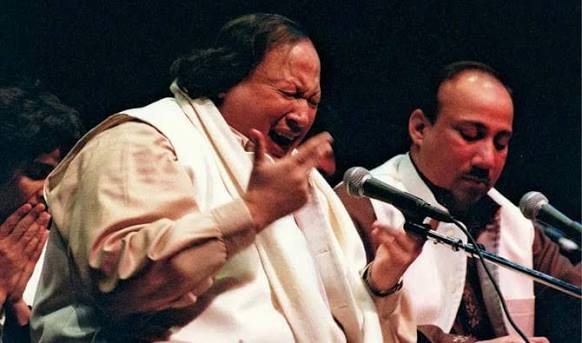
Few artists have carried the sound of Pakistan across the globe as powerfully as Nusrat Fateh Ali Khan. Revered as the “Shahen Shah-e-Qawwali” (King of Kings of Qawwali), his voice transcended language, religion and geography, introducing millions to the spiritual tradition of Sufi music. Nearly three decades after his passing, his performances continue to attract new generations of listeners, proving that truly timeless music knows no borders.
Born on October 13, 1948, in Faisalabad, Nusrat belonged to a family that had preserved the qawwali tradition for more than 600 years. Ironically, music was not initially meant to be his future. His father, Ustad Fateh Ali Khan, reportedly hoped his son would pursue a more conventional profession because musicians often struggled financially. However, fate took a different course after his father’s death in 1964. During the mourning period, family members recalled that Nusrat experienced a vivid dream in which his father encouraged him to sing. It became a defining moment that inspired him to dedicate his life to music.
His rise was extraordinary. In 1971, following the death of his uncle, Nusrat became the leader of the family qawwali ensemble. His powerful vocal range, remarkable breath control and gift for improvisation quickly distinguished him from his contemporaries. A single performance could stretch beyond an hour, with intricate vocal passages delivered seemingly without effort, leaving audiences spellbound.
One of the lesser-known chapters of his career unfolded in 1985 at the WOMAD festival in England. Until then, qawwali had largely remained unfamiliar to Western audiences. Nusrat’s electrifying performance stunned listeners who had never encountered the devotional art form. That concert opened the doors to international recognition and eventually led to collaborations with Peter Gabriel, Michael Brook, Eddie Vedder and other renowned musicians. Through these partnerships, Nusrat introduced Pakistan’s spiritual musical heritage to concert halls, film soundtracks and music charts around the world.
Another remarkable fact is that Nusrat held the Guinness World Record for the most recordings by a qawwali artist, with more than 125 albums released during his lifetime. His prolific output ensured that traditional Sufi poetry reached audiences far beyond South Asia while preserving centuries-old compositions for future generations.
Hollywood also embraced his talent. His haunting vocals featured in acclaimed films such as The Last Temptation of Christ, Natural Born Killers and Dead Man Walking, exposing entirely new audiences to the emotional depth of qawwali. Yet despite his international fame, Nusrat remained deeply rooted in the spiritual message of his music—one centred on divine love, humility and devotion.
His influence extended far beyond Pakistan. American singer Jeff Buckley famously described Nusrat as “my Elvis,” while countless contemporary artists continue to cite him as an inspiration. In 2024, previously unreleased recordings from 1990 were rediscovered and released as Chain of Light, reminding the world that even decades after his death, Nusrat’s voice still has the power to astonish.
Nusrat Fateh Ali Khan passed away on August 16, 1997, at just 48 years of age. Yet his legacy has only grown stronger with time. He transformed an ancient Pakistani musical tradition into a global phenomenon without compromising its authenticity. In doing so, he became far more than a legendary singer—he became one of Pakistan’s greatest cultural ambassadors, whose voice continues to unite hearts across continents.