WGS 2026: Spain Announces Social Media Ban as Dubai Records Largest Global Gathering
Spanish PM Pedro Sánchez calls social media a "failed state" at WGS 2026, announcing a ban for under-16s and criminal charges for algorithmic manipulation.
Feb 4, 2026
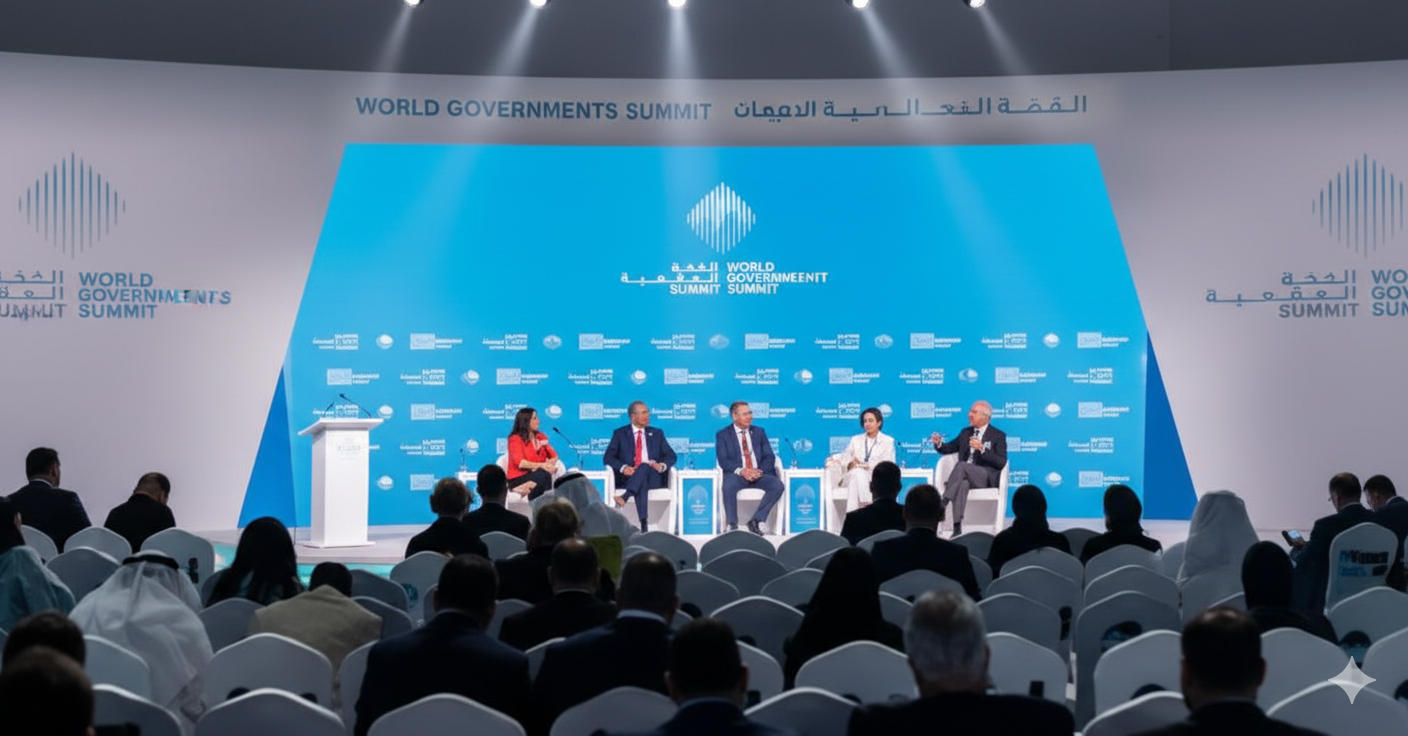
The World Governments Summit (WGS) 2026 has officially reached its peak in Dubai, solidifying its role as the premier global laboratory for future governance. Running from February 3 to February 5, the summit has convened a record-breaking 6,250 participants. This historic assembly includes 60 heads of state and 87 Nobel laureates, all gathered under the theme "Shaping Future Governments."
Record Global Participation at WGS 2026
The summit set a new benchmark for international engagement upon its official opening on February 3. This year marks the largest leadership participation in the history of the event, with delegations representing more than 150 governments and over 500 ministers. UAE President His Highness Sheikh Mohamed bin Zayed Al Nahyan maintained an active diplomatic schedule throughout the first two days, holding high-level bilateral meetings with the President of North Macedonia, the Prime Minister of Latvia, and the Prime Minister of Kyrgyzstan.
A major highlight occurred when the UAE President presented the "Most Reformed Government" global award to Paraguay’s President Santiago Peña. This prestigious recognition underscores the summit’s commitment to celebrating nations that demonstrate measurable progress in transparency and administrative efficiency.
With over 840 journalists documenting these milestones, the summit has successfully positioned itself as the primary venue for global policy shifts and accountability.
Future Realities and the $78 Billion AI Forecast
On February 4, the summit’s tech-focused discussions produced a staggering economic outlook for the next decade. New research released during the event forecasts that global AI spending by local governments is expected to reach $78 billion by 2033. This projection highlights a massive shift in how municipalities plan to manage urban growth and public services. Experts noted that this investment is no longer optional but a necessity for cities aiming to stay competitive in an increasingly digital world.
The “Human Algorithm" sessions continued to be a viral sensation, particularly those debating "Human 2.0." Leaders explored the arrival of agentic AI—systems capable of autonomous reasoning—and how they will influence the labor market. The consensus remains that while AI will become a "co-pilot" in governance, the protection of human creativity must remain a policy priority. Governments are now urged to adopt the newly launched AI Readiness Tool to assess their maturity and ensure they are not left behind in this rapid transition.
"We have to become multi-planetary to understand our past and future," stressed Sara Sabry, the first African and Arab woman astronaut, during a powerful session at WGS 2026. She emphasized that for future civilizations to be inclusive, diverse voices must have a "seat at the table" in space exploration today.
New Foreign Policy Toolkit and Geopolitical Trends
A significant addition to this year’s summit was the launch of the "2026 Foreign Policy Toolkit." Developed in collaboration with the Fiker Institute, this toolkit provides a strategic roadmap for diplomats to navigate a fragmented global landscape. It identifies critical geopolitical trends and risks, offering a structured approach to conflict resolution and international cooperation in an era of digital sovereignty.
This toolkit aims to help smaller nations have a larger voice in global affairs. This session emphasized that traditional diplomacy is undergoing a comprehensive restructuring. The goal is to move from a reactive posture to a proactive strategy that anticipates global shifts before they become crises.
Financial Stability and Global Economic Prosperity
The groundwork for the summit's economic agenda was laid on February 2 during preliminary forums focused on fiscal stability. The tenth Public Finance Forum in Arab Countries brought together finance ministers to discuss innovative financing models. IMF Managing Director Kristalina Georgieva addressed the forum, highlighting the need for resilience against global market volatility.
These discussions evolved on February 4 into the "Future of Economy Forum," where the "Blue Economy" was identified as a vital pillar for GCC states. Speakers emphasized that sustainable maritime trade and "longevity infrastructure" will define the next decade of growth. As regional economies move beyond oil dependency, the focus has shifted to securing digital trade routes and investing in human capital.
Innovation in Public Services and Urban Futures
The practical application of "GovTech" was a recurring theme throughout the ministerial roundtables. The UAE government presented its model for eliminating bureaucracy through a "simplify, secure, and scale" approach. This strategy aims to leverage decentralized ledger technologies to make public services more accessible and transparent.
One of the more unique sessions, "The Future of Interspecies Understanding," explored how AI can be used to interpret animal communication. While seemingly futuristic, the research presented showed how acoustic analysis could revolutionize environmental conservation. This session, alongside the debate on "reviving extinct species," demonstrated the summit's ability to bridge the gap between high-level policy and groundbreaking scientific exploration.
Spain Declares War on the "Digital Wild West"
In the most confrontational session of the summit, Spanish Prime Minister Pedro Sánchez delivered a keynote address that sent shockwaves through the tech industry. Labeling social media a "failed state where laws are ignored and crimes are tolerated," Sánchez announced a five-point legislative offensive set to begin next week.
Most significantly, Sánchez announced a total ban on social media for minors under 16, requiring "real barriers" for age verification rather than simple checkboxes. He confirmed that the public prosecutor would investigate specific legal violations by Grok, TikTok, and Instagram, a move that prompted Elon Musk to publicly label the PM a "tyrant" on social media.
A Proactive Future for Global Governance
As the summit’s main sessions conclude, the message from Dubai is one of urgency. Mohammad Al Gergawi, Chairman of the WGS Foundation, stated that the "wait and see" approach to governance is no longer viable. The release of 36 strategic reports provides a massive data repository for governments to use as they return home and implement these new visions.
With the official closing scheduled for February 5, the WGS 2026 has provided more than just a platform for speeches. It has delivered a concrete roadmap for the next decade. From the $78 billion AI investment forecast to the new Foreign Policy Toolkit, the summit has equipped global leaders with the tools necessary to build governments that are as agile and innovative as the technology they oversee.