What went wrong with the Greenshirts against India?
The men in green had every advantage but struggled to deliver when it mattered most against India.
Feb 16, 2026
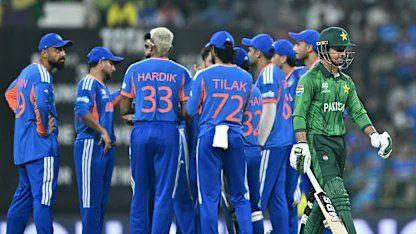
They won the toss but couldn't make the right call. They had the upper hand in the power play but failed to consolidate. They had big names — but only on paper. Yes, we are talking about the Pakistan cricket team, which lost its crucial T20 World Cup match to India despite playing at a neutral venue, in front of a favorable crowd, and after initially boycotting the fixture. After the match, questions arose about the team's performance, which fell short of expectations.
There were issues with almost everything Pakistan did in a match billed as one of the biggest contests of the tournament — yet it struggled to deliver. The star bowlers couldn't take wickets, leaving the job to the all-rounders. The star batter failed to fire yet again, piling pressure on others. The fielding was sharp in patches, but not consistently. Let's try to decipher what went wrong with the men in green and how this defeat could have been avoided.
Was fielding first the right call with a shaky lineup?
Pakistan's challenge began the moment its captain, Salman Ali Agha, decided to field first against India. Was he aware of his team's capabilities, especially with the bat? Did he consider that Babar Azam wasn't in form, that Sahibzada Farhan and Usman Khan are still developing, and that Shadab Khan isn't even a specialist batter? Did he assess India's batting strength before the match? What made him think his batters would chase down runs against Indian spinners who have both variation and the temperament to win big games?
Had he dropped the out-of-sorts Shaheen Shah Afridi and Babar Azam and included Salman Mirza and Khwaja Nafay instead, Pakistan might have had a chance. But he didn't. Yes, his out-of-the-box thinking while opening the bowling was appreciated — but that was overshadowed when Shaheen Afridi was brought on for the second over and then the final over of the innings, a move that affected Pakistan's chances significantly. Where was the out-of-the-box thinking when Pakistan batted? Why wasn't the batting order tweaked to surprise the opposition? That's a lot of questions for a match that lasted fewer than 40 overs.
Are Shadab and Shaheen in the squad despite recent form concerns?
The Pakistan Cricket Board appears reluctant to sideline players with influential backing. Shaheen Afridi and Shadab Khan were selected after a disappointing (in Shaheen's case) and average (in Shadab's case) Big Bash League ahead of the T20 World Cup. Had the PCB taken a stricter merit-based approach, Sufyan Muqeem might have replaced Shadab, and one of Abbas Afridi, Zaman Khan, or Akif Javed could have come in for Shaheen.
When accountability takes a back seat, and other factors take priority, results suffer. Shadab Khan is regarded as one of Pakistan's best fielders, yet he fumbled more than once. Shaheen Afridi, meanwhile, has struggled with pace and consistency in recent years. Against India, he conceded heavily in his two overs and couldn't even complete his full quota — a spell that shifted momentum decisively. Yet there seems to be little consequence. A strong PSL season often guarantees selection in limited-overs cricket, especially in ODIs where he remains captain.
What is Faheem Ashraf's role in the squad?
Despite hitting the winning runs against the Netherlands, Faheem Ashraf continues to raise questions. He doesn't cement his place as a specialist batter, bowler, or even fielder — so what is his role in the squad? Questions remain about what his primary contribution should be. That wouldn't matter if he delivered consistently, but too often he contributes little with either bat or ball. At this level, consistency is crucial.
Babar Azam — searching for form
Then there is Babar Azam, once hailed as one of the finest batters in the world. Today, he appears to be going through a challenging phase. He struggles against spin, consumes dot balls, and finds it difficult to anchor innings. Against India, he managed just 5 runs off 6 balls before being bowled by left-arm spinner Axar Patel. For a player of his stature, more was expected.
Sustained form is essential to maintain one's standing in international cricket. Babar must realize that his prolonged slump is affecting both the team and his own legacy. Dot balls pile up, pressure builds, and then comes a soft dismissal. That is not how big matches are won. Yes, Salman Ali Agha and Saim Ayub share responsibility, but they contributed with the ball. With the bat, Babar offered limited support.
Is Mike Hesson empowered to make decisions?
Mike Hesson is considered one of the top coaches in the game, yet even he seems constrained in Pakistan's setup. Appointed after an impressive stint in franchise cricket, he was expected to restructure the team. But that requires autonomy. Can a world-class coach be effective if he cannot select the XI he believes in?
If fans could foresee that certain players would struggle against India, shouldn't the coaching staff have anticipated the same? If Usman Khan is most effective at the top of the order during the power play, why not utilize him there? If Shadab's inclusion raises concerns among observers, what justifies persisting with him? And if the coach's hands are tied, perhaps a review of the structure is needed — as has been suggested in the past.
Does the PCB chief's visit add pressure?
In 2008, ahead of the Kitply Cup final against India, then-PCB chief Nasim Ashraf reportedly sent a stern message to the team demanding better performances — and Pakistan delivered. Accountability was clear.
In recent years, however, PCB chiefs have taken a more friendly approach, meeting players ahead of major fixtures. While intended as encouragement, such visits may instead add pressure. When the stakes are high, players need clarity and focus — not distractions. Sometimes, the best support is space.
The path forward: Accountability and merit
The Pakistan cricket team is not a local club side; it represents a nation. These players are expected to put country before contracts. Yet with lucrative endorsements, documentaries, and league NOCs, the perception is that financial security may compete with national priorities. Fair or not, that impression exists.
Representation of Pakistan is both an honor and a privilege. If performances don't justify selection, difficult decisions must follow. Underperformers need to be reassessed. NOCs should be reviewed. Merit must be reinforced. This may be demanding, but accountability is essential for progress — especially when millions of fans invest their passion in this team.