
UAE Rainstorm Warning Issued as Severe Storm Peaks Thursday Night
The UAE is bracing for its most intense storm in months as forecasters warn Thursday night could echo the chaos of the record-breaking April 2024 deluge.
Mar 24, 2026
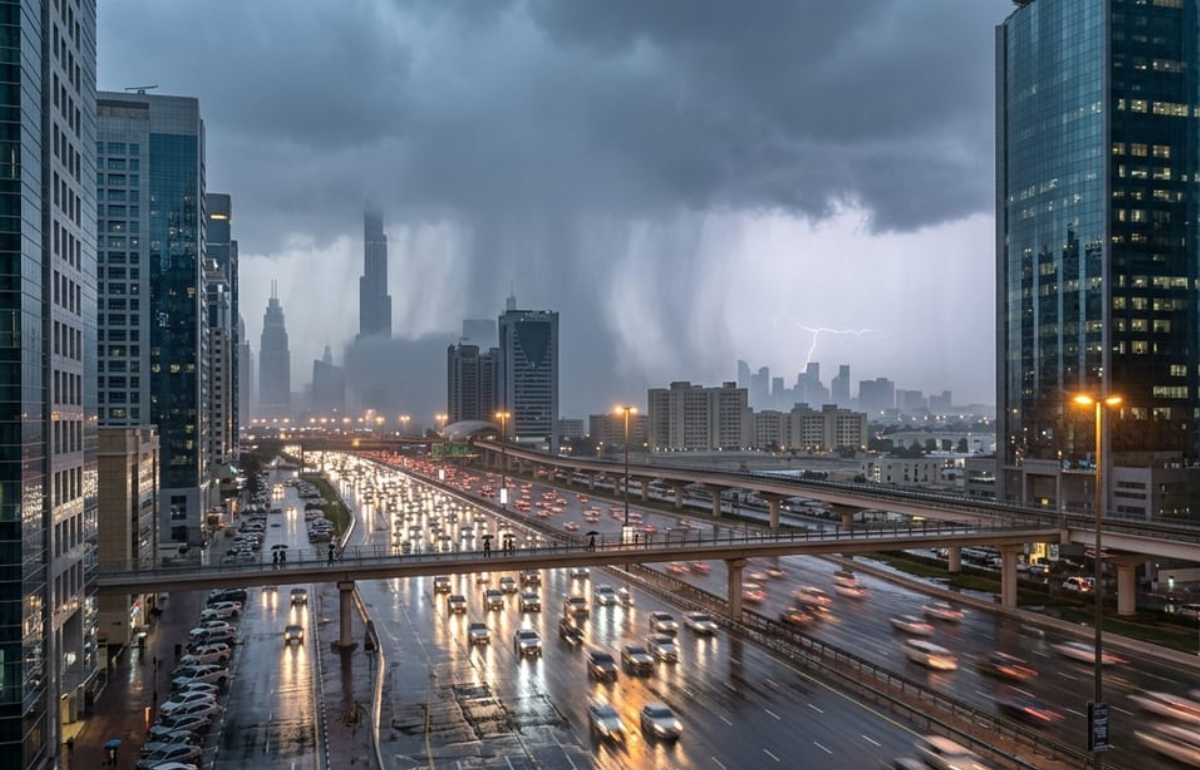
The UAE is bracing for a powerful storm overnight Thursday, nearly two years after the most catastrophic rainfall event in the country's recorded history.
Forecasters at the National Centre of Meteorology warned that Thursday night into Friday morning will mark the peak of an unstable weather system that has already been battering the country since the weekend. Heavy rain, strong winds, and thunder are expected to build across Abu Dhabi emirate before sweeping the entire country overnight.
Parts of Abu Dhabi and Ajman were hit hard earlier this week, with some areas recording close to a year's worth of rainfall in a single day. The NCM's gauge at Al Manama in Ajman recorded 93.3mm, while Ghayathi in western Abu Dhabi logged 91mm and Al Wathba, near Abu Dhabi city, received 88.2mm. More rain fell on Wednesday across scattered areas before conditions are set to deteriorate sharply by Thursday evening.
https://www.instagram.com/reels/DWRHAmcCpZ9/
UAE Storm Warning in Effect Until Friday as Authorities Issue Safety Alerts
The National Emergency Crisis and Disaster Management Authority confirmed it is monitoring developments around the clock and has coordinated with the Ministry of Interior and the NCM to activate readiness plans across all sectors. Guidance will be issued through the authority's early warning system if any direct threat to safety emerges.
The Ministry of Interior urged residents to stay away from flooded areas and wadis. Police in Abu Dhabi have reduced speed limits to 80kph on main roads during the adverse conditions, while Dubai Police issued driving guidelines warning motorists to anticipate reduced visibility and water accumulation on roads.
Dubai International Airport and major carriers including Emirates and Etihad have cautioned passengers that adverse weather may affect flight schedules through March 27. Travelers have been advised to check flight status before heading to airports and to allow extra travel time.
Wind gusts of up to 50kph could lift sand and dust across affected regions, further reducing road visibility. Residents have also been warned to avoid open and elevated areas during lightning, and to stay out of the sea.
Meteorologists have flagged an additional risk. Conditions this week present the potential for waterspouts and even tornadoes in the region. Scientists explained that wind shear, a critical factor in tornado formation, is present in severe thunderstorm systems of this type. While tornadoes are unusual in the UAE, they have been recorded before.
UAE Rainfall Records and Climate Change Behind More Frequent Storms
The current storm arrives almost exactly two years after the April 16, 2024 event, which remains the most extreme rainfall on record since the country began keeping weather records in 1949. On that day, Dubai Airport alone received 144mm of rain in 24 hours, roughly 1.5 times its typical annual total. At Khatm Al Shakla in Al Ain, 254.8mm fell in under 24 hours. The flooding killed five people in the UAE, caused an estimated US$2.9 to 3.4 billion in insurance losses, and left more than 1,200 flights cancelled or disrupted at Dubai International Airport.
Research by scientists at Abu Dhabi's Khalifa University and the NCM found that there are now up to two more stormy days per year in the UAE compared to 2000. Climate change is the driving factor. A warmer atmosphere holds more moisture, fuelling the kind of intense convective storms now striking the country with increasing regularity. One study estimated that an event like April 2024 is now 30 times more likely than it would have been in a pre-industrial climate.
Dubai Municipality has responded to the new reality by awarding Dh1.4 billion in stormwater drainage contracts as part of the broader Dh30 billion Tasreef project, the emirate's largest unified stormwater collection system. The contracts cover key areas including Nad Al Hamar, Dubai International Airport surrounds, Al Garhoud, Al Quoz, and Al Wasl.
For now, residents across the Emirates are being asked to stay indoors where possible on Thursday night, monitor official channels for updates, and take no risks on flooded roads. The memory of 2024 is still fresh enough. Nobody needs reminding what happens when the UAE underestimates the rain.