UAE at Davos 2026: Architects of the Intelligent Age
The United Arab Emirates arrived at the 56th World Economic Forum with a decisive agenda: to rewrite the rulebook for the Intelligent Age. UAE moved beyond participation to active leadership through a new "Sovereign Governance-in-the-Loop" framework and high-level economic dialogues. This strategy, backed by its fifth-largest delegation in history, positioned the country as the world's primary "living lab" for future governance.
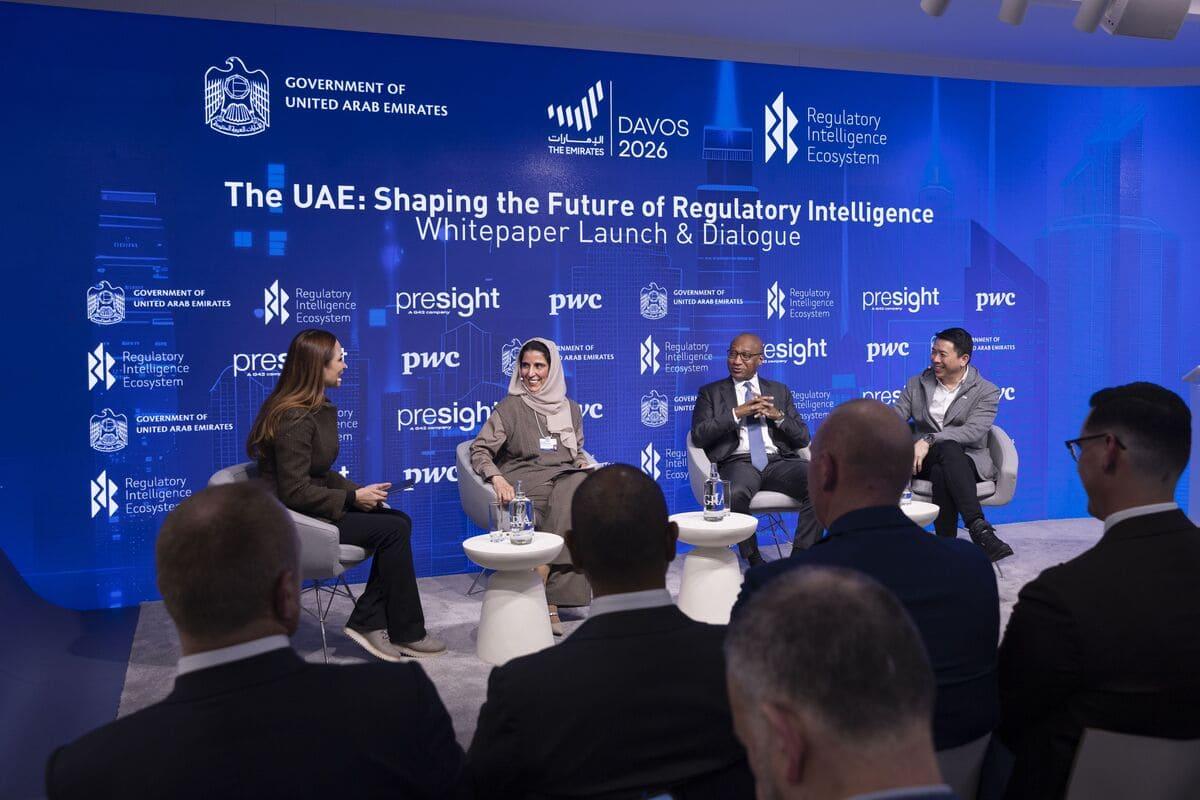
The United Arab Emirates (UAE) unveiled a pioneering regulatory framework for Artificial Intelligence at the 56th World Economic Forum (WEF) in Davos. The nation deployed its fifth-largest delegation in history to the Swiss mountain town. Over 100 ministers, government officials, and top-tier private sector leaders comprised the group. They operated under the theme "Impossible is Impossible" for the fourth consecutive year.
This massive presence served a specific purpose. It signaled a rapid transition from a resource-based economy to a knowledge-based powerhouse. Khaleej Times notes that the delegation reflected a "whole-of-government" approach. Every key sector had representation. This unified front demonstrated to global investors that the UAE offers a seamless, stable business environment in an otherwise fractured world.
Revolutionizing AI Governance
The most consequential outcome of the summit was the UAE’s aggressive move into Artificial Intelligence (AI) governance. While other nations continue to debate the theoretical risks of AI, the UAE government launched a landmark whitepaper titled “The UAE: Shaping the Future of Regulatory Intelligence.”
Developed in collaboration with Presight (a G42 company) and PwC, this document proposes a radical shift. It argues that static, slow-moving legislation cannot govern self-learning machines. Maryam bint Ahmed Al Hammadi, Minister of State and Secretary-General of the UAE Cabinet, presented the framework to global peers. Her message was clear: the world needs an "AI-enhanced regulatory ecosystem."
The whitepaper introduces the concept of "Sovereign Governance-in-the-Loop" (SGiL). This is a technical and legal breakthrough. It explicitly defines AI as a supportive tool rather than a substitute for legislators. The framework ensures that human decision-makers remain involved at all critical stages of the regulatory process.
Furthermore, the UAE introduced the concept of a "Unified Regulatory Digital Twin." This is a live digital model of the entire regulatory ecosystem. It allows the government to simulate the economic and societal impacts of new laws before they are enacted. Economy Middle East reports that this move establishes the country as a global "living lab." Tech companies can now view the UAE as a sandbox for testing the governance structures of tomorrow. With this approach, the Emirates is solving the "pacing problem,” the gap between how fast technology moves and how slow laws change.
The Great Rebalancing
The World Economic Forum’s 2026 theme was "A Spirit of Dialogue." The UAE embodied this by positioning itself as a neutral broker between the Global North and South. This role was most visible during a high-profile session titled "The Great Rebalancing."
Badr Jafar, the UAE’s Special Envoy for Business and Philanthropy, joined IMF Managing Director Kristalina Georgieva on the main stage. The discussion focused on global economic divergence. Georgieva warned of an "AI tsunami" that could disrupt labor markets and widen inequality.
Jafar offered a counter-narrative centered on resilience. He highlighted the UAE’s strategy of "doubling down on partnerships." He focused specifically on "frontier markets," which are home to 85% of the world's population. In a world where trade barriers are rising, the UAE is lowering them. He positioned the Emirates as the Switzerland of the Middle East. It is a place where capital, talent, and innovation can meet without political baggage. Zawya reported that his comments resonated with investors looking for safe harbors. The UAE’s argument is that economic connectivity is the best hedge against geopolitical instability.
Economic Vision: Beyond the Barrel While technology garnered headlines, the economic fundamentals remained the bedrock of the visit. Minister of Cabinet Affairs Mohammad bin Abdullah Al Gergawi articulated the country’s direction during several sessions. He emphasized "future-oriented sectors," specifically industrial innovation and advanced manufacturing.
The UAE is actively integrating these sectors into the global supply chain. This strategy aims to future-proof the economy against oil price volatility. The narrative was specific: the UAE is open for "design-led innovation." They are seeking partners who will transfer technology and expertise, not just extract resources.
Driven Properties highlighted that this strategy is already yielding results. Non-oil trade numbers continue to break records. The delegation emphasized that the UAE is no longer just a logistics hub. It is becoming a manufacturing center where products are designed, built, and exported to the world.
Soft Power as an Economic Asset
A key theme of the UAE’s participation was the monetization of reputation. The delegation engaged deeply with the findings of the Global Soft Power Index 2026. Officials argued that in a fragmented world, a nation’s brand is a tangible economic asset.
Sarah Al Amiri, a prominent voice in the delegation, underscored the link between human capital and global influence. She argued that investments in science, education, and technology are tools of foreign policy. The logic is simple. Capital flows to stability. As trust in traditional global institutions declines, countries that project "authenticity" and openness will win the race for Foreign Direct Investment (FDI).
The UAE used Davos to present itself as the most stable, predictable partner in the Global South. By hosting dialogues on sustainable finance and the digital economy, the Emirates demonstrated its convening power. It proved it can bring diverse stakeholders to the table to solve complex problems.
The UAE’s participation in Davos 2026 was a masterclass in modern statecraft. The delegation did not rely on the country’s wealth to buy influence. Instead, they used policy innovation to earn it.
From the "Impossible is Impossible" pavilion to the launch of the Regulatory Intelligence Innovation Loop, the Emirates controlled the agenda. They demonstrated that they are no longer waiting for the developed world to set the standards. Whether in AI regulation, soft power projection, or economic diversification, the UAE showed up to Davos 2026 not as a participant, but as an architect.