
Pakistan Will Save $6.3B This Year By Using Solar Energy
Pakistan has avoided over $12 billion in fossil fuel imports since 2018, with another $6.3 billion in projected savings this year as solar capacity tops 51 gigawatts.
Mar 19, 2026
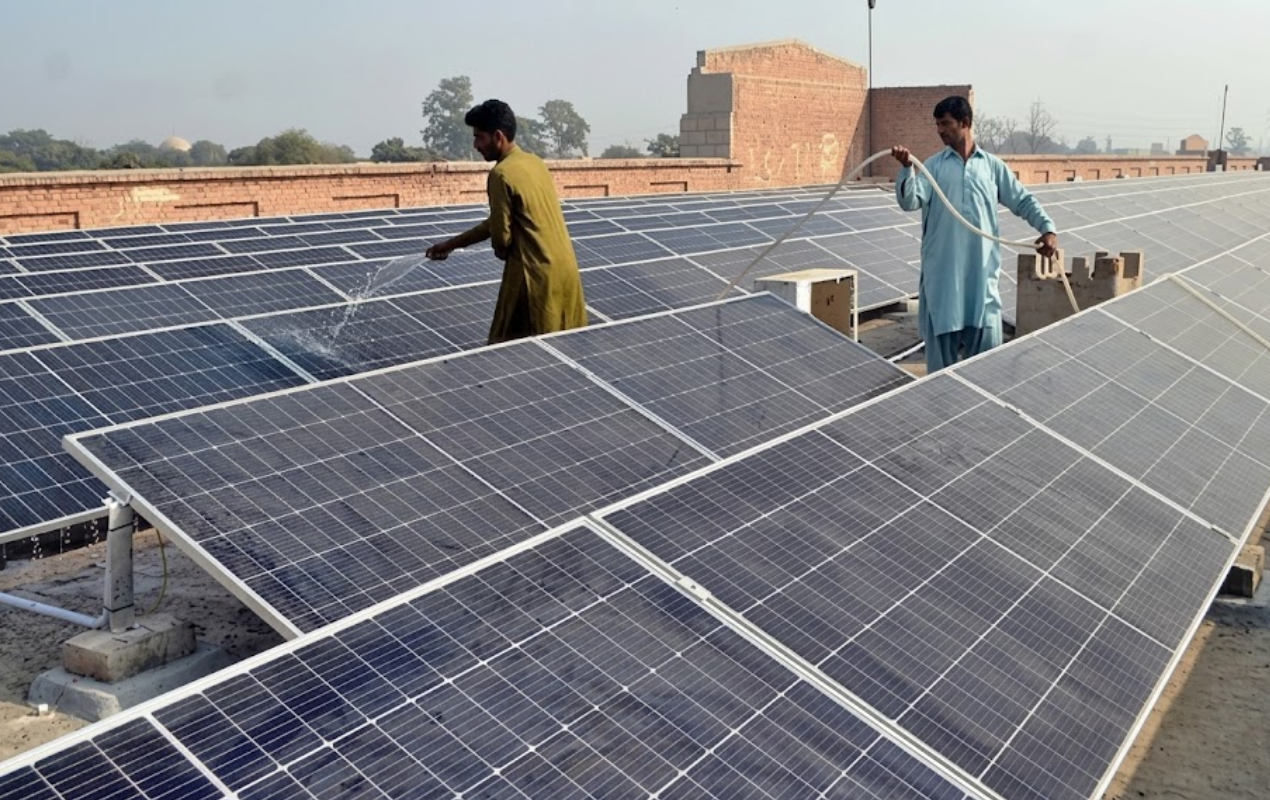
Pakistan imports nearly all of its crude oil, refined petroleum products, and liquefied natural gas, the bulk of it transiting the Strait of Hormuz. With US-Iran hostilities disrupting regional energy flows and fossil fuel prices climbing, a new report finds that the country's rapid solar expansion is now providing measurable financial relief.
The joint report, released March 17 by Renewables First and the Centre for Research on Energy and Clean Air (CREA), finds that Pakistan's rapid solar expansion has already avoided more than $12 billion in oil and gas imports, and could save a further $6.3 billion by the end of 2026, helping cushion the impact of soaring fossil fuel prices caused by the war in the Middle East.
Pakistan Solar Capacity Reaches 51 Gigawatts
Pakistan has grown from under 1 GW of solar panel imports in 2018 to over 51 GW by early 2026, representing one of the fastest consumer-led energy transitions on record, and one that drove a 40 percent drop in oil and gas imports between 2022 and 2024.
The report attributes the growth to market forces, consumer demand, and government policy. While western economies erected tariff walls against Chinese solar imports, Pakistan did the opposite, maintaining a zero-rated tax regime on solar PV imports that held from 2013 until mid-2025.
The 2022 energy crisis, which followed Russia's invasion of Ukraine and a drop in Chinese solar manufacturing costs, accelerated adoption. The report states that the grassroots solar surge has delivered falling fuel import dependence, stronger energy security, and relief from rising electricity costs for millions of households. Solar is now Pakistan's largest electricity source, up from fifth place in 2023.
Installed solar capacity reached about 33 gigawatts by March 2025, while cumulative solar panel imports rose from under 1 gigawatt in 2018 to more than 51 gigawatts by early 2026.
Pakistan Solar Growth Shields Country From Hormuz Disruptions
Despite reduced dependence, the Strait of Hormuz remains critical for Pakistan, which ranked third globally in LNG dependence and fifth for oil on Hormuz-transiting shipments in 2024.
The report notes that solar growth has directly reduced LNG demand. Solar has cut LNG demand enough for some contracted cargoes to be diverted and for the government to renegotiate LNG terms. The spread of solar has also helped Pakistan avoid load-shedding or other peak-demand restrictions despite the current crisis.
The study describes Pakistan's $12 billion in avoided imports since 2018 as a structural reduction in geopolitical risk exposure that no LNG contract or hedging strategy could have delivered at equivalent scale or speed.
Lauri Myllyvirta, co-founder of CREA, described Pakistan's rooftop solar as an insurance policy against escalating energy crises and geopolitical tensions. The study concluded that distributed solar offers the lowest-cost path to energy access for low and middle-income households, and that every additional gigawatt deployed strengthens Pakistan's resilience.
Pakistan still generates more than half its electricity from thermal sources. The report notes that despite the solar cushion, any sustained disruption to the Strait of Hormuz would still send immediate shockwaves through Pakistan's energy system.
Pakistan's National Electric Power Regulatory Authority reports that capacity payments to power plants exceeded PKR 2 trillion, or $7 billion, in 2024, costs that must be recovered through higher tariffs on fewer ratepayers.
The government has also moved to renegotiate solar buyback tariffs under the net-metering regime, citing the rising fiscal cost of purchasing excess solar power from households and businesses.