
Dark Matter Galaxy CDG-2 Confirmed: Astronomers Find a Galaxy That Is 99% Invisible
Astronomers have confirmed CDG-2, a galaxy in the Perseus cluster that is between 99.94 and 99.98 percent dark matter, making it the first galaxy ever detected entirely through its globular cluster population.
Feb 23, 2026
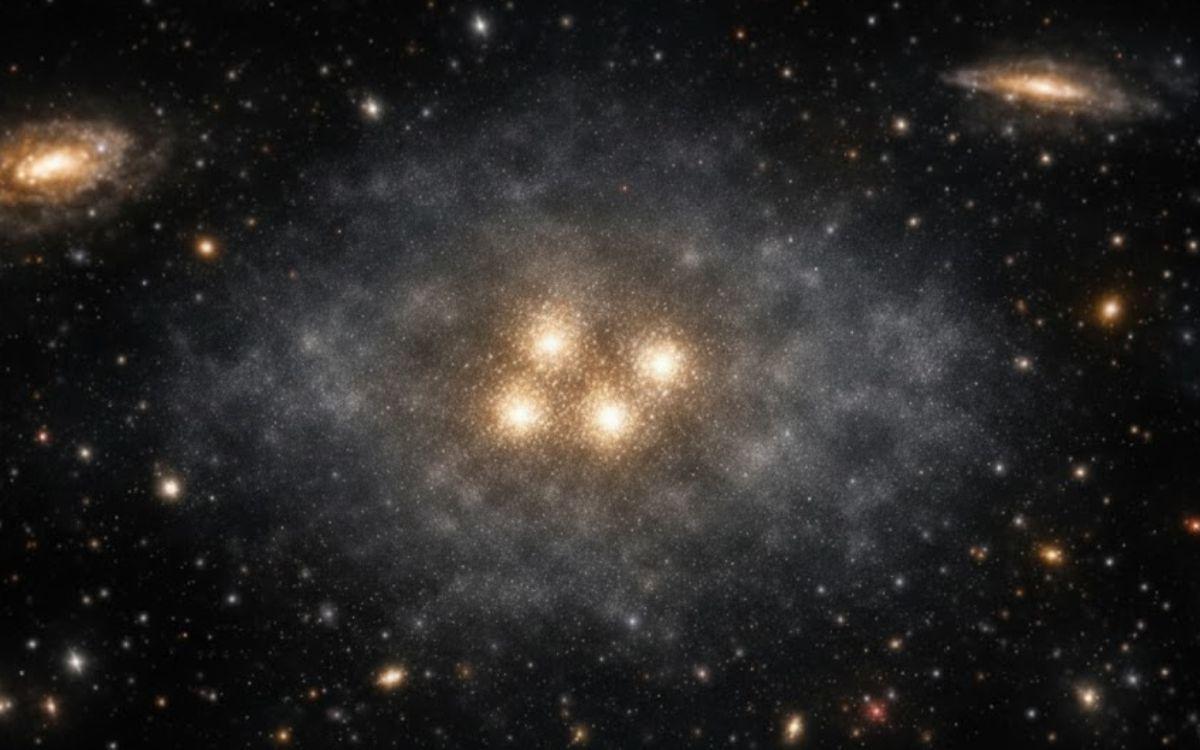
There is a galaxy 300 million light-years away that you cannot see. Almost none of it is there, at least not in any form that can be detected with light. Yet it exists, held together by something that has never been directly observed.
Astronomers have confirmed the existence of CDG-2, short for Candidate Dark Galaxy-2, a galaxy that is estimated to be between 99.94 and 99.98 percent dark matter. The finding was published in The Astrophysical Journal Letters and is based on combined observations from three of the most powerful telescopes currently in operation.
What Is CDG-2 and Where Was It Found
CDG-2 is located in the Perseus galaxy cluster, approximately 300 million light-years from Earth. It is classified as a low-surface-brightness galaxy, meaning it emits so little light that it is nearly undetectable using conventional observational methods. Its total luminosity is equivalent to roughly six million Sun-like stars, which is extremely faint by galactic standards. For context, the Milky Way contains an estimated 100 to 400 billion stars.
The galaxy was not found by looking for it directly. Astronomers identified it through four tightly packed globular clusters, small dense groupings of stars, that had previously been recorded in the Perseus cluster but treated as independent objects. After further analysis, researchers determined these four clusters were not isolated but were instead the visible fragments of a single, much larger system. Those four clusters account for approximately 16 percent of CDG-2's total visible brightness. The rest of the galaxy produces almost no detectable light.
How Three Telescopes Confirmed the Discovery
The confirmation required data from NASA's Hubble Space Telescope, ESA's Euclid space observatory, and the ground-based Subaru Telescope in Hawaii. Hubble provided high-resolution imaging that pinpointed the four globular clusters within the Perseus cluster. Follow-up observations combining data from all three instruments revealed a faint, diffuse glow surrounding the clusters. That barely visible halo of light provided the evidence researchers needed to establish that the clusters were embedded within an underlying galaxy.
"This is the first galaxy detected solely through its globular cluster population," said David Li, the study's lead author at the University of Toronto. According to conservative estimates, the four clusters likely represent CDG-2's entire globular cluster system, meaning there are no other visible structural components to work with.
What Dark Matter Is and Why CDG-2 Is Significant
Dark matter is a substance that does not emit, absorb, or reflect light. It cannot be directly observed or measured. Scientists infer its existence from its gravitational effects on visible matter, radiation, and the large-scale structure of the universe. According to current models, dark matter accounts for roughly 27 percent of the universe's total energy density and approximately 85 percent of its total matter content.
In a typical galaxy, dark matter outweighs stars, gas, and dust by roughly five to one. The Milky Way, for example, is estimated to be embedded in a dark matter halo that makes up around 90 percent of its total mass. CDG-2 pushes that ratio to an extreme. Between 99.94 and 99.98 percent of its mass is dark matter. The remaining fraction, the four visible globular clusters and whatever sparse stars exist around them, is ordinary matter.
Scientists believe CDG-2 once contained more normal matter and may have supported star formation at an earlier point in its history. Over time, gravitational encounters with neighboring galaxies likely stripped away most of its stars and gas. The globular clusters survived those interactions because of how densely packed they are, while the rest of the galaxy's visible content faded away. What remains is a gravitationally bound system held together almost entirely by an invisible structure.
What CDG-2 Means for Dark Matter Research
So-called dark galaxies are of particular interest to researchers because they function as isolated test cases for dark matter theories. A galaxy that has lost nearly all of its visible matter through environmental processes is difficult to study in isolation because the stripping itself complicates the data. CDG-2's location within the Perseus cluster means it has been subject to those kinds of interactions, which researchers will need to account for in their analysis.
Future observations using the James Webb Space Telescope, which operates in the infrared spectrum, could potentially detect faint stellar populations within CDG-2 that current instruments cannot resolve. Ongoing hydrogen surveys using instruments like MeerKAT and the planned Square Kilometre Array will also systematically search for gas signatures in galaxies of this type across larger volumes of space.
The study was published in The Astrophysical Journal Letters on February 21, 2026.