


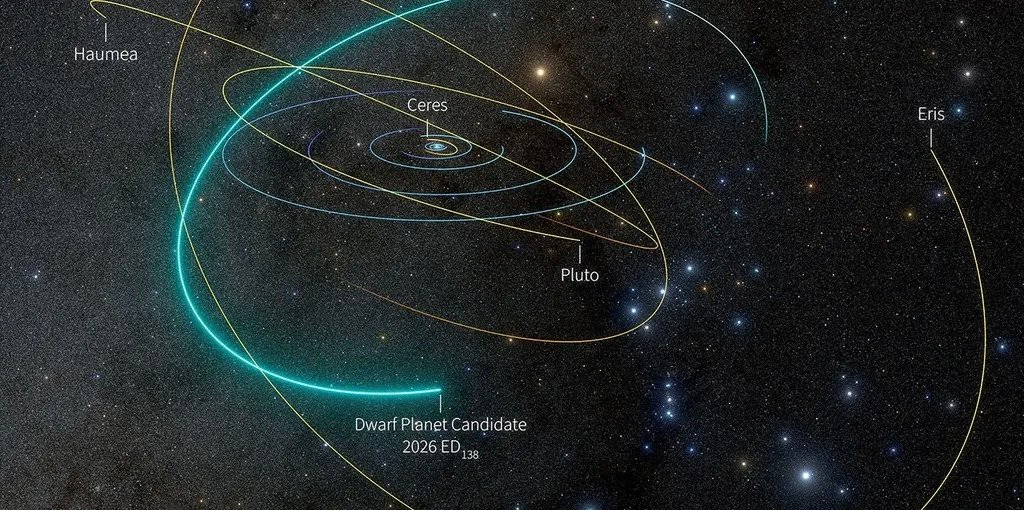
Astronomers have identified a potentially massive dwarf planet candidate beyond Pluto using observations from the Vera C. Rubin Observatory in Chile. The object, provisionally designated 2026 ED138, is estimated to measure between 600 and 1,500 kilometres in diameter and could become the sixth officially recognised dwarf planet in the solar system if further observations confirm its classification.
The discovery was announced on October 27, 2026, by the International Astronomical Union’s Minor Planet Center. Researchers presented their findings at the 58th annual Division for Planetary Sciences meeting in Spokane, Washington.
According to the NSF–DOE Vera C. Rubin Observatory, ED138 is a trans-Neptunian object, meaning it orbits the Sun beyond Neptune. Its estimated distance from the Sun is approximately 46 astronomical units, with one astronomical unit representing the average distance between Earth and the Sun.

Pluto, by comparison, orbits the Sun at an average distance of approximately 40 astronomical units.
Astronomer Matthew Holman, a senior astrophysicist at the Center for Astrophysics | Harvard & Smithsonian, identified the object on October 13 while analysing observations collected earlier in 2026 by the Rubin Observatory.
Holman used a computer program developed with colleague Kevin Napier to identify moving objects in astronomical data. The software compares detections across observations to identify objects moving through the solar system.
The object’s brightness and distance immediately attracted attention because they suggested it could be unusually large.
Following the initial identification, researchers searched additional observations to establish whether the object could be independently detected. Mario Jurić, the Rubin Observatory’s solar system lead scientist at the University of Washington, examined the observatory’s catalogues and images.
The team subsequently identified 20 additional observations of ED138, recorded between March 4 and July 11, 2026. In total, the Rubin Observatory detected the object 30 times across 20 nights.
Researchers also located the object in archival observations dating back to 2016. These images were collected using the Dark Energy Camera, installed on the Victor M. Blanco 4-metre Telescope at the Cerro Tololo Inter-American Observatory in Chile.
The combined observations allowed scientists to trace the object’s orbit over approximately a decade.
Initial estimates suggest ED138 has a diameter between 600 and 1,500 kilometres. Researchers calculated this range using its observed brightness, distance and estimated surface reflectivity.
The object’s actual diameter remains uncertain because its reflectivity has not been precisely established.
For comparison, Pluto measures approximately 2,370 kilometres across, while Ceres, the smallest officially recognised dwarf planet, measures approximately 940 kilometres in diameter.
If ED138’s upper size estimate is confirmed, it could be larger than Ceres. However, astronomers have not officially classified ED138 as a dwarf planet. Under the International Astronomical Union’s definition, a dwarf planet must orbit the Sun, possess sufficient mass for gravity to give it a nearly spherical shape, and not have cleared its orbital neighbourhood of other objects.
Scientists expect an icy body of ED138’s estimated size to be approximately spherical, but additional measurements are required.
ED138 was found in a region close to the plane of the Milky Way, where millions of background stars make astronomical observations more challenging. Its position among these stars likely contributed to its remaining unidentified in earlier observations.
The Rubin Observatory’s ability to repeatedly photograph large areas of the southern sky helped researchers identify its movement against the background stars.
The observatory’s powerful camera and automated detection systems allow scientists to identify changes across large volumes of astronomical data.
Researchers are planning additional observations to determine ED138’s physical characteristics more accurately.
Infrared observations are expected to help scientists establish its actual diameter by measuring the heat emitted by the object.
If confirmed as a dwarf planet, ED138 would join Pluto, Ceres, Eris, Haumea and Makemake. The discovery also demonstrates the Rubin Observatory’s potential to identify previously undetected objects in the outer solar system.
The observatory began collecting early scientific data in preparation for its decade-long Legacy Survey of Space and Time, which began in June 2026.
Scientists expect repeated observations to improve their understanding of the solar system’s distant objects and their orbital characteristics.