


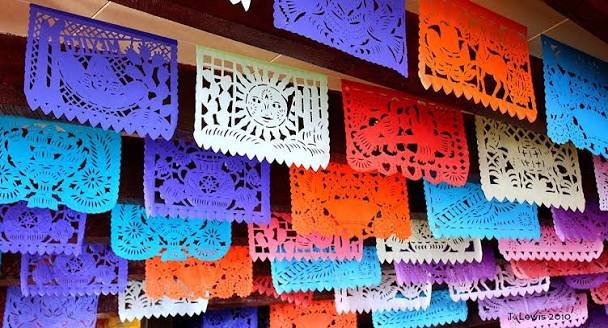
In a small town in central Mexico, families are still cutting colorful paper banners by hammer and chisel ahead of the Day of the Dead.
Every year in the weeks before November 1, the streets, homes and altars of Mexico fill with rows of colorful cut-paper banners fluttering in the breeze. Many of them begin their journey in one small town in the state of Puebla.
San Salvador Huixcolotla is widely regarded as the birthplace of papel picado, the delicate tissue-paper decorations that have become one of the most recognizable symbols of the Day of the Dead. Of the town’s nearly 17,000 residents, about three-quarters work in making them, AFP reported.
While machines and mass-produced versions are now widely available, many artisans in Huixcolotla still make each design entirely by hand, in family workshops where the skill has been passed down for generations.
How Papel Picado Is Made by Hand
The process starts with a design drawn on a template. Artisans then stack as many as 50 sheets of tissue paper, known in Mexico as papel de China, and cut through all of them at once using a hammer and a set of chisels.
The chisels come in straight, curved and zigzag shapes. They are made in the town by a local craftsman known simply as “el señor de los fierros,” or the iron man.
Roberto Carlos, a 34-year-old artisan, said the work requires great care, since a single tear in a small detail can ruin a whole sheet. One of his designs features a skull wearing an elegant hat, cut into a stack of purple paper.
Once cut, the sheets are glued in alternating colors onto long cotton threads, about five meters each, to create the garlands that hang over streets and altars. The colors have grown over the years as customers have asked for more, from lime green and Mexican pink to royal blue, bougainvillea purple and the bright orange of the marigold, the flower most closely linked to the Day of the Dead.
Orders come in from across Mexico, as well as from Spain, the United States, Italy, South Korea and Japan. Customers also order custom designs year-round, including company logos and messages for baptisms and quinceañeras, the celebration of a girl’s 15th birthday. Demand peaks just before the Day of the Dead, when markets buy hundreds of thousands of sheets.
The History of Papel Picado in Mexico
The craft has roots in pre-Hispanic Mexico, when people cut simple patterns into amate, a paper made from tree bark. Tissue paper arrived around 1850, sold at the company stores on large estates where farm workers bought goods against their wages. Artisans in Huixcolotla began cutting it into decorative designs, later switching from scissors to chisels for more detail.
In the 1930s, local artisan José María García opened the town’s first shop dedicated to papel picado, and the craft spread to other parts of Mexico in the decades that followed. In 1998, the Huixcolotla tradition was officially recognized as cultural heritage.
For more than a century, the tissue paper itself was imported from China. Today it is also produced in Huixcolotla, allowing the town to handle the whole process locally.
On Day of the Dead altars, known as ofrendas, papel picado represents air, one of four elements honored alongside earth, fire and water. The celebration, held on November 1 and 2, is a time when families remember relatives who have died. It is recognized by UNESCO as part of the Intangible Cultural Heritage of Humanity.