


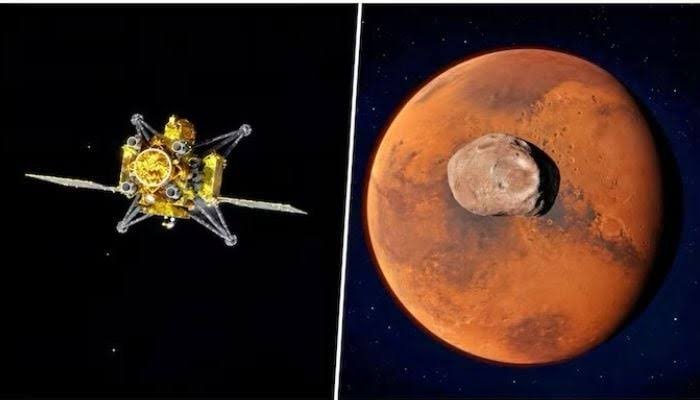
Japan’s MMX spacecraft is headed for Mars, where it will collect soil from the moon Phobos and return it to Earth in 2031.
Japan has launched a spacecraft on a mission no country has attempted before: landing on one of Mars’s moons, collecting samples from its surface and bringing them back to Earth.
The Martian Moons eXploration (MMX) spacecraft lifted off on an H3 rocket from the Tanegashima Space Center in southern Japan at 4:41am local time on October 20. The Japan Aerospace Exploration Agency (JAXA) later confirmed that the spacecraft had separated from the rocket’s upper stage and was on course for Mars.
Its target is Phobos, the larger of Mars’s two moons. Scientists hope the samples will help answer a question that has puzzled them for decades. Where Mars’s moons came from? The findings could also offer clues about how the early solar system formed and how water and other building blocks of life were delivered to planets such as Earth.
How Japan’s MMX Mission to Phobos Will Work
The spacecraft is expected to take about a year to reach Mars, entering orbit around the planet in August 2027 and moving into orbit around Phobos the following month, according to the European Space Agency, one of the mission’s partners.
In early 2029, MMX will release a small rover named IDEFIX onto Phobos. Built by the French and German space agencies, CNES and DLR, the 25-kilogram rover will study the moon’s surface and help identify a safe spot for the main spacecraft to land. Because Phobos has very weak gravity, the rover would weigh only about 15 grams there.
The spacecraft is then scheduled to touch down on Phobos in 2030 to collect at least 10 grams of material. It carries two sampling tools: one that uses a puff of gas to gather loose surface soil, and a coring device designed to reach material more than two centimeters below the surface.
Before heading home, MMX will also make several close flybys of Deimos, Mars’s smaller moon. A return capsule carrying the samples is expected to land in Australia in 2031, before being taken to Japan for analysis.
The spacecraft carries a range of scientific instruments, including cameras, a laser altimeter and spectrometers to study the moons’ minerals and chemistry. NASA has contributed a gamma-ray and neutron spectrometer, while ESA is providing deep space communications support. A high-resolution 8K camera developed with Japanese broadcaster NHK will also capture images of Mars.
Why Phobos Matters for Understanding the Solar System
Phobos is a small, irregularly shaped moon about 22 kilometers across that orbits roughly 6,000 kilometers above the Martian surface, closer to its planet than any other known moon in the solar system.
There are two main theories about its origin. One suggests Phobos and Deimos are asteroids that were captured by Mars’s gravity. The other suggests they formed from debris thrown into space after a large object struck Mars. Studying samples directly in a laboratory could help scientists settle the debate.
“The data and samples returned by MMX are a window to study the evolution of Mars and the Solar System,” said Elliot Sefton-Nash, ESA’s MMX project scientist.
The mission builds on Japan’s track record in sample return. Its Hayabusa spacecraft brought back particles from the asteroid Itokawa in 2010, and Hayabusa2 returned samples from the asteroid Ryugu in 2020. MMX was originally scheduled to launch in 2024 before being moved to 2026.