


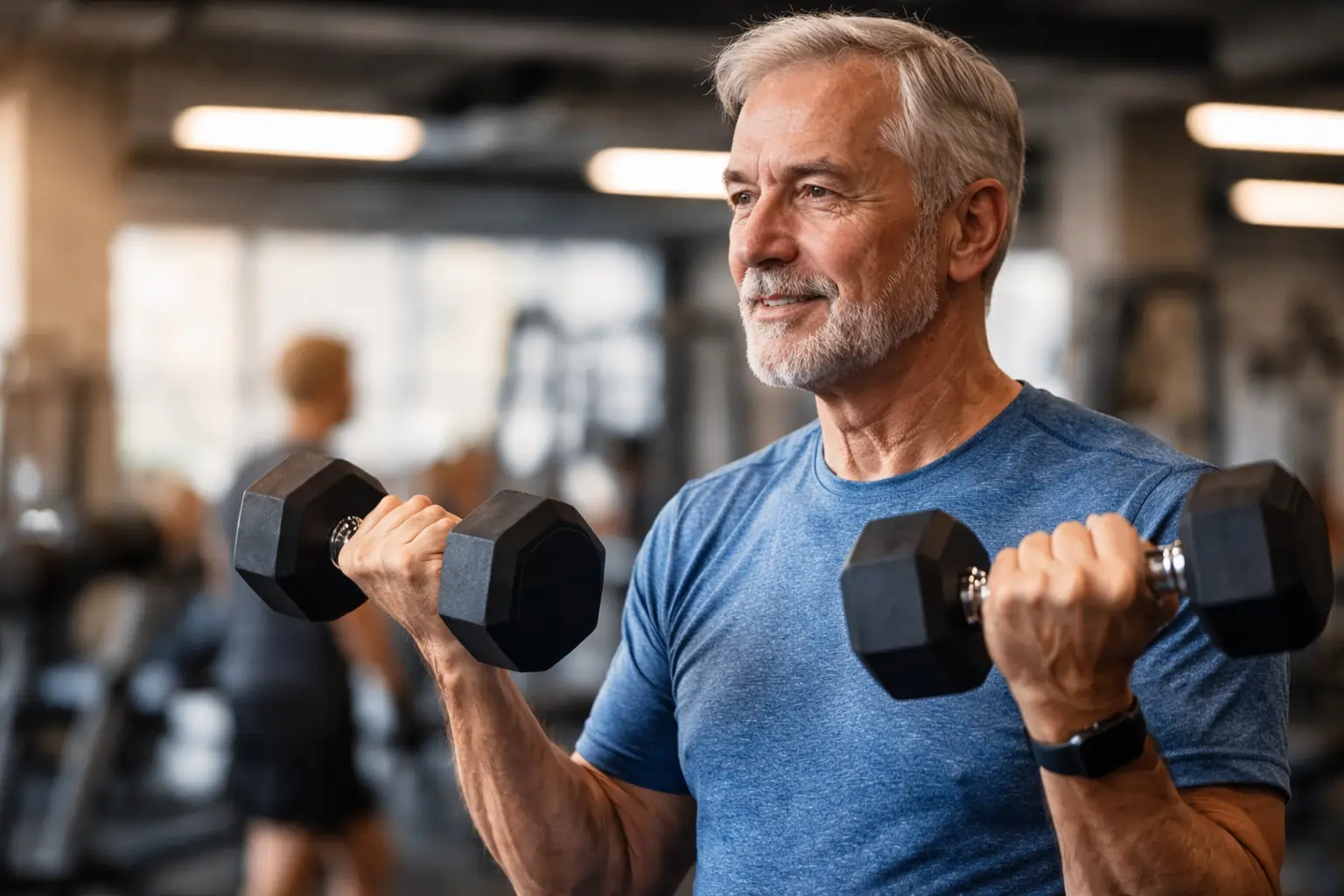

A new study published in GeroScience has found that resistance training can slow down biological brain aging in healthy older adults. The research used computational models called brain clocks to measure whole-brain health before and after a year-long exercise program, and found that participants who lifted weights had brains that appeared 1.4 to 2.3 years younger than those who did not exercise.
Brain clocks are mathematical tools that analyze functional MRI scans to estimate a person’s biological brain age based on patterns of neural activity. If the estimated age falls below a person’s actual age, it indicates the brain is aging at a slower rate. Researchers trained the brain clock model using resting-state fMRI data from 2,433 healthy adults before applying it to the study group.
The study enrolled 309 healthy adults between 62 and 70 years old. Participants were randomly assigned to one of three groups. The first group completed heavy resistance training, attending three supervised weightlifting sessions at a training center each week for a full year. The second group followed a moderate-intensity program consisting of one supervised session and two unsupervised home workouts per week. The third group served as a non-exercise control and continued their normal daily routines. Brain scans and physical fitness tests were conducted at the start, after one year, and again at the two-year mark.
What the Brain Scans Showed After a Year of Weightlifting
After the one-year program, both the heavy and moderate training groups showed significant reductions in biological brain age compared to the control group, which showed no meaningful change. The reduction ranged from 1.4 to 2.3 years across the two exercise groups. These younger brain ages held at the two-year follow-up, suggesting the effects were not short-lived.
In the heavy training group, brain scans also showed increased connectivity between prefrontal regions compared to the control group. The prefrontal cortex handles functions including planning, attention, and decision-making.
Crucially, the anti-aging effects were not confined to one specific brain network. Researchers tested individual systems, including those controlling movement and vision, and found that the changes were distributed across the whole brain. This suggests resistance training influences brain health through broad systemic mechanisms rather than targeting isolated regions.
Lead researcher Agustin Ibanez, a professor at the Global Brain Health Institute and director of the Latin American Brain Health Institute at Universidad Adolfo Ibanez, noted that most previous exercise studies looked at specific isolated brain areas and produced inconsistent results. This study used brain clocks to assess the whole brain within a randomized controlled trial, making it one of the more methodologically rigorous examinations of resistance training’s neurological effects to date.
The researchers also found a modest link between improved leg strength and reduced brain age, specifically in the moderate-intensity group. This association did not appear in the heavy training group, which the researchers attributed to a possible ceiling effect, meaning more intense training does not always produce proportionally larger brain benefits.
Limits of the Resistance Training Brain Health Study
The study has several limitations the researchers themselves flagged. The entire cohort consisted of healthy older adults living in a high-income European country, which limits how broadly the results apply to people with existing health conditions or those from different socioeconomic backgrounds.
Brain age is also a probabilistic biomarker rather than a literal measure of aging. It reflects patterns in brain connectivity and health, not a precise count of biological years reversed. Ibanez described the findings as evidence of improved brain resilience rather than a literal reversal of aging.
The study does not establish exactly which biological mechanisms connect resistance training to whole-brain changes, though researchers noted that vascular, metabolic, and inflammatory processes are likely involved. Future research will need to clarify how these improvements translate to real-world protection against memory loss and cognitive decline over longer time horizons, and whether the findings hold across more diverse populations.
The study was authored by Raul Gonzalez-Gomez, Naiara Demnitz, Carlos Coronel, Anne Theil Gates, Michael Kjaer, Hartwig Siebner, Carl-Johan Boraxbekk, and Agustin Ibanez, and published under the title “Randomized controlled trial of resistance exercise and brain aging clocks” in GeroScience.