

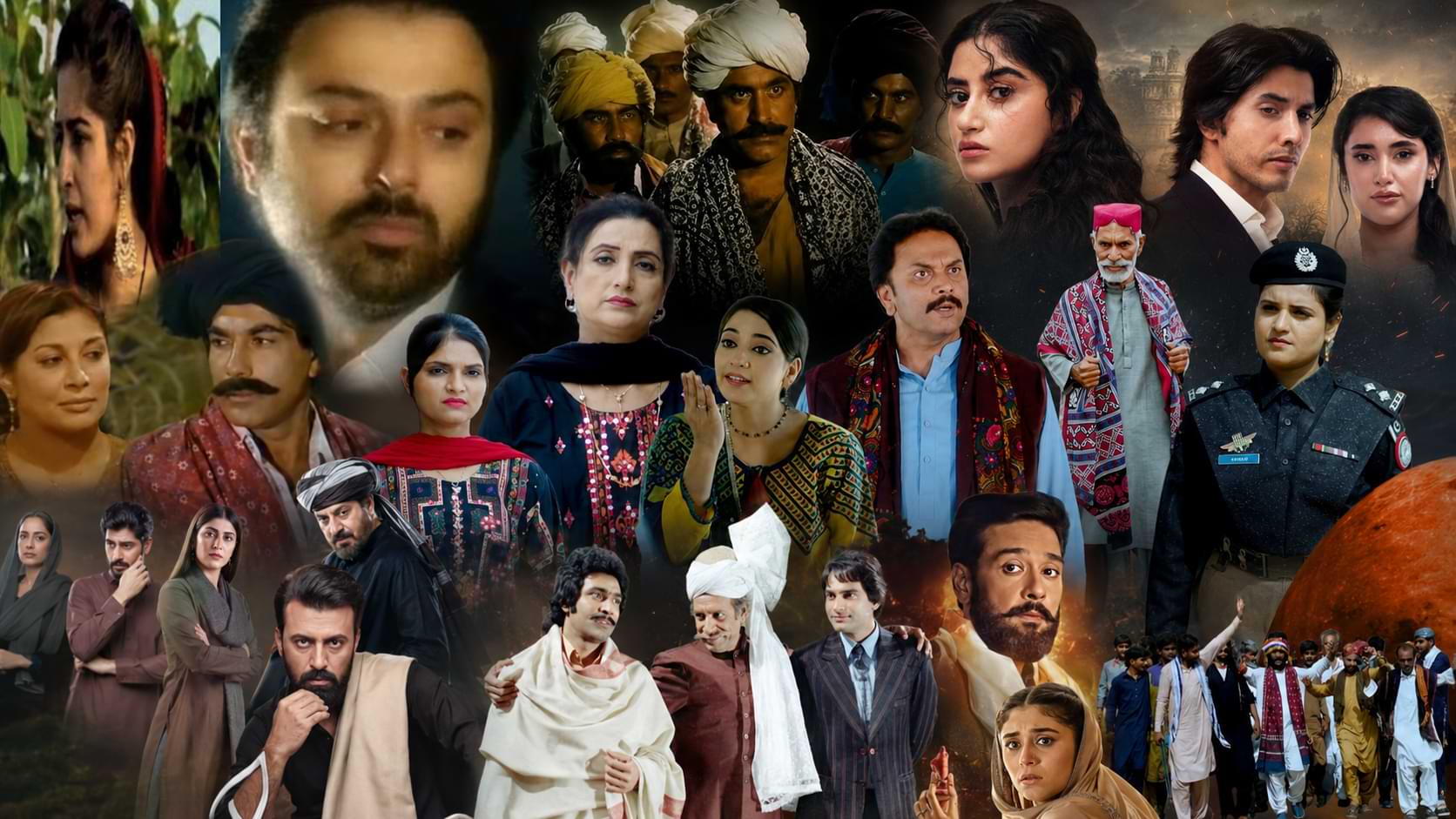
HUM TV’s Zanjeerain is currently winning the TRP battle with its captivating plot that ventures into the realm of rural drama. Not only is this genre something that Pakistan Television gave to the world, but it has also helped drama writers and directors show the good, bad, and ugly sides of a system that still rules the country’s rural areas.
Like Zanjeerain, many other plays have explored the complex interplay among power, tradition, and family structures, impressing viewers with their bold storytelling. It arrives at a time when Pakistani audiences are once again engaging with stories rooted in rural and tribal realities.
Tribal and feudal dramas have long defined Pakistani television. These stories often center on honor, revenge, land disputes, forced marriages, and generational conflict. They portray societies governed by unwritten rules, where personal freedom is often sacrificed for collective pride. Beyond entertainment, these dramas reflect social realities that persist across the country.
Let’s take a look at a few such plays that have managed to stay relevant, sadly, with the passage of time, but not before unmasking the evils that are part and parcel of the society we live in.
Waris (1979 – 1980)
Aired at a time when the country was getting used to General Zia ul Haq’s Martial Law, Amjad Islam Amjad’s screenplay was brilliantly adapted by Ghazanfar Ali and Nusrat Thakur. It is said that the play was so popular that even the country’s President praised it for tackling feudalism in a progressive manner and awarded the cast and crew medals after the play ended.
When I once spoke to Amjad Islam Amjad about the creative process behind the play, he said he had always wanted to incorporate the structure of an English novel into a Pakistani play, and Waris gave him that chance. The result was a play in which, as an angry young man searched for his dead brother’s murderer, his employer and the village patriarch stood tall against development.
The story doesn’t end there; the patriarch’s eldest surviving son wants his daughter to marry another young man who has no clue that he is also the patriarch’s grandson, the son of the elder son who passed away, while the patriarch’s other heirs are fighting among themselves for their rights. And while all this is going on, there is a treasure to be found, the location of which is known only to a man in the patriarch’s basement.
Even after 50 years, the play is considered modern and realistic, largely due to Mehboob Alam’s performance as Chaudry Hashmat, Abid Ali as the angry young man, Shujaat Hashmi as the mysterious friend, and the performances of Uzma Gillani, Munawwar Saeed, Agha Sikandar, Firdous Jamal, Samina Ahmed, Aurangzeb Leghari, and others in well-suited roles. Not only did it depict a world where those in power use fear and manipulation to control others, but it also highlighted the key figures who seek to hinder progress.
Deewaren (1983)
PTV Karachi wasn’t far behind, responding to Waris with Deewaren, which tackled issues closer to home. Written by Abdul Qadir Junejo and directed by Haroon Rind, the drama was first aired in the Sindhi language as Rani Ji Kahani and became so popular that it was remade in Urdu for a pan-Pakistani audience.
Not only did it explore family rivalries and the social structures that sustain conflict over the years, but it also examined how disagreements over land, honor, and power can divide families and communities in Sindh. Its discussion of the emotional toll on those involved set a benchmark for future playwrights and directors.
Featuring a cast of senior actors like Saqi, Qurban Jilani, and Noor Mohammad Lashari, as well as junior actors who went on to make a name for themselves, like Sakina Samo, Mansoor Baloch, Fareed Nawaz Baloch, and Anwar Solangi, this play helped the issues behind rural families through its strong writing, performances, and realistic portrayal of power dynamics.
Jungle (1986)
Director Haroon Rind returned with another drama that followed the same structure, but this time it was written by Noor ul Huda Shah, who later wrote Tapish, Hawa Ki Beti, and Marvi. The serial examined the position of women in feudal society and how practices such as marrying them to the Quran to prevent the division of family property destroyed the family fabric.
Not only do many of the cast members of Deewaren return to this drama in other roles, but Neelma Hasan, Ismail Shah, Gulab Chandio, and Kehkashan Awan also get a chance to showcase their skills opposite Usman Peerzada, Shafi Mohammad Shah, Mehmood Siddiqi, Subhani Ba Yunus, and Salahuddin Tunio. The show remains popular today, as it was one of the first dramas to expose how power structures are maintained through tradition.
Dasht (1993)
There are good dramas, and then there are great dramas. Dasht was one of those who fell in the latter category. Aired in 1993 on Network Television Marketing (NTM), the drama was written by Munnu Bhai, and produced by Abid Ali, who co-directed with F H Qureshi.
It was one of the first major dramas to tackle the tribal situation in Balochistan. Even though PTV had aired dramas in which Jamal Shah and Ayub Khoso played lone gunmen, those were primarily revenge sagas. Dasht was an intergenerational drama in which the deeds of one generation were carried over to the next. And when, amid all that, two beautiful souls, Balaaj and Shahtaaj (Naumaan Ijaz and Atiqa Odho, respectively), fall in love, hell would follow.
Call it whatever you like, whether a modern-day take on classic tragedies like Laila Majnoon, Shirin Farhad, or even Romeo and Juliet, it was a rage when it aired. Just imagine Naumaan Ijaz and Atiqa Odho thirty years ago, wearing traditional Baloch dresses and lip-syncing to songs that have since become part of pop culture, and you will get it.
The drama was shot entirely on location in Balochistan and featured Ayub Khoso, Fazila Qazi, Shaista Jabeen, Sabiha Khanum, Azra Aftab, Noor Mohammad Lashari, Rasheed Naz, and Asad Malik, along with Naumaan Ijaz, Atiqa Odho, and Abid Ali. It introduced a more psychological dimension to tribal storytelling and explored themes of obsession, revenge, and the emotional scars left by tradition.
Its setting and atmosphere reflected the realities its characters faced, and it was among the first dramas to feature a filmi background score, courtesy of Wajid Ali Nashad. The music complemented the film-style shoot, in which some shots were so far ahead of their time that they had to be studied to be believed. By questioning the glorification of pride- and honor-based conflicts, it left a lasting impression that has remained relevant for decades.
Chand Girhan (1994)
Chand Girhan is considered a stepping stone for Pakistan’s TV drama industry because it was the country’s biggest TV production and the first official drama produced by the first private TV channel, Shalimar Television Network (STN). Written by Asghar Nadeem Syed and directed by Tajdar Alam (some say it was Haider Imam Rizvi who ghost directed the play), it approached culture through emotional storytelling and personal conflicts.
The show focused on family honor, social expectations, and the silent suffering of women trapped in tradition. Like Waris and Asghar Nadeem Syed’s Pyaas before it, the story moved in multiple directions, keeping the audience guessing about what would happen in the end. Not only did it bring depth to familiar themes, but it also explored emotional oppression and societal pressures and introduced viewers to a dynamic car driven by Huma Nawab’s character, whose doors opened upward, much like Automan, which aired on the same channel.
Chand Girhan is still remembered for its story as much as for its star cast, especially Suhail Asghar’s Jahanian Shah, who drove everyone nuts because of the free rein his politician father gave him, and Sheema Kirmani, who played a Bengali woman stuck in Pakistan, looking for her husband. Shafi Mohammad Shah played the central character, who had a fiercely independent daughter, played by Huma Nawab, and Faryal Gauhar, a popular singer whom he kept as his second ‘wife’. The cast also includes Ayaz Naik, Shakeel, Qazi Wajid, Ruby Niazi, Sajida Syed, Tahira Wasti, Sheema Kirmani, Gulab Chandio, and Latif Kapadia in pivotal roles.
Mera Saaein (2011)
Naumaan Ijaz was at his menacing best as Malik Wajahat in Mera Sayeen, which gained popularity for its portrayal of arrogance and domestic oppression within a tribal household. Loosely based on Tehmina Durrani’s My Feudal Lord, the series featured Sunita Marshall, Savera Nadeem, Aamina Sheikh, and Saba Faisal in the star cast alongside Faisal Qureshi and Mohib Mirza.
The drama (and its sequel, Mera Sayeen 2, in which Fahad Mustafa played Malik Wajahat’s successor) highlighted the abuse often concealed by status and authority. While sometimes melodramatic, the Sameera Fazal-Babar Javed collaboration sparked conversations about women’s rights and the normalization of emotional and physical control in patriarchal societies.
Sang-e-Mar Mar (2016) and Sang-e-Maah (2022)
Under Saife Hasan’s brilliant direction, both Sang-e-Mar Mar and Sang-e-Maah carved out distinct identities. Both dramas revolve around tribal customs in northern Pakistan and are widely praised for their realism. First, Sang-e-Mar Mar, and later, Sang-e-Maah, achieved a level of authenticity rarely seen on television, largely because the writer, Mustafa Afridi, hails from the area and knows what’s acceptable and what’s not.
Both dramas, filmed six years apart, explored the effects of honor and patriarchy in tribal culture. They showed how outdated traditions can affect both men and women, often leading to tragedy and emotional isolation. They also addressed issues such as women’s rights, forced marriages, and toxic masculinity, and even questioned traditions that continue to shape communities.
As for the cast, the former featured Mikaal Zulfiqaar, Kubra Khan, Sania Saeed, and Naumaan Ijaz as the main actors, while the latter featured Atif Aslam, Zaviyar Naumaan, Kubra Khan, Sania Saeed, Samiya Mumtaz, and Naumaan Ijaz as the principal cast.
Jindo (2023)
Writer Qurban Ali Rao and director Anjum Shehzad’s Jindo was a one-of-a-kind drama that aired on the newly launched Green Entertainment. Featuring Humaima Malik as the lead – her first play in 12 years – the serial revolved around the rustic dunes and deserts of Pakistan, where a mysterious woman revolts against tribal patriarchy and those who benefited from it.
Add a landlord (Nazrul Hasan) who sleeps with young brides, his son (Gohar Rasheed), who is more lustful than his father, and a band of blind followers who would do anything for the landlord, and you have a drama that makes you want to take a stand against patriarchal elements of society.
What’s more impressive is that the drama centers on a female character who challenges the oppressive customs and patriarchal attitudes that govern her community. The show addresses issues such as women’s rights, social injustice, and the misuse of power by elites, and it is made memorable by the outstanding performances of Humaima Malik and Naeema Butt.
Khayee (2024)
Put Faysal Qureshi in any role, and he will blow your mind with his superlative performance. Add Durrefishan Saleem to the equation, along with a writer (Saqlain Abbas) who knows local customs and a director (Syed Wajahat Hussain) who excels at revenge sagas, and you get Khaie, a drama that single-handedly revived the revenge-driven tribal narrative with modern production values and cinematic scale.
Shot entirely in northern Pakistan, the show portrayed violence not merely as spectacle but as a destructive force that consumes families and communities alike. The story revolves around Zamdaa (Durrefishan), who is caught in the crossfire of a longstanding vendetta between two tribal families led by Darwesh Khan and Channar Khan. However, unknown to her in-laws, who married her against her wishes, she plots a methodical revenge, driven by grief and a thirst for vengeance.
In addition to Faysal Qureshi and Durrefishan, the drama featured Uzma Hassan, Laila Wasti, Osama Tahir, Shuja Asad, Mah-e-Nur Haider, Shamyl Khan, Saba Faisal, Javed Jamal, and Hina Khawaja Bayat. It was the final TV appearance of veteran film and TV actor Khalid Butt, who played the main antagonist so well that it shocked even his most ardent fans.
From Waris to Khaie and now Zanjeerain, rural storytelling continues to offer some of the most memorable and thought-provoking narratives on Pakistani television. Feudal and tribal stories are integral to both our lives and our dramas, and their enduring popularity is undeniable. The themes they explore, such as power, oppression, family loyalty, revenge, and the struggle for freedom, are universal, regardless of when the play is aired.
Zanjeerain is not the first play to tackle these issues and will definitely not be the last, but with its engrossing storyline, it has given a new lease of life to the genre that is nothing short of Pakistan’s gift to the world of film and TV.