Why Sar Kata Insaan still stands tall after 30 years!
Pakistan's cult horror classic Sar Kata Insaan proved 30 years ago that local cinema could do sci-fi, horror, and romance — all in one film.
Mar 14, 2026
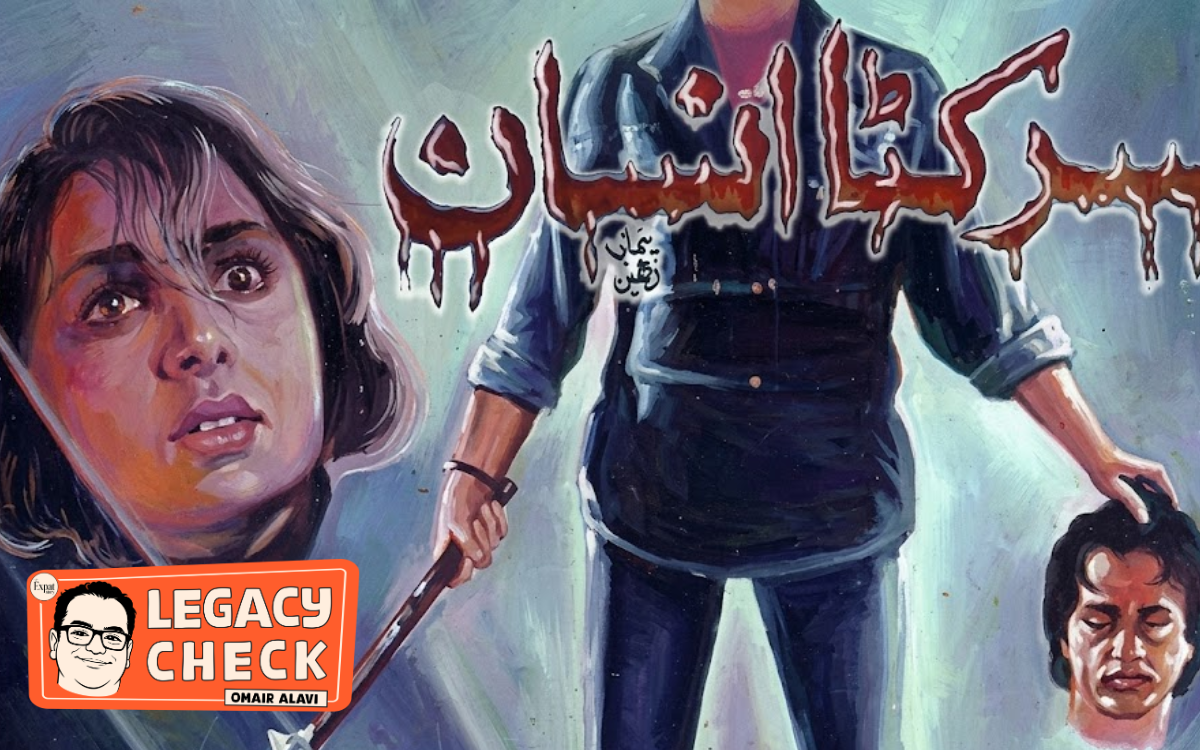
Before the Maddock Universe in Bollywood introduced Sar Kata as an antagonist, Pakistan’s film industry fielded its own version of Sar Kata Insaan, which not only helped revive the careers of all the actors associated with the film but also gave the audience a taste of science fiction, horror, and romance in one.
Sar Kata Insaan is one of the few films that have remained relevant long after their release. The cult horror classic, directed by Saeed Rizvi, was recently re-released in cinemas 30 years after its initial release and was appreciated for its daring concept, technical experimentation, and memorable performances.
At a time when the local industry was mostly producing formulaic romance or action dramas, Rizvi attempted something completely different: a science-fiction horror film that relied heavily on visual storytelling, unusual character work, and innovative special effects. The result was a film that not only succeeded at the box office but also became a talking point among cinema enthusiasts.
Decent execution ahead of its time
One of the biggest reasons behind the film’s longevity is its execution. Director Saeed Rizvi created elaborate sets rarely seen in Pakistani films of that era. He experimented with lighting techniques inspired by Hollywood productions and carefully designed the visual tone to complement the film’s eerie atmosphere.
Interestingly, the film was structured almost like a series of chapters — something that has become fashionable in modern cinema but was rarely attempted in Pakistan back then. This approach helped the narrative flow smoothly while maintaining suspense throughout.
Be it the scene where Ghulam Mohiuddin’s character is resting in the sewers or the Sholay-style village from where his character originated, everything stood out in such a way that many viewers refused to believe that the film was produced in Pakistan. That’s exactly the same thing that happened when Rizvi used to direct commercials – out of his 2500 TVCs, many were so out-of-the-box that they were considered to have been helmed by an international director.
Perfect casting
A film with such an unusual premise required actors who could bring conviction to their roles. Fortunately, the casting was spot-on. The film featured a powerful lineup, including Ghulam Mohiuddin, Babra Sharif, Izhar Qazi, and Qavi Khan, with Ghulam Mohiuddin playing the title character, and Izhar Qazi playing the cop who tries to solve the riddle behind the headless human.
Looking back, Ghulam Mohiuddin believes the film's uniqueness was evident from the beginning.
“Sar Kata Insaan was a very different film. The way we were making films in Pakistan at the time, it was certainly not routine. It was entirely the creation of Saeed Rizvi, who conceived the character and the story.”
He told The Expat Story that the role required a completely different approach to acting.
“It didn’t have the kind of dialogue or performances we see in ordinary films. Everything had to be done through facial expressions and body language.”
According to Mohiuddin, before shooting began, he spent hours discussing the character with the director.
“Before the shoot, Saeed and I sat down for a couple of hours to decide how it should be portrayed — a man cutting off his own head and carrying it in his hand. Because of the visual effects involved, every scene required careful planning.”
Songs in a horror film
Even though it was a horror film, Saeed Rizvi included two memorable songs. One was the quirky “Dum Dama Dum”, which featured characters like the Ninja Turtles and Pink Panther dancing alongside Babra Sharif — a sequence that still surprises viewers today.
The second song, “Main Subho Ka Tara”, played in the background and was edited almost like an advertisement film, highlighting Babra Sharif’s beauty with stylized visuals.
While ‘Dum Duma Dum’ was sung by Rizvi’s favorite TVC singer, Shabana Benjamin, and was the first song ever shot combining animation and live-action in a Pakistani film, it was the other song that took the award for being too spooky.
Rizvi once shared an interesting anecdote about how ‘Main Subho Ka Tara’ came into being. Initially, he approached several lyricists to write a song for his horror film, but most declined. They all thought that the idea of a headless man falling in love was not worth the risk, but the director persisted. Eventually, he went to legendary lyricist Qateel Shifai, who had previously worked with his father, Rafiq Rizvi.
At first, even Qateel Shifai was hesitant. But later, he accepted the challenge and asked Rizvi for a day to pen the lyrics. The result was a haunting song that went on to win a Nigar Award for Best Lyricist, while singer Tehseen Javed won the award for Best Singer.
Innovation at its best
Perhaps the most remarkable aspect of the film was its technical innovation. For Pakistani cinema of the 1990s, the special effects and visual tricks used in the film were groundbreaking. It was only the second film of Saeed Rizvi’s career after Shanee, but the way he handled the technical aspect was mind-blowing.
Ghulam Mohiuddin recalls how carefully every scene was crafted.
“Before every scene, we would discuss what should be done and what should not be done. Sometimes Saeed would suggest changes, and sometimes I would try something myself. When he liked it, he would say, ‘Yes, this is exactly what we want.’”
He says the experience was enjoyable precisely because it allowed him to experiment as an actor.
“When a performer gets a different kind of character, he enjoys it more. This project gave us that opportunity.”
A cult classic that lives on
Over the years, Sar Kata Insaan has gained cult status among fans of Pakistani cinema, which is why a remastered version of the film was released in September 2023. Not only did it seem dated, but it also resonated with the audiences who have no clue about the history of Pakistani films.
As Ghulam Mohiuddin puts it:
“People still remember it, which is a good thing, since we always thought it was ahead of its time. Often they say we should make more films like this.”
He adds that Rizvi had already shown his creative ambition earlier with the Shanee, and Sar Kata Insaan was another example of his willingness to experiment.
Thirty years on, the film remains a reminder that innovation and courage in storytelling can give a movie a life far beyond its time — something Pakistani cinema could always use more of.