

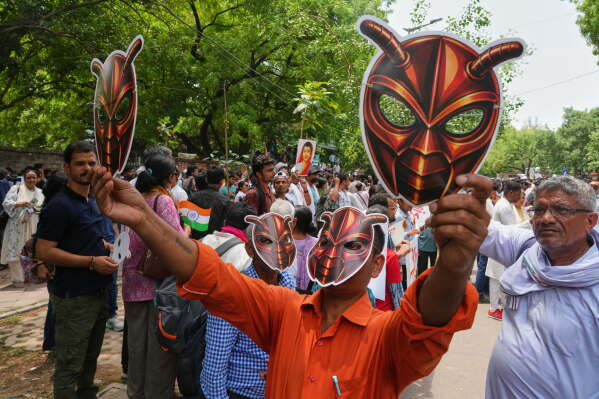
A satirical group called the Cockroach Janta Party has grown from an online joke into a youth-led protest in India.
It started as a joke. Now thousands are marching for it.
A satirical group called the Cockroach Janta Party drew young supporters onto the streets of New Delhi over the weekend, weeks after starting as an online joke. Hundreds gathered at a designated protest site near parliament on Saturday, and the crowd grew into the thousands once media and onlookers were counted, according to Al Jazeera. Some wore paper cockroach masks. The protest centered on alleged irregularities in recent national exams.
The group, known as the CJP, is not a registered political party and does not claim to be one. It calls itself a satirical youth movement. The name plays on Prime Minister Narendra Modi’s Bharatiya Janata Party, the BJP, which translates from Hindi as the Indian People’s Party. CJP keeps the “people’s party” and swaps in “cockroach.” It spread mostly through Instagram and similar platforms, and since launching in mid-May it has picked up millions of followers.
How the Cockroach Janta Party Started as a Meme
The whole thing traces back to a courtroom moment. During an open Supreme Court hearing in mid-May, India’s chief justice, Surya Kant, used the words “cockroaches” and “parasites” while describing people he said were attacking the system. Many took the remarks as aimed at unemployed young people, and the reaction online was immediate.
Kant later said his comments had been taken out of context. He explained that he meant people who entered the legal and media professions using fake degrees, not ordinary job seekers, and he added that he was proud of India’s youth. The hearing itself concerned a petition tied to senior advocate appointments and the misuse of professional credentials.
The clarification did little to cool things down. The comments spread fast online. Many young people took offense and they read the words as a swipe at unemployed youth. By then, the meme had taken on a life of its own.
CJP Founder Abhijeet Dipke and the Delhi Protest
The person who turned the backlash into a movement is Abhijeet Dipke, a 30-year-old from Chhatrapati Sambhajinagar, the city in Maharashtra once known as Aurangabad. He studied journalism in Pune before moving to the United States for a master’s in public relations, and he had earlier worked as a political communications strategist with the opposition Aam Aadmi Party.
Dipke says the idea took shape as he watched the anger build online. The day after the chief justice spoke, he posted a message on X wondering what would happen if all the so-called cockroaches joined forces, then set up a website and social accounts for the group. He pitched it as a home for anyone who felt dismissed for speaking up, and the response ran well past what he expected, pulling in students and young workers across several states.
He flew back to India from the US on Saturday to lead the protest himself, arriving to a heavy police presence and clearance to march. His central demand is the resignation of Union Education Minister Dharmendra Pradhan over a new on-screen exam-marking contract handed to a firm Dipke calls controversial. He has given a seven-day deadline and warned that the protests will go on if the minister stays in office.
What the Cockroach Janta Party Wants
The CJP laid out five core demands last month, and the list says a lot about how the group works. Some are serious. It calls for stronger protection of voting rights, more accountability from powerful institutions, and an overhaul of how exams, recruitment, and education are run. It also presses for greater representation for women in government.
Others are openly tongue in cheek. The group has called for free WiFi for everyone, afternoon naps protected by law, weekly rant sessions in parliament, and official recognition of laziness as a lifestyle. Its own slogan plays along, billing the CJP as a voice for the lazy and unemployed.
The mix is the whole point. The jokes get people to share, while the message underneath focuses on jobs, fairness, and accountability. The group has named spokespeople, among them an investigative journalist and a filmmaker, who say the real demand is simply more accountability in the system.
There is a Gulf angle too. A large Indian community lives across the region, and exam leaks and hiring problems have frustrated students and their families for years. The group continues to organize both online and on the streets. For now, a cartoon cockroach has become a symbol for a section of India’s youth, and the story behind it points to wider questions about exams, employment and trust in institutions.
Stay tuned for more updates and news!