



Apple’s first foldable iPhone headlined a packed September event marking John Ternus’s debut as CEO.
The hype had been building for the better part of a year, and on September 9, 2026, Apple finally delivered. At its “Surprise and Shine” event at Apple Park in Cupertino, the company unveiled its first-ever foldable phone, the iPhone Duo, ending years of speculation about whether Apple would ever join a category its rivals had owned for half a decade. Foldables had long been the one major smartphone form factor Apple sat out, and the wait turned this reveal into one of the most anticipated launches in recent memory.
The event carried a second layer of significance. It was the first keynote led by new chief executive John Ternus, who stepped into the role at the start of the month after taking over from Tim Cook. Ternus teed up the day on his own account, posting the full lineup ahead of time: iPhone Duo, iPhone 18 Pro and iPhone 18 Pro Max, Apple Watch Series 12 and Apple Watch Ultra 4, AirPods 5, and a playful sign-off, “… and Joz,” teasing an appearance from marketing chief Greg Joswiak. Once on stage, Ternus saved the foldable for last, letting the rest of the lineup build toward it.
iPhone Duo foldable features, specs, and price
The iPhone Duo is the star of the show and Apple’s boldest hardware redesign in years. It ends years of “iPhone Fold” and “iPhone Ultra” rumors with a name almost nobody predicted, and it arrives as a genuinely new kind of iPhone rather than a bigger version of an existing one. The core features are:
- Two Super Retina XDR displays. A 7.6-inch inner display, the largest ever on an iPhone, roughly 50 percent larger than the iPhone 18 Pro Max. Closed, a 5.4-inch outer display delivers more than 90 percent of the screen area of an iPhone 18 Pro. Both share the same aspect ratio, so content scales cleanly between them.
- Nano-texture inner display. A matte finish that reduces glare and reflections and helps make the fold crease less noticeable. The screens support ProMotion, Always On, and up to 3,000 nits of peak outdoor brightness.
- A20 Pro chip with vapor-chamber cooling. The same processor as the iPhone 18 Pro, paired with a custom vapor chamber and dual-battery architecture, one cell per side.
- Grade 5 titanium build. A titanium frame and hinge cover, Ceramic Shield on the back and Ceramic Shield 2 on the front, and an IP68 rating rated to 6 meters for up to 30 minutes.
- 48MP Dual Fusion camera. A 48MP main lens and a 48MP ultra-wide. There is no dedicated telephoto, so zoom tops out at a 4x optical range and 10x digital, and it skips the variable aperture found on the iPhone 18 Pro.
- Folding-only camera tricks. Duo Preview lets your subject see themselves on the outer screen, Smart Take waits until everyone in a group shot is ready, Kid Cue plays animations to hold a child’s attention, and Duo FaceTime lets someone join a call from the outer display.
- Touch ID, not Face ID. Built into the side button and working whether the phone is open or closed, with Apple Watch unlock supported too.
- New C2 modem. Up to 50 percent faster than the C1X, with 5G mmWave in the US and up to 15 percent lower power draw.
- Dual-battery system. Rated up to 24 hours of typical use, with a 60W adapter reaching 50 percent in about 20 minutes, plus MagSafe and Qi2 at up to 25W.
- eSIM only worldwide. No physical SIM tray in any market, freeing internal space for battery.

The Duo measures 5.2 mm thick when open and 11.3 mm closed, and weighs 254 grams. It comes in two colors, Star White and Night Sky, with storage up to 2TB. Pricing starts at $1,999 for the 256GB model. Pre-orders open October 16, with shipping from October 23. Apple Pencil (USB-C) support is coming later in the year.
iPhone 18 Pro and Pro Max: chip, camera, and pricing
The Pro line received a focused, spec-driven upgrade rather than a redesign. Key features include:
- 2-nanometer A20 Pro chip. Built to run cooler and more efficiently, connected directly to a next-generation vapor chamber tuned for sustained workloads like gaming and video.
- Variable-aperture 48MP main camera. The standout imaging feature, giving finer control over depth of field and low-light performance. This is the one major camera advantage the Pro holds over the Duo.
- Battery efficiency. Apple rates the iPhone 18 Pro for up to 36 hours of video playback, reaching 50 percent charge in around 15 minutes with a compatible adapter.
- New finishes across the lineup and full iOS 27 and Siri AI support.
Pricing moved up $100 over last year. The iPhone 18 Pro starts at $1,199 and the Pro Max at $1,299. Pre-orders begin Saturday, September 12, with availability from September 18. Apple did not announce a standard iPhone 18, keeping the spotlight on the Pro models and the foldable.
iPhone Duo vs iPhone 18 Pro Max: how they compare
The Duo costs roughly $700 more than the Pro Max at entry level, but it is not simply a higher-spec phone. The premium buys the folding display, the second screen, the titanium hinge, and the dual-battery design, not better cameras. In several areas the Pro Max is actually the stronger performer.
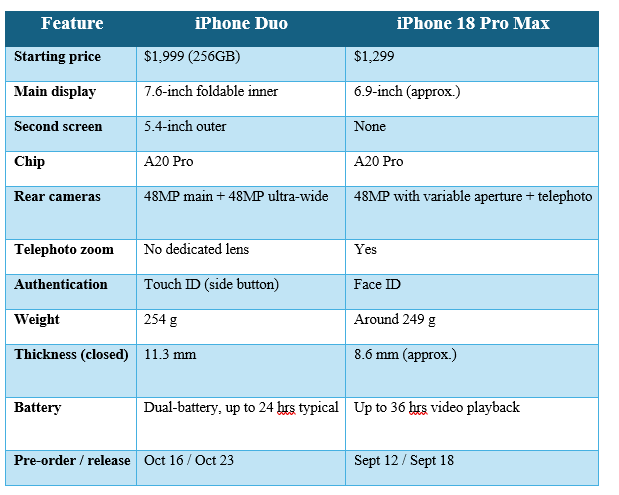
The simple way to read it: the iPhone 18 Pro Max prioritizes cameras, battery efficiency, and familiar one-handed use, while the iPhone Duo trades camera range and pocketability for a 7.6-inch folding workspace built for multitasking.
AirPods 5 and Apple Watch Series 12 features
The AirPods 5 brought a headline first to Apple’s open-fit earbuds. The main additions are:
- Active noise cancellation on the open-fit design for the first time, shifting automatically between blocking and letting in outside sound.
- On-stem volume control, another first for the standard AirPods.
- Siri AI support and Live Translation built in.
- Longer battery life than the previous generation.
The AirPods 5 are $129, or $149 with a wireless charging case, on sale September 18. On the wearable side, the Apple Watch Series 12 and Apple Watch Ultra 4 both leaned hard into fitness and health-tracking improvements, and both are available for pre-order immediately.
iOS 27 release date and Siri AI
Rounding out the announcements, iOS 27 ships Monday, September 14. The update arrives with Siri AI in beta, initially in English, though it will not launch in the European Union at first. On the Duo, iOS 27 adapts to the folding form with Split View multitasking, hands-free FaceTime and video, and a reimagined StandBy mode that works without charging. Between the software leap and a hardware lineup anchored by its first foldable, Apple used Ternus’s debut to signal that its next era is firmly underway.


