

The United Arab Emirates is widely recognized for its futuristic skylines, illuminated landmarks, and rapidly growing urban centers. Cities such as Dubai and Abu Dhabi are known for their bright lights, towering skyscrapers, and large-scale entertainment attractions that attract millions of visitors every year. However, away from the glow of these urban environments lies a remote desert location where the night sky remains largely untouched by artificial light.
Located in the Al Quaa Desert near Abu Dhabi, one of the darkest locations in the UAE is drawing attention for offering a rare opportunity to see the Milky Way with the naked eye. The site has become increasingly popular among astronomy enthusiasts, photographers, and residents looking to experience a clearer view of the night sky.
The growing interest in Al Quaa highlights a wider issue affecting many modern cities around the world: light pollution. As urban areas expand and artificial lighting becomes more widespread, visibility of stars and other celestial objects continues to decline. According to a scientific study published in 2016, approximately 99 percent of the UAE’s population is unable to view the Milky Way from where they live due to artificial light interference. The research described the phenomenon as a “luminous fog” created by human activity that obscures the natural night sky.
The UAE ranks among some of the most light-polluted countries globally, largely because a significant portion of its population resides in densely developed urban areas. Bright road networks, commercial districts, LED billboards, architectural lighting, and large-scale attractions contribute to the continuous glow visible across much of the country. Landmarks such as Dubai’s Burj Khalifa and other illuminated developments symbolize the nation’s rapid modernization but also contribute to reduced visibility of astronomical features.
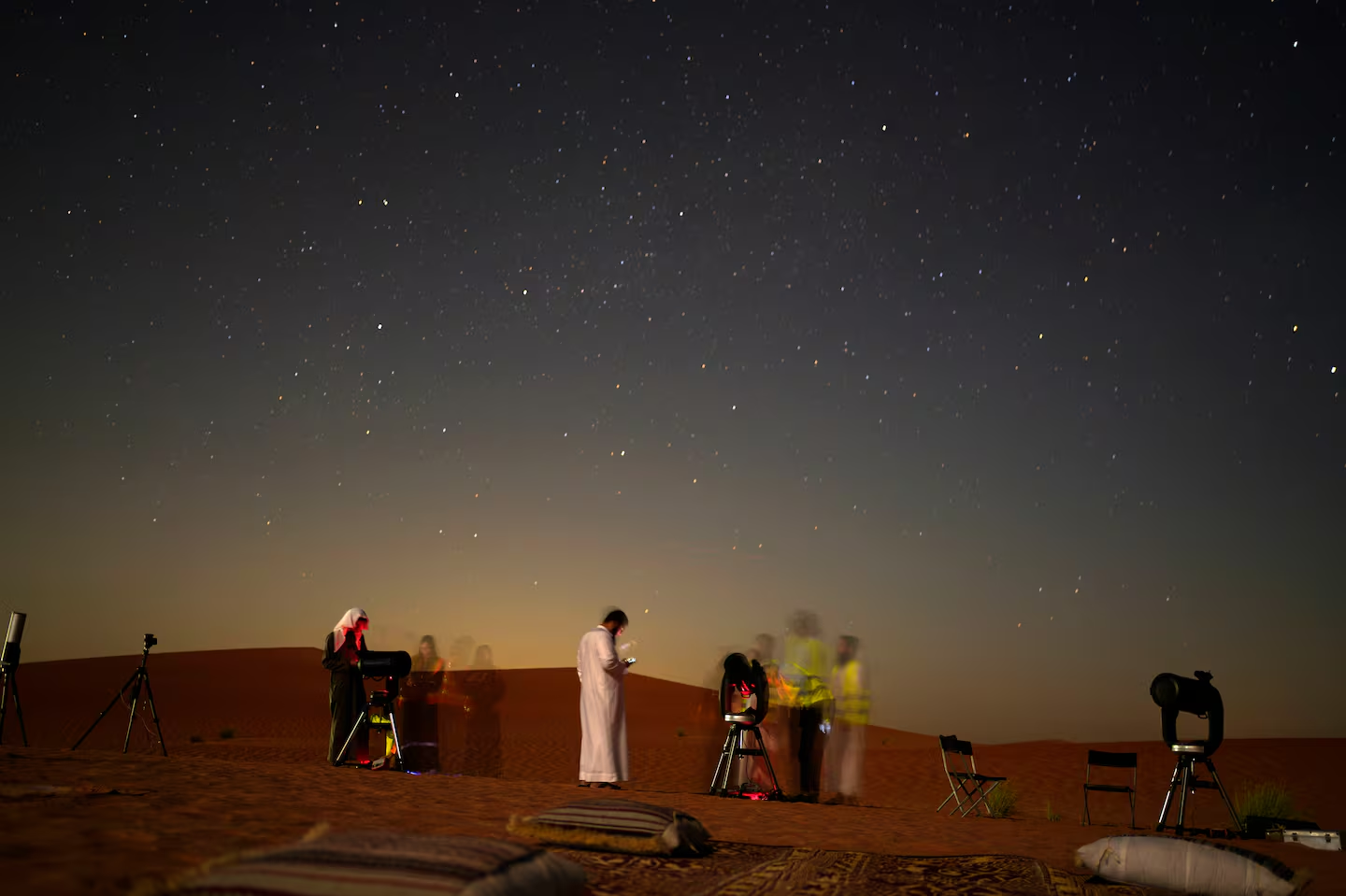
In contrast, Al Quaa Desert offers a significantly darker environment. Situated roughly 100 kilometers southeast of Abu Dhabi, the area is far enough from major urban centers to escape much of the surrounding light pollution. Once visitors move deeper into the desert, city lights gradually disappear, allowing the night sky to become more visible. Under favorable weather conditions and during moonless nights, the Milky Way can be observed stretching across the sky.
The location has become a popular destination for organized stargazing trips. Groups such as the Dubai Astronomy Group regularly arrange nighttime excursions to the desert, introducing participants to constellations, planets, meteors, and deep-sky objects. During these events, visitors often use telescopes and mobile phone photography techniques to capture long-exposure images of the galaxy. Astronomy guides also help attendees identify celestial formations that may otherwise be difficult to recognize.
Beyond its scientific appeal, the experience also carries cultural significance. For centuries, Bedouin communities across the Arabian Peninsula relied on the stars for navigation while traveling through vast desert landscapes. Before modern technology and GPS systems, celestial observations played a crucial role in guiding journeys across the region. Stargazing experiences in Al Quaa provide visitors with a glimpse into this historical relationship between people and the night sky.
The growing awareness of light pollution has also encouraged discussions about environmental and urban planning policies. In 2024, Abu Dhabi introduced a “Dark Sky Policy” aimed at reducing unnecessary light emissions and improving night-sky visibility across the emirate. The initiative focuses on responsible lighting practices while balancing safety, sustainability, and urban development requirements. The policy reflects broader international efforts to address light pollution and preserve access to natural night environments.
Astronomers note that darker skies do not only benefit stargazers. Reducing excessive artificial lighting can support wildlife, improve energy efficiency, and contribute to environmental conservation efforts. Studies have shown that many species rely on natural day-night cycles for migration, feeding, and reproduction. Limiting unnecessary light can therefore have ecological benefits in addition to improving astronomical visibility.
As the UAE continues to develop its cities and tourism infrastructure, locations such as Al Quaa Desert offer a reminder of a different side of the country. While the nation is often associated with innovation, architecture, and modern entertainment, the desert’s dark skies provide a connection to both nature and history. For many visitors, witnessing the Milky Way in a region known for its bright city lights serves as a rare and memorable experience.
The increasing popularity of Al Quaa demonstrates that even in one of the world’s most urbanized and illuminated regions, opportunities still exist to reconnect with the natural night sky. As awareness of light pollution grows, preserving these dark-sky locations may become increasingly important for future generations.