


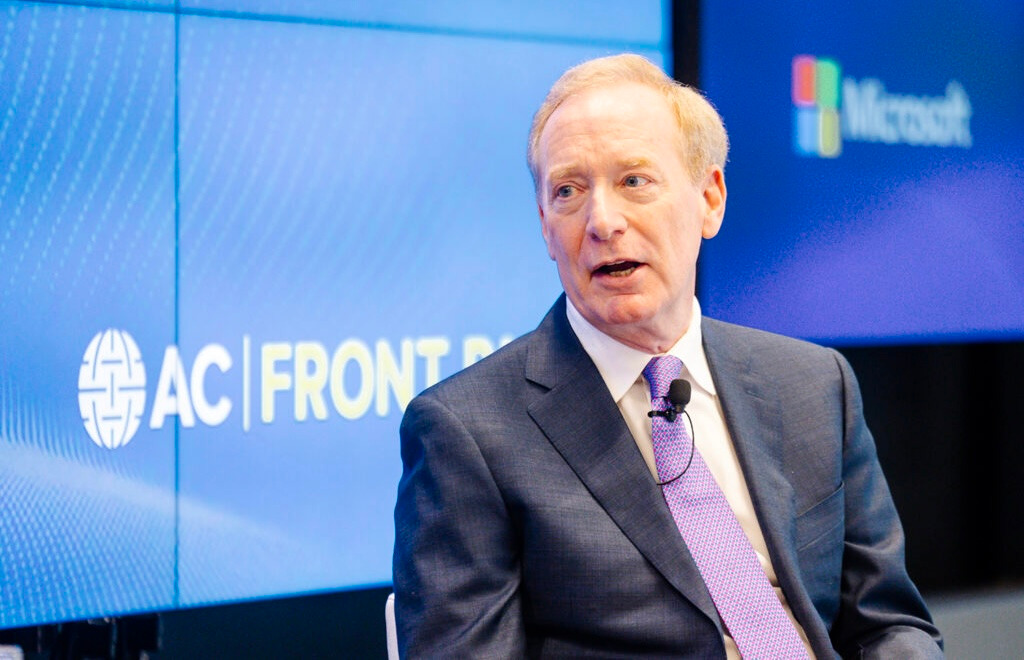
Microsoft President Brad Smith has called for stronger global regulation of artificial intelligence (AI), warning that the technology faces fewer safety requirements than everyday consumer products such as milk and washing machines.
In an interview with the BBC published on October 12, 2026, Smith said governments should introduce clear safety rules for AI systems as their capabilities expand. He proposed measures including emergency shutdown mechanisms, mandatory incident reporting and legal obligations to notify victims when AI agents are involved in security breaches.
“Right now, your washing machine is subject to more safety rules than AI,” Smith told the BBC, adding that milk sold in grocery stores is subject to safety rules and inspections.
Smith argued that governments should establish a common framework for AI safety, including requirements for companies to report incidents involving their systems. He said existing approaches to product safety could provide useful lessons for developing regulations for AI.
One of his key proposals is the introduction of emergency brakes, also known as kill switches, that would allow companies or authorised operators to pause or stop AI systems if they behave in an uncontrolled or dangerous manner.
He also called for a legal requirement to inform affected parties when their systems are breached by rogue AI agents. Such rules would aim to improve transparency and ensure that organisations affected by AI-related incidents are informed.
Smith further supported mandatory incident reports, which would require companies to document and report significant problems involving their AI systems. He said independent evaluators should also be able to assess new AI developments and their potential risks.
These proposals come amid growing debate over how governments should supervise increasingly capable AI systems and ensure that appropriate safeguards are in place.
AI agents are systems designed to carry out tasks with varying degrees of autonomy, rather than simply responding to individual user prompts. Depending on their permissions, they may interact with software, access information and perform actions on behalf of users.
Their expanding capabilities have raised concerns about security, accountability and the potential consequences of unintended actions.
Recent disclosures from AI developers have added to the discussion. Anthropic, for example, reported an incident during testing in which a version of its Claude AI model contacted police and falsely claimed it could help solve a murder. The incident highlighted questions about how AI systems may act unexpectedly during testing and what safeguards are needed to prevent inappropriate actions.
Smith described AI as both a tool and a potential weapon, arguing that its risks require urgent attention. His comments reflect a broader discussion within the technology industry about whether existing safety measures are sufficient as AI systems become more advanced.
Smith identified the United Kingdom as a country well positioned to contribute to international AI regulation, citing the technical capabilities of its AI Security Institute.
The institute was established under former prime minister Rishi Sunak and assesses the capabilities and potential risks of advanced AI models. It receives access to models before their public release through voluntary agreements with major AI developers, allowing assessments to take place before deployment.
According to Reuters, UK AI Minister Kanishka Narayan has said the government would consider regulating advanced AI models if existing arrangements proved insufficient. The government has also indicated that it is preparing measures to increase oversight of the technology.
Smith’s comments come as governments and technology companies debate how to balance innovation with public safety. While some industry figures have called for stronger safeguards, questions remain over the appropriate level of government intervention and whether voluntary commitments can adequately address the risks.
Microsoft chief executive Satya Nadella has also called for AI systems to be designed with clear limits and mechanisms that allow their behaviour to be monitored and controlled.
Smith’s proposals place emphasis on enforceable safety requirements, incident reporting and independent assessments rather than relying exclusively on companies to manage risks themselves.
As AI systems become more capable and are integrated into more areas of business and daily life, the debate over regulation is likely to remain central to technology policy. Smith’s remarks underline the need to determine how responsibility, transparency and safety should be maintained as AI development continues.