

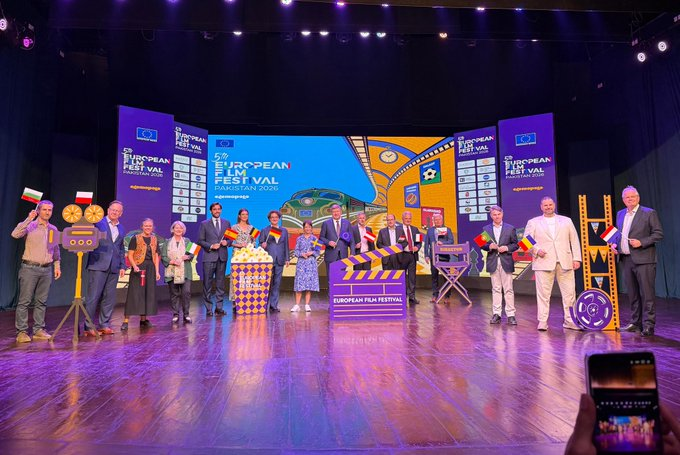
The fifth European Film Festival in Pakistan wrapped up in Hyderabad and Jamshoro, bringing international cinema to a university town in Sindh for the first time.
The curtain has come down on the fifth European Film Festival in Pakistan, and its final scenes played out somewhere many might not have expected. After stops in Islamabad and Sialkot, the traveling festival closed in Hyderabad and Jamshoro, in Pakistan’s southern province of Sindh, with two days of screenings, conversations, music and live performances on September 29 and 30.
The EU Delegation to Pakistan marked the end of the run with a message thanking audiences for joining the screenings and performances and for being part of the crowds that brought the festival to life.
The closing leg was hosted by the Shaheed Allah Buksh Soomro University of Art, Design and Heritage, which brought the festival to Jamshoro for the first time. It was also the first time the event had come to Sindh outside Karachi, which had previously been its main host city in the province.
European Film Festival Pakistan 2026 Travels to Three Cities
The 2026 edition ran from September 12 to 30 and was organized by the Delegation of the European Union to Pakistan, with curation by Olomopolo Media. It opened at the Pakistan National Council of the Arts in Islamabad on September 12 and 13, then moved to Sialkot on September 16 and 17, where screenings were held at Government College Women University and GRID by BLCK.
The festival has never been only about films. Alongside screenings, it offered a stand-up comedy and improv showcase, children’s segments with storytelling and music, creative mixers for filmmakers and content creators, and a live musical performance as part of the closing program.
The film lineup was broad. In Islamabad alone, audiences watched 16 European short films from countries including Ireland, Portugal, Spain, Belgium, Poland, Austria, the Netherlands, Ukraine and Bulgaria, along with a European feature film and 11 Pakistani short films. Austria, for example, was represented by the shorts “Im Kreis / Roundabout” by Zoe Schmidt and “Out of Sync” by Adam Baroud.
Since launching in Pakistan in 2021, the festival has traveled to Gilgit, Quetta, Peshawar, Gujrat, Faisalabad, Multan, Lahore, Karachi and Islamabad. With Sialkot and Hyderabad-Jamshoro added this year, it has now reached 11 cities across the country.
Why the European Film Festival Matters for Jamshoro and Hyderabad
Jamshoro is best known as an education hub. The small city just outside Hyderabad is home to several major institutions, including the University of Sindh, Mehran University of Engineering and Technology and the Liaquat University of Medical and Health Sciences, which together draw thousands of students from across Sindh.
What the area has rarely had is access to international cultural events of this kind. Film festivals, live performances and creative networking sessions in Pakistan tend to be concentrated in Karachi, Lahore and Islamabad, leaving students and young audiences in smaller cities with fewer chances to experience them firsthand. Bringing the festival to Jamshoro put European cinema, Pakistani independent films and conversations with creatives within reach of a young audience that would otherwise have had to travel to see them.
The festival’s emphasis on local voices made that connection stronger. This year’s edition featured stories told in many European languages alongside Pakistani films in five regional languages, a mix aimed at showing that local storytelling belongs in the same space as international cinema. For audiences in Sindh, that meant seeing regional narratives sit side by side with films from across Europe.
The festival describes its goals as expanding cinematic experiences, using film to connect cultures and creating spaces for people to come together. In a university town where such events are rare, those aims took on a practical meaning, with students, families and local creatives gathering for something that had not reached their city before.
With its fifth edition now complete, the festival has extended its reach well beyond Pakistan’s largest cities. Whether it returns to Jamshoro in future years remains to be seen, but its closing stop has already given the city a place on the country’s cultural map.