


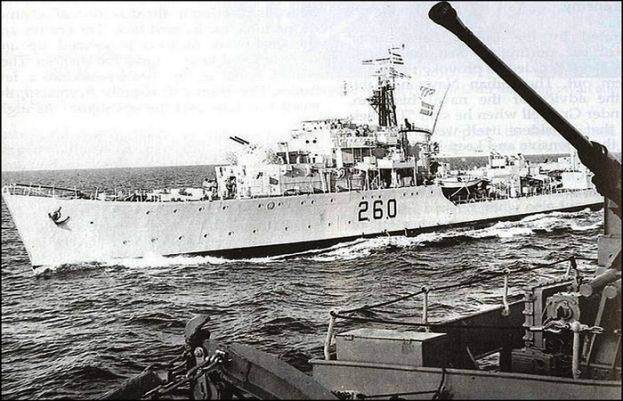
Operation Dwarka was a naval operation conducted by the Pakistan Navy during the 1965 India-Pakistan War. The operation took place on the night of 7–8 September 1965, when a flotilla of seven Pakistani warships approached the Indian coastal town of Dwarka on the Saurashtra coast of Gujarat and opened fire on coastal targets. In Pakistan, the operation is also known by its codename, Operation Somnath, and 8 September is commemorated as Pakistan Navy Day.
The operation came at a time when fighting between India and Pakistan had intensified on land and in the air. The naval forces of both countries had largely remained in defensive positions during the early stages of the war. Pakistan Navy planners nevertheless sought an opportunity to conduct an operation against the Indian coast while protecting Pakistan’s maritime approaches and the port of Karachi.
According to Pakistan Navy accounts, Dwarka was selected because of its coastal location and military and communications facilities. The operation had several stated objectives. These included drawing Indian naval forces out of Bombay (now Mumbai), attacking the radar installation at Dwarka, affecting Indian morale and diverting Indian air operations away from the northern areas. The presence of Pakistan Navy’s submarine PNS Ghazi was also incorporated into the broader operational plan.
The task group consisted of seven ships: the light cruiser PNS Babur, destroyers PNS Khaibar, PNS Jahangir, PNS Alamgir, PNS Shah Jahan and PNS Tippu Sultan, and the frigate PNS Badr. The force was commanded by Commodore S. M. Anwar, who was Commander Pakistan Fleet at the time. The ships sailed from the vicinity of Karachi toward Dwarka while maintaining operational security.
The bombardment began around midnight on 7–8 September. Pakistani naval vessels fired at targets in and around Dwarka before withdrawing from the area. Pakistani accounts describe the operation as a successful strike against shore installations. Indian official historical accounts, however, provide a different assessment of the damage. India’s official history of the 1965 war states that approximately 125 shells were fired and that most landed on the beach, while a railway rest room and a small section of railway track suffered damage.
One of the disputed aspects of the operation concerns the Dwarka radar installation. Pakistan Navy accounts state that the radar station and associated facilities were among the targets of the attack. Indian accounts, however, state that the radar was not destroyed. The Indian official history records that the bombardment caused relatively limited physical damage.
The operation did not develop into a major surface engagement between the two navies. Pakistani ships completed the bombardment and withdrew without suffering losses. Indian naval forces did not engage the Pakistani task group during the attack. India’s official history notes that several Indian naval vessels were undergoing maintenance or were positioned elsewhere, limiting the possibility of an immediate surface response.
Despite the limited physical damage reported by Indian sources, Operation Dwarka acquired considerable importance in Pakistan’s naval history. It demonstrated that the Pakistan Navy could conduct an offensive operation along the Indian coast during the war. The operation also became closely associated with Pakistan Navy Day, observed annually on 8 September to commemorate the service’s role in the 1965 war.
Operation Dwarka therefore occupies an important place in the naval history of the 1965 India-Pakistan War. While Pakistani and Indian accounts differ significantly over the extent of damage and the operation’s strategic impact, the basic historical record is clear: on the night of 7–8 September 1965, seven Pakistan Navy warships conducted a bombardment of Dwarka, after which the force withdrew without suffering losses. The event remains one of the most notable naval actions of the 1965 conflict.