


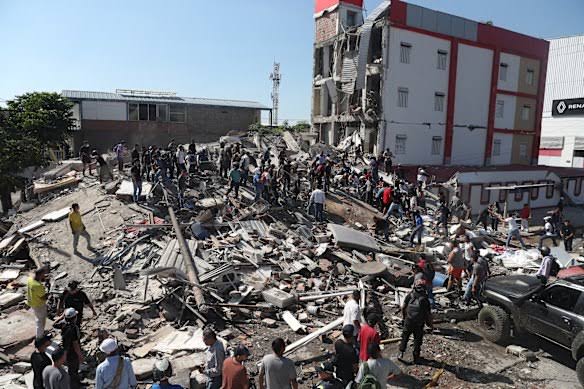
At least 29 people were killed after a powerful earthquake struck western Colombia and neighbouring parts of Latin America on Monday, collapsing buildings, damaging infrastructure and leaving residents trapped under rubble, local authorities said. Some other tallies compiled from regional officials have put the death toll considerably higher, as high as 47, and the number is expected to keep rising as rescue and assessment operations continue.
The Colombian Geological Service and the United States Geological Survey (USGS) measured the earthquake at magnitude 7.4, with its epicentre located near San José del Palmar in Colombia’s Chocó department, at a depth of around 107 kilometres. Colombian authorities initially recorded the tremor at magnitude 6.6. The USGS also reported a magnitude 5.0 aftershock less than an hour later, complicating rescue efforts and raising concerns about further structural collapse in already-damaged buildings.
The heaviest loss of life was reported in Pereira, a city in Colombia’s coffee-growing Eje Cafetero region, where Mayor Mauricio Salazar said 18 people had died. Two others were killed in nearby Manizales, according to Mayor Jorge Eduardo Rojas. Officials also reported deaths in Chocó department, Calima El Darién, Zarzal and Támesis, while authorities in the Valle del Cauca department — home to Cali, Colombia’s third-largest city — reported a further 27 deaths.
“The situation is critical,” Salazar said, as emergency teams responded to the devastation caused by the earthquake.
In Buenaventura, Colombia’s main Pacific port, one person was killed when a building collapsed, trapping several people inside. Meanwhile, rescue operations continued in Cali, where dozens of structures were reported to have collapsed.
Cali Mayor Alejandro Eder said emergency teams were responding to at least 12 critical sites and that around 25 structures had collapsed. Two people, including an elderly woman and a young girl, had already been rescued alive, while others remained trapped.
The earthquake was also felt in Ecuador, Panama and Venezuela. Colombian officials said there was no immediate threat of a tsunami despite the earthquake’s strength.
In Bogota, residents rushed into the streets as emergency sirens sounded, with some fleeing their homes in their night clothes. Mayor Carlos Galan said the capital appeared to have escaped major structural damage, although cracks were reported on the facades of some buildings.
The governor of Choco province reported injuries and serious damage to buildings in Quibdo, the provincial capital. Footage broadcast by Colombian media showed damaged and collapsed buildings in several cities, including Pereira and Manizales.
“There is no electricity or cell phone coverage. It was strong, really strong. Things fell in my house,” said Martha Estrada, a 66-year-old resident of the Eje Cafetero region.
The earthquake also disrupted air travel, with six small airports in western Colombia suspending operations in Pereira, Manizales, Quibdo, Armenia, Cartago and Buenaventura.
President Abelardo de la Espriella announced that he would travel to the affected region as rescue and assessment operations continued.
The disaster has renewed concerns over Colombia’s vulnerability to major earthquakes, with authorities now focused on locating survivors, assessing structural damage and restoring essential services in the worst-hit areas.