


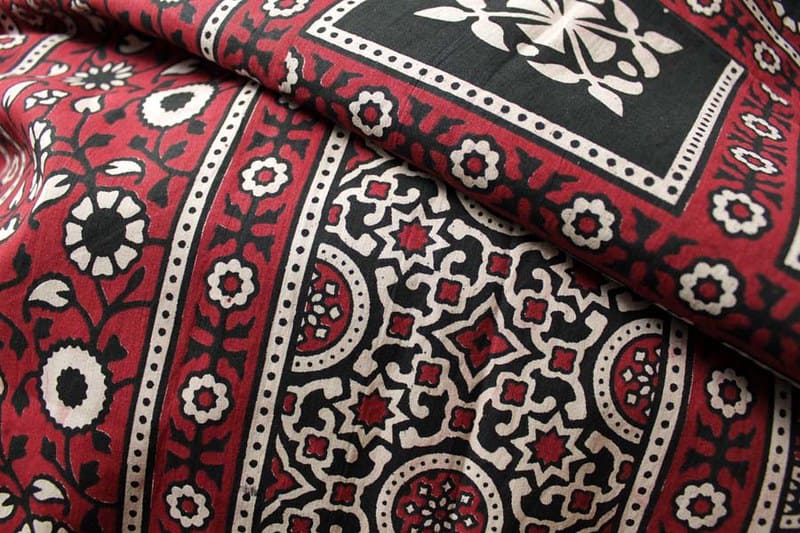
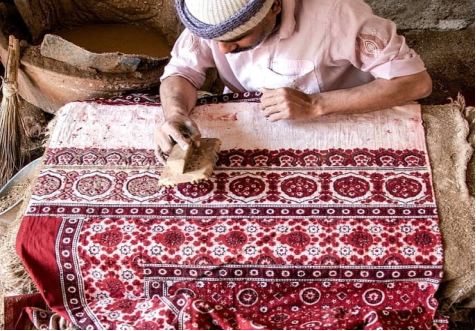
In the narrow lanes of Hala and Matiari, where the Indus River bends through Pakistan’s southern province of Sindh, artisans still wake before dawn to do something their ancestors were doing millennia ago: stamp cloth with hand-carved wooden blocks, dip it in vats of indigo, and lay it out to dry along the riverbank. The result is Ajrak — a deep blue, block-printed textile widely regarded as one of the oldest living craft traditions in South Asia, and one of the most evocative threads connecting modern Pakistan to the Indus Valley Civilization.A Statue That Anchors the Legend
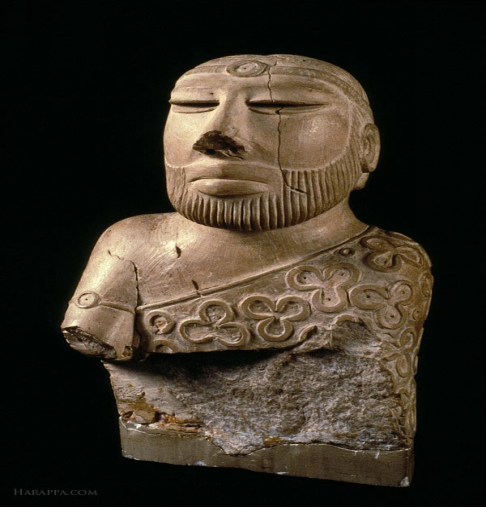
The case for Ajrak’s ancient pedigree rests, in large part, on a small steatite sculpture no taller than a hand span.Unearthed at Mohenjo-daro — the ruined Bronze Age metropolis in Sindh and one of the largest cities of the Indus Valley Civilization — the “Priest-King” figure is considered the most famous stone sculpture the civilization ever produced.
Dated to roughly 2000–1900 BCE, it depicts a bearded figure draped in a carved shawl bearing a trefoil pattern interspersed with circles, a motif some scholars interpret as three overlapping sun-disks representing the ancient deities of earth, water and sun.
Ajrak artisans have long recognized something more familiar in that carving: they call the same trefoil shape kakar, their traditional cloud motif, still stamped onto cloth today. Traces of red pigment recovered from the statue point to early use of madder root, the same plant-based dye that still produces Ajrak’s signature crimson.
Archaeologists are careful not to overstate the link. No unbroken chain of evidence connects the stone-carved cloak directly to the woven, block-printed textile made in Sindh today but it remains, by scholarly consensus, a striking visual echo. For the artisan families who have passed the craft down for generations, the resemblance is close enough to feel like inheritance.
Born of a River, Guarded by a Community
Ajrak’s survival is inseparable from the geography that produced it. The Indus River, which gave the ancient civilization its name, historically supplied the indigo and madder used in traditional dyeing, and its water remains central to the process today — cloth must be washed between each stage of printing before it can absorb the next layer of dye.
The craft has been preserved for centuries largely by Sindh’s Khatri artisan community. Producing a single authentic Ajrak involves numerous stages of washing, resist printing, natural dyeing and sun-drying, often stretching across several weeks. Every motif is hand-stamped using carved wooden blocks, and because the process resists exact repetition, no two pieces of Ajrak are ever truly identical.
A Name With Three Stories
Even the word “Ajrak” carries layered history, and no single origin story has won out.The most widely accepted theory traces it to the Arabic azrak, meaning “blue,” a nod to the indigo that dominates the cloth. A second theory points to the Sanskrit a-jharat — “that which never fades” — a fitting description for a dye process built to last. A third, more folkloric explanation traces the name to the Sindhi phrase aaj ke din rakh, or “keep it for today,” reflecting a belief that Ajrak was once considered too precious for everyday wear and reserved for special occasions.
Whichever theory is correct, all three converge on the same point: Ajrak was never treated as ordinary cloth. Sindh’s Muslim rulers are said to have formalized that status by awarding Ajrak as a mark of honor for loyal service or achievement — much as earlier courts bestowed ceremonial robes known as khilat. A textile made of dye and carved wood became, in effect, a currency of respect.
Cradle to Grave: A Textile for Every Occasion
For the people of Sindh, Ajrak is less a garment than a thread running through the entire span of life. It serves as a hammock for infants, headgear for young girls, a bridal accessory, a turban, a shawl, a bed cover, a tablecloth — and, at the end of life, part of funeral rites. Its geometric patterns, inspired by nature, the stars and the cosmos, are built on repetition and symmetry, echoing values of harmony and balance long embedded in Sindhi culture.
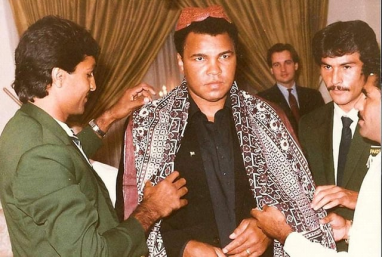
That devotion has its own annual stage. Every year on the first Sunday of December, Sindhis around the world mark Sindhi Cultural Day, decorating towns in Ajrak and exchanging it as a gift alongside the traditional Sindhi cap, or topi. The pairing has become so central to regional identity that it features in folk songs, and Pakistani officials and visiting dignitaries alike are frequently seen draped in Ajrak as a gesture of solidarity with Sindh.
The craft has occasionally spread beyond Pakistan’s borders — distinct regional variants developed in Kutch and Barmer, across the border in India — but its historical roots remain firmly planted in Sindh, where it continues to serve as one of the country’s most recognizable cultural emblems.
A Craft Under Pressure
For all its resilience, Ajrak now faces modern threats. Machine-printed imitations have flooded markets, undercutting artisans who still practice the labor-intensive hand method. Pollution along stretches of the Indus has raised concerns about the water traditionally used in dyeing. And fewer young people, artisans say, are willing to commit to a craft that demands years of apprenticeship before it becomes a reliable livelihood.
In response, artisan cooperatives and cultural bodies in Pakistan have pushed for Ajrak to receive Geographical Indication status — legal recognition that authentic Ajrak originates from Sindh, and nowhere else, similar to protections given to products like Champagne or Darjeeling tea.
Why It Matters
Few living cultures can point to even a visual echo of a Bronze Age civilization still worn in daily life. Sindh can. The Indus Valley Civilization’s great cities were abandoned roughly 3,500 years ago, but the trefoil pattern carved onto one of its most famous statues survives — reinterpreted, reinvented, but recognizably alive — on cloth still stamped by hand along the same river, in the same province, by the descendants of the same artisan families.
The unbroken line from Mohenjo-daro’s stone carving to today’s block-printed cotton, the two are bound by something harder to dismiss: a shared home, a shared river, and a shared refusal to let the pattern fade.


