


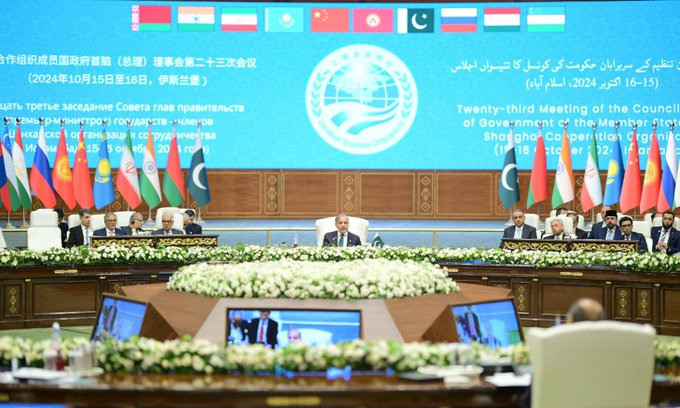
Pakistan is set to chair the SCO Business Council in 2027, a role that signals its growing economic weight inside a major Eurasian bloc.
Pakistan has secured a leadership role inside one of the world’s largest regional organizations. The Federation of Pakistan Chambers of Commerce and Industry, known as the FPCCI, announced that Pakistan will chair the Shanghai Cooperation Organization Business Council for the 2027 term. The decision was confirmed at the council’s board meeting in Bishkek, Kyrgyzstan, and it arrives just as Pakistan steps into wider leadership across the bloc.
To understand why this matters, it helps to know what the SCO is, how Pakistan reached this point, and what the chairmanship actually delivers.
The SCO Explained: From Shanghai Five to Global Bloc
The Shanghai Cooperation Organization began as the Shanghai Five, formed in 1996 by China, Russia, Kazakhstan, Kyrgyzstan, and Tajikistan to settle border disputes left over after the Soviet Union collapsed. When Uzbekistan joined in 2001, the group was renamed the SCO and widened its mission to cover politics, security, and economic cooperation.
It has grown into a heavyweight. According to Britannica, the SCO now includes ten members: China, Russia, Kazakhstan, Kyrgyzstan, Tajikistan, Uzbekistan, India, Pakistan, Iran, and Belarus. India and Pakistan joined in 2017, Iran in 2023, and Belarus in 2024. Together the bloc covers roughly 80 percent of the Eurasian landmass and about 40 percent of the world’s population, and as of 2021 it accounted for close to 20 percent of global GDP.
The SCO’s mandate centers on mutual trust, regional security, and economic cooperation. Its highest decision-making body is the Council of Heads of State, which meets once a year. The organization also runs a counterterrorism wing and the SCO Business Council, the private-sector arm that Pakistan is about to lead.
Pakistan’s SCO Journey: From Observer to Leader
Pakistan’s path into the SCO has been a long one. According to Pakistan’s Ministry of Foreign Affairs, the country became an observer in 2005 and was the first observer state to apply for full membership, in 2010. The Heads of State agreed in principle to admit Pakistan in 2015, and full membership followed in 2017 at the Astana summit.
Pakistan’s case for joining rested on geography and trade. The foreign ministry framed membership as a way to deepen energy and transport links with Central Asia and to position the country as a regional trade corridor. That same logic drives Pakistan’s approach today.
The role is now expanding quickly. Deputy Prime Minister and Foreign Minister Ishaq Dar has said Pakistan will assume the chairmanship of the SCO Council of Heads of State in September and will host next year’s summit. Dar described Pakistan’s involvement as advancing from observer to proactive full member since 2017, calling the leadership role a reflection of regional and global confidence in the country.
What Pakistan’s 2027 SCO Chairmanship Means
The Business Council chairmanship is the economic piece of this larger picture. The council is the private-sector arm of the bloc, bringing together national chambers of commerce and business leaders to promote trade, investment, and commercial cooperation. Pakistan will hold the chair for 2027, represented by the FPCCI.
The federation has signaled what it intends to do with the seat. FPCCI President Atif Ikram Sheikh, who also serves as deputy chairman of the SCO Business Council, said the role reflects member states’ confidence in Pakistan’s constructive role and gives the country’s business community a chance to help shape the council’s agenda. Vice President Tariq Khan Jadoon said Pakistan would push initiatives on trade facilitation, investment, and inclusive regional growth.
At the Bishkek meetings, the Pakistani delegation highlighted the country’s location linking South Asia, Central Asia, and the Middle East, and called for stronger connectivity in energy, information technology, logistics, and infrastructure. Pakistan has increasingly used the SCO platform to widen economic engagement with Central Asia, treating regional trade and investment as central to its economic diplomacy.
The practical impact will depend on follow-through. The SCO has long struggled to deepen economic cooperation, with proposals for a development bank and a free-trade zone stalling over competing member interests. A chairmanship gives Pakistan a platform to set priorities and convene business leaders, though turning an agenda into real trade volume takes time.
What stands out is the trajectory. In the span of two decades, Pakistan has moved from outside observer to a member holding leadership of both the bloc’s top political council and its business wing within the same window.