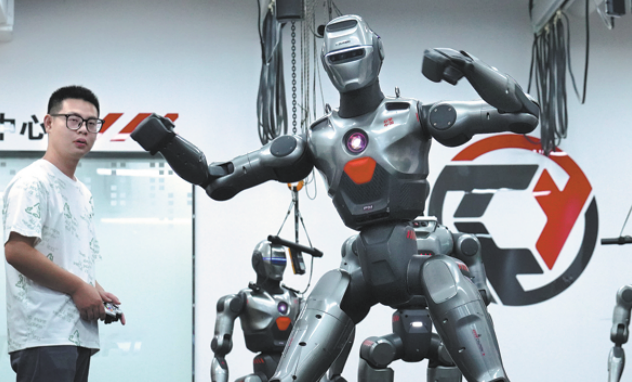
In Shenzhen, workers wear VR rigs to pilot humanoid robots in a fast-growing job that teaches machines how to move.
A new kind of job is spreading across Shenzhen, the city at the center of China’s hardware manufacturing. Workers put on virtual reality headsets, motion-tracking gear and arm controllers, then steer humanoid robots through ordinary tasks. The job has a simple name. They are called robot pilots, and Chinese firms are hiring them as fast as they can train them.
At IO-AI Tech, a Shenzhen company first reported on by Wired, operators control humanoid robots through a VR rig that maps a person’s movements onto the machine. When the worker lifts an arm, the robot lifts its arm too. Each movement is captured as data and uploaded to teach the machine how to copy human dexterity. The technique is known in the industry as teleoperation.
The work exists because of a shortage of training data. Humanoid robots need enormous amounts of movement information that combines what a machine sees with how it should act, and that kind of data is scarce. Without it, robots struggle with tasks as simple as folding a shirt or opening a door.
To close the gap, local governments and companies across China have funded dozens of training centers where this data gets collected. The tasks are repetitive by design. Trainers repeat the same simple actions hundreds of times a day, folding clothes, opening microwave doors, sorting packages and stacking blocks. Each repetition adds another data point to a growing library that a robot can later draw on to work on its own.
The process is described in similar terms across these facilities. At a training center in Wuhan’s Optics Valley, AI robot trainer Qu Qiongbin told Euronews that operators wear VR glasses and hold controllers so their left and right hands act as the robot’s arms. The captured postures are uploaded to the cloud, approved into a dataset, then sent back so the robot can learn from them.
The barrier to entry is low, which keeps the talent pool wide. Almost anyone can be taught to wear the rig and move, though the work calls for spatial awareness, focus and precision over long shifts. That accessibility is part of why the role is spreading across factories, warehouses and service settings.
China Robot Pilot Jobs Fuel a Fast-Growing Humanoid Sector
Teleoperation is not the only method companies are testing. Some Chinese tech firms are paying ordinary residents and factory workers to film their daily chores, since teleoperation is costly and time-consuming. As reported by Rest of World, a homeowner named Wang paid 149 yuan, about 22 dollars, for a three-hour session in which a robot from Shenzhen-based X Square Robot collected data inside his home while a human housekeeper did most of the actual work. Others, such as Shenzhen startup MindOn, are building systems trained on human motion data rather than robot-collected data.
The spending behind these efforts is large. Many of the biggest orders for humanoid robots have come from the public sector, including the training facilities themselves. UBTech Robotics, based in Shenzhen, sold 566 million yuan, around 80 million dollars, worth of humanoid robots to three data collection centers in Jiangxi, Guangxi and Sichuan. State-owned operator China Mobile placed 124 million yuan in orders with leading robot makers Unitree and AgiBot for use in research, customer service and security patrols.
China has named embodied intelligence a national priority and backed it with policy support. More than 150 humanoid companies now operate in the country, according to the National Development and Reform Commission. In November, the same agency issued a rare warning about the risk of a bubble forming in the humanoid robotics industry, pointing to the speed at which money and companies have entered the field. In Shenzhen and other hubs, building a smarter robot still depends on a person in a headset moving the machine through one task at a time.