



A neuroscientist’s claim that Gen Z may be less intelligent than previous generations has sparked debate.
Recently, during a hearing in the U.S. Senate, a neuroscientist made a claim that sparked debate about Gen Z’s cognitive abilities. According to neuroscientist Dr. Jared Cooney Horvath, the answer might be yes. But what does the scientific evidence really show, and why does this claim spark both interest and controversy?
Who Is the Neuroscientist and What Did He Claim?
Dr. Jared Cooney Horvath is a neuroscientist and former educator known for his work on how the brain learns and processes information. In January 2026 he appeared before the U.S. Senate Committee on Commerce, Science and Transportation, where he presented evidence suggesting that Gen Z has scored lower on measures of cognitive ability, including attention, memory, reading, mathematical reasoning, and general IQ, than the generation before them.

According to his testimony, this shift is historic: he said that since formal cognitive assessments began in the late 19th century, no generation has previously scored lower on these measures than the one before it. This, he argued, contradicts the long-observed trend of steadily rising intelligence test performance across generations.
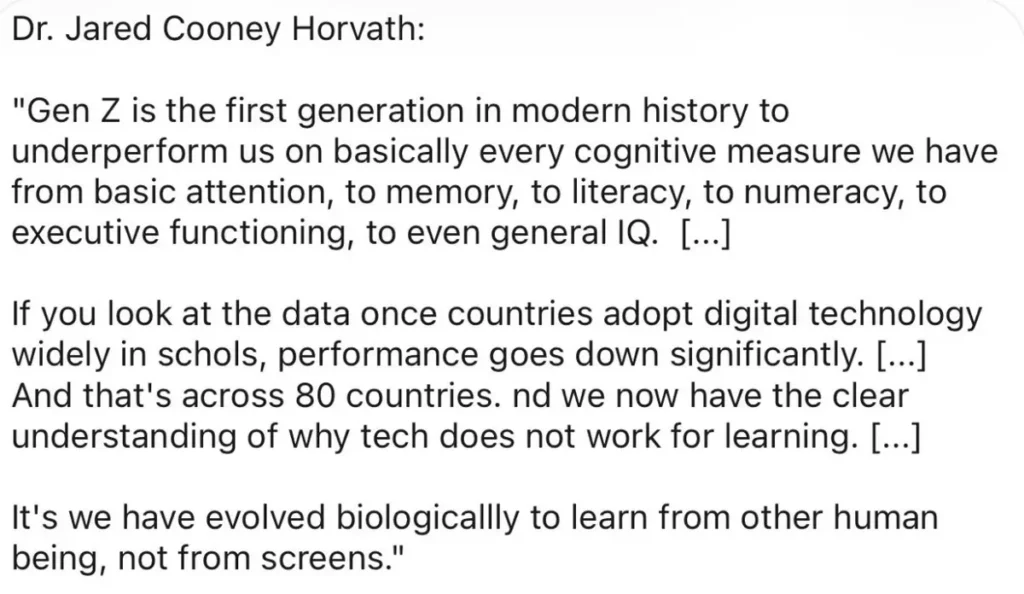
His explanation centers on a dramatic transformation in how young people experience learning and attention. He and other experts in the hearing proposed that the widespread use of screens and “educational technology” (EdTech) in classrooms and everyday life is undermining cognitive development. In his view, young brains are “wired” to learn best through deep focus, social interaction, and sustained reading, not short video clips, scrolling feeds, and fragmented tasks.
He said, “The human brain isn’t wired to learn from short video clips online and reading brief sentences summarising larger books and complex ideas.” Dr. Horvath explained in a media interview that the brain is naturally designed to learn through real-world interaction and focused study rather than constant screen use. He said, “A teenager’s half time of the day is spent staring at the screen.”
What Is the Historical Baseline – The Flynn Effect?
To understand why this claim caused such a stir, we need some context.
For much of the 20th century, psychologists observed a phenomenon known as the Flynn Effect, where average performance on intelligence tests rose generation after generation. Multiple countries saw consistent gains of about three IQ points per decade, driven by improvements in education, nutrition, healthcare and other environmental factors.
This trend suggested that, on average, each new generation was performing better on cognitive tests than the last.
Evidence of IQ Stagnation or Decline
In the past decade, however, studies in several countries have reported that IQ gains have slowed or even reversed. For example:
- Some research has shown that IQ scores in parts of Europe and the U.S. have leveled off or declined since the early 2000s.
- A large cognitive study from Northwestern University found that between 2006 and 2018, performance on multiple cognitive domains dropped rather than increased.
These trends are sometimes referred to as the Reverse Flynn Effect. Importantly, these studies do not conclusively link the changes to any single cause, and scientists debate how much of the change truly reflects intelligence versus differences in testing, environment, or motivation.
Technology and Cognitive Development
One core element of Dr. Horvath’s argument is that modern technology, screens, apps, short-form videos, and constant digital multitasking, reshapes how young people think:
- Critics of heavy screen use argue that short-attention tasks and rapid switching between apps can make sustained focus and deep reading more difficult.
- Research in cognitive neuroscience does indicate that constant interruptions and fragmented attention can affect memory and comprehension.
- Some studies link heavy digital media use to lower retention of information and reduced capacity for sustained concentration.
However, experts also stress that correlation does not imply causation, and that technology itself does not inherently reduce brainpower. Instead, how technology is used, for passive browsing versus active learning, may be the real variable.
Limitations of IQ and the Broader Nature of Intelligence
Crucially, intelligence is not a single, fixed trait, and IQ tests measure only certain kinds of cognitive ability:
- Traditional IQ metrics prioritize logic, memory and analytical reasoning.
- They do not capture creative thinking, digital literacy, emotional intelligence, social awareness, adaptability, or problem-solving within complex real-world contexts, areas where Gen Z frequently excels.
Indeed, other research outside of this debate shows that Gen Z, on average, attains higher levels of formal education than earlier generations, and often demonstrates strong digital skills, multitasking ability, and cultural fluency. These competencies are not fully captured by classic intelligence tests.
Generational Biases and the Narrative of “Decline”
Part of the discussion around Gen Z also intersects with a long historical pattern: older generations have often criticized younger ones for being less motivated, less disciplined, or less capable. This is not unique to the digital age.
Psychologists caution that generational comparisons can reflect cultural differences rather than real cognitive deficits. For instance, one generation’s strength in extended reading might be another’s strength in multimedia problem-solving.
A Complex Trend, Not a Simple Verdict
Dr. Jared Cooney Horvath’s testimony brought attention to an important conversation about how modern life, particularly technology and educational methods, interacts with developing minds. His claims are noteworthy because they challenge long-standing assumptions about generational cognitive progress and call for careful scientific exploration.
But it would be premature, and misleading, to conclude that Gen Z is inherently less intelligent than previous generations based solely on current IQ data and preliminary analyses. Intelligence is multifaceted, dynamic, and deeply shaped by social, educational and technological contexts.
What this debate does highlight is a critical need for continued research into how young people learn and think in an age of rapid technological change, and how societies can best support cognitive growth across all generations.