

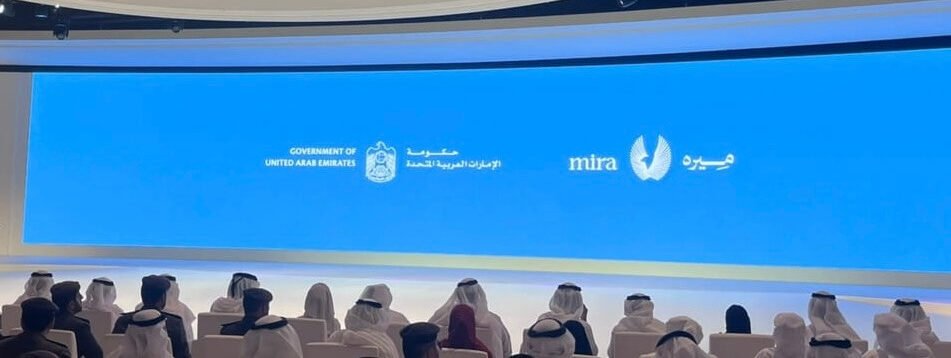
The United Arab Emirates has unveiled Mira, an artificial intelligence-powered personal assistant designed to simplify access to government services, allowing citizens, residents and business owners to complete various administrative transactions through a single conversation. The new platform is scheduled to become available to the public in March 2027, with additional services expected to be introduced throughout the year.
The announcement was made on November 23, 2026, during an event organised by the UAE Government at Expo City Dubai. Sheikh Mohammed bin Rashid Al Maktoum, Vice President and Prime Minister of the UAE and Ruler of Dubai, witnessed the launch alongside senior government officials.
Mira is designed to change how people interact with government departments by allowing users to describe their requirements in their own words rather than searching through multiple websites, applications and service portals. The assistant will guide users towards relevant services and, depending on the transaction, allow them to review information, confirm requests and complete procedures within the same conversation.
Mohammad bin Abdullah Al Gergawi, Minister of Cabinet Affairs and Chairman of the National Committee for the Agentic AI Project, said the initiative represents a new approach to government service delivery, where people can explain what they need without having to know which department handles the request or how the process works.
The initial rollout will focus on several essential areas, including identity, residency, passports, healthcare and education. These services will be integrated into a single platform to reduce the need for users to switch between different government channels.
In the identity and residency sector, Mira will assist citizens and residents with passport and Emirates ID renewals, newborn documentation and family residence permits. Users will also be able to check relevant information and complete renewal procedures through conversations with the assistant.
For businesses, Mira will support employment-related transactions, including issuing and renewing employee contracts, tracking contract expiry dates, making changes to employment details and processing work permits. Business owners will be able to review employee information, make necessary updates and pay applicable fees through the platform.
The assistant will also introduce services for industrial investors. These include renewing industrial registrations, applying for customs duty exemptions and obtaining In-Country Value certificates. The services will be brought together through an integrated process intended to simplify administrative requirements for businesses.
Healthcare is another major area included in Mira’s initial demonstrations. Patients will be able to describe their symptoms through a video conversation and answer questions to generate a structured summary for their doctor to review before an appointment.
Users will also be able to select medical specialties and healthcare facilities, view available appointment slots, and book, reschedule or cancel consultations through the assistant.
In education, Mira will provide students with information about universities, academic programmes and admission requirements. Prospective students will be able to compare available options, submit applications and monitor their application progress.
Parents will also be able to access information about their children’s academic performance, attendance, examination schedules and school activities. The platform is expected to provide alerts and school bus tracking information, bringing several education-related services together.
The launch of Mira forms part of the UAE’s broader strategy to incorporate agentic artificial intelligence into government operations. The country aims to deploy agentic AI across 50% of federal government sectors, services and operations within two years, under a framework announced in 2026.
Agentic AI refers to technology that can understand requests, coordinate tasks and take actions towards completing specific objectives rather than simply providing information or answering questions. Mira’s ability to connect different government services within a single interaction reflects this approach.
The UAE has previously introduced several initiatives to modernise its public services. Electronic government services were introduced in 2001, followed by the transition to Smart Government in 2013. The UAE Strategy for Government Services was subsequently announced in 2021.
According to the government announcement, Mira will initially become available in March 2027, with additional services introduced progressively. The government aims to bring all government services onto the platform before the end of 2027.
The initiative is intended to reduce administrative procedures, improve access to public services and allow individuals and businesses to complete transactions without navigating multiple government departments. Its implementation will mark another stage in the UAE’s efforts to integrate artificial intelligence into public administration.