


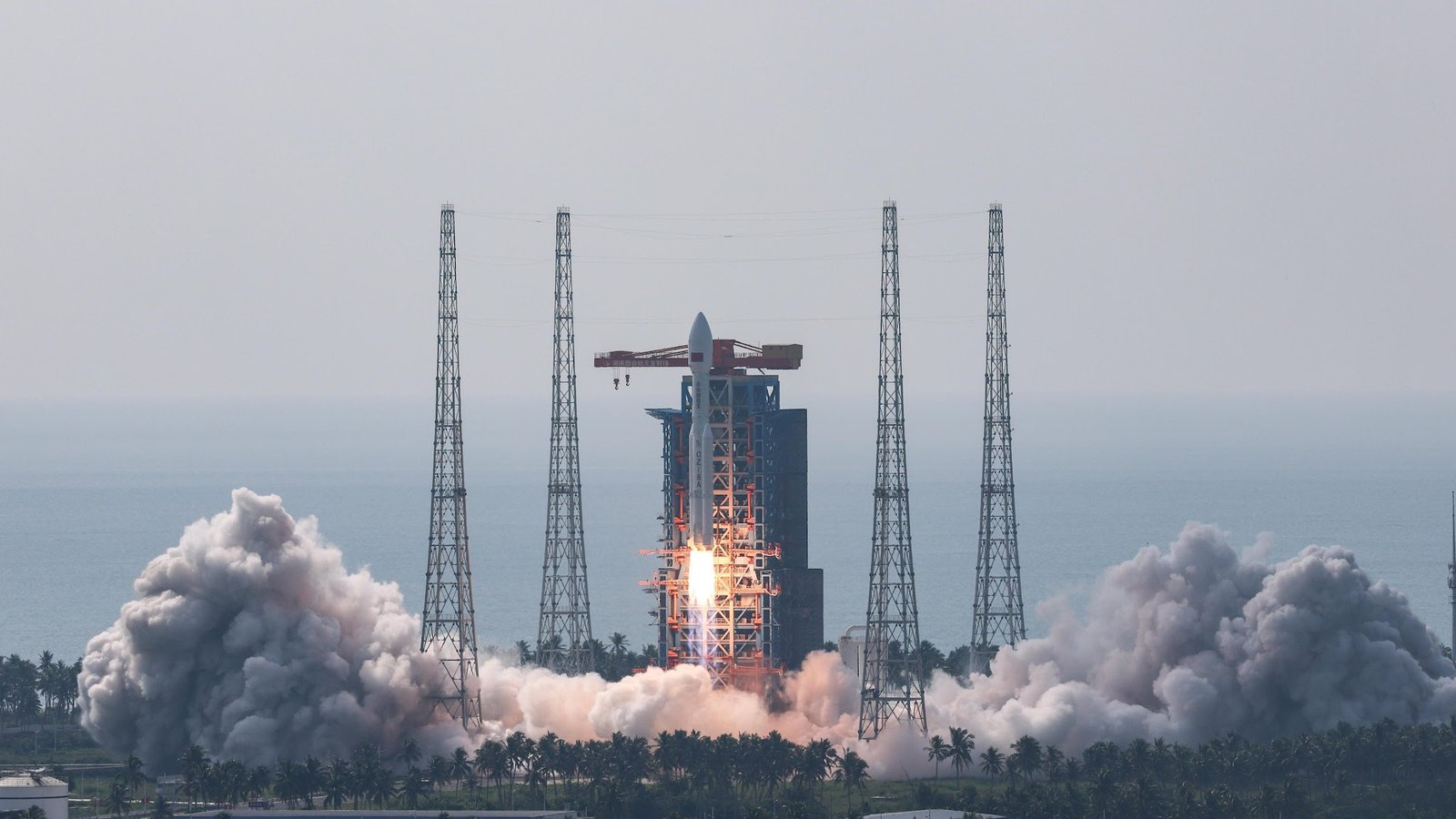
A Long March-8A rocket lifted off from Hainan on Sunday, carrying the latest group of satellites for China’s national low Earth orbit internet network.
China sent another group of internet satellites into orbit on Sunday, adding to a network that could one day number more than 13,000 spacecraft. A Long March-8A rocket lifted off from the Hainan Commercial Spacecraft Launch Site in Wenchang at 10:03 a.m. Beijing time on October 25, carrying the 28th batch of satellites for the Guowang constellation, also known as SatNet.
The satellites, built by the China Academy of Space Technology, reached their planned low Earth orbit. It was also a milestone for China’s workhorse rocket family, marking the 674th flight of the Long March series, according to Xinhua.
The launch came barely two weeks after the previous one. In the early hours of October 10, a Long March-12 rocket lifted off from the same site with the 27th batch, keeping up a pace that has become routine for the program this year.
Inside China’s Plan for a 13,000-Satellite Internet Network
Guowang means “national network” in Chinese. The project is run by China Satellite Network Group, a state-owned company better known as China SatNet.
The plan calls for two main layers of satellites. Around 6,000 are expected to fly between 500 and 600 kilometers above Earth, with roughly 7,000 more at about 1,145 kilometers. Keeping satellites this close to the planet allows for faster connections and less delay than older communications satellites parked much farther out.
Work on the network began with test satellites in July 2023. The first operational batch, made up of 10 satellites, followed on December 16, 2024, and the program has since flown on several rockets, including the Long March 5B, 6A, 8A and 12, as well as the commercial Jielong 3.
Once fully built, the constellation is meant to serve remote mountains, deserts, oceans and rural communities, while also supporting aviation, shipping and emergency communications when ground networks go down.
Hainan Keeps Up a Busy Launch Schedule
China kicked off 2026 with two batches in January alone. The 18th group, carrying nine satellites, launched on January 13, and the 19th went up six days later with another nine. More followed in March, April and June. One April mission on a Long March-6A placed the 21st group into a polar orbit at around 1,135 kilometers, and a new test satellite went up on a Jielong 3 rocket just days later.
Another nine satellites flew on a Long March-12 in mid-June, and launches have continued at a steady clip through the second half of the year, leading up to the back-to-back October missions.
Most of these missions have flown from Hainan, which is home to both the Wenchang Space Launch Site and the newer commercial launch site next to it. The commercial site was built to handle the growing number of launches needed for large satellite networks, which depend on frequent flights to fill their orbits.
Guowang is not China’s only project of this kind. Qianfan, also called Spacesail or the Thousand Sails constellation, is a separate commercial network backed by Shanghai that also plans to put thousands of satellites into orbit.
China SatNet has yet to announce when Guowang will begin offering commercial services, but more launches are expected as the company works to fill out both layers of the network.


