


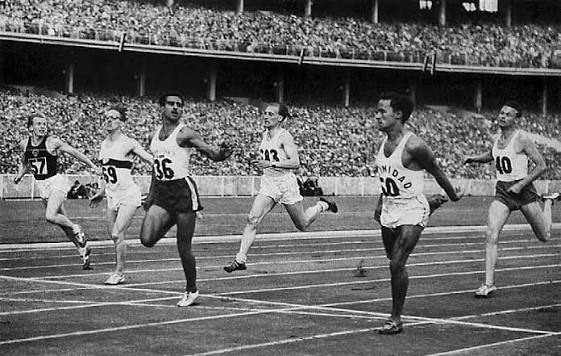
Long before Pakistan built a modern sporting identity, one man had already carried its name into Asia’s fastest company. Subedar Abdul Khaliq — remembered forever as the “Flying Bird of Asia” — was Pakistan’s first great name on the international track.
Born on 23 March 1933 in the village of Jand, Chakwal, Khaliq’s speed was first noticed not on a running track but on a kabaddi field. Brigadier C.H.B. Rodham, then head of the Army Sports Control Board, spotted the young villager’s explosive pace during a local match and recruited him into the Pakistan Army. What followed was a career built on discipline as much as talent — a young nation shaping one of its earliest global icons through the ranks of its military.
Khaliq’s breakthrough arrived at the 1954 Asian Games in Manila. He tore through the 100 metres in a record 10.6 seconds, shattering the previous mark and claiming the title “Fastest Man of Asia.” He added a silver in the 4x100m relay for good measure. Watching from the stands as chief guest, Indian Prime Minister Jawaharlal Nehru was reportedly so struck by the young sprinter’s grace that he coined the name history would remember him by: “The Flying Bird of Asia.”
Two years later, Khaliq stood on the biggest stage of all — the 1956 Melbourne Olympics — racing against the finest sprinters on Earth. He clocked a personal-best 21.1 seconds in the 200 metres, a mark that stood among the fastest posted in the Games’ early rounds, and pushed deep into the competition in both the 100m and 200m before elite international fields brought his run to an end. For an athlete from a country barely a decade old, with a fraction of the infrastructure of the nations he raced, simply standing on that track was itself a statement.
Khaliq’s dominance continued at the 1958 Asian Games in Tokyo, where he defended his 100m title and added a 200m silver — remaining Asia’s fastest man for close to a decade. His rivalry with India’s Milkha Singh became one of the defining sporting stories of the subcontinent, watched and debated across two young nations still finding their feet.
Abdul Khaliq passed away in 1988, but his legacy endures as a high-water mark in Pakistan’s athletic history — proof that a young nation, with grit and little else, once sent its fastest son flying past the rest of Asia.