
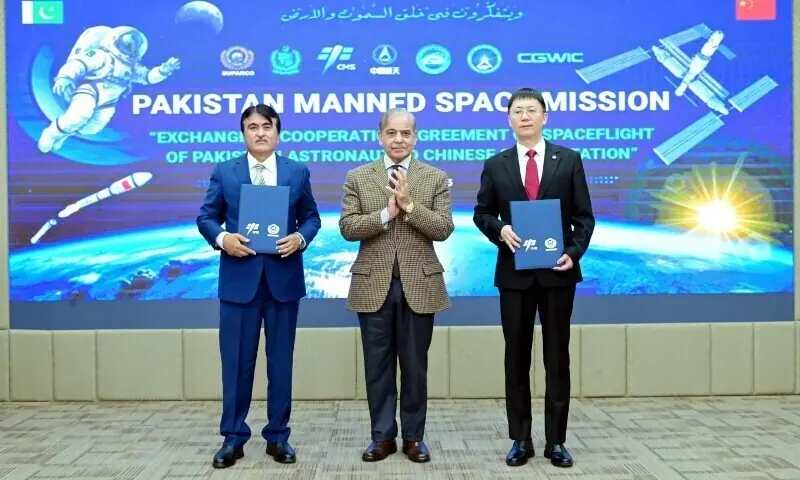
A Pakistani payload specialist will become the first foreign astronaut to visit China’s space station, under a 2025 agreement between the two countries.
A Pakistani astronaut will travel to China’s Tiangong space station as part of the Shenzhou-24 mission, becoming the first foreign astronaut to visit the station.
The China Manned Space Agency (CMSA) that a Pakistani payload specialist will join the Shenzhou-24 crew for a short stay in orbit. The agency did not name the astronaut or give a launch date, saying only that the mission is expected before the end of 2026.
Pakistan’s Federal Minister for Planning, Development and Special Initiatives, Ahsan Iqbal, said in October that the flight would take place on November 25.
The Pakistani astronaut will be one of two candidates, Muhammad Zeeshan Ali and Khurram Daud, who were selected in April to begin training in China. Officials have not said which of the two will fly.
Pakistan’s Shenzhou-24 Mission Details
Shenzhou-24 will carry a three-member crew to Tiangong. Launch is planned on a Long March 2F rocket from the Jiuquan Satellite Launch Center in northwest China. The Chinese crew members are expected to remain aboard the station for about six months.
The Pakistani astronaut will make a shorter visit of about a week. During that time, the payload specialist will carry out scientific experiments in microgravity, covering material science, fluid physics, life sciences and biotechnology. Pakistan’s Ministry of Information has said the research is linked to climate resilience, food security and industrial innovation.
At the end of the visit, the Pakistani astronaut will return to Earth aboard the Shenzhou-23 spacecraft, which docked with Tiangong in May.
Prime Minister Shehbaz Sharif met both candidates in April and described the mission as “a matter of pride for the entire nation.” He said it could “add new dimensions to the brotherly relationship between Pakistan and China.”
How Pakistan’s Astronauts Were Selected
The mission is the result of an Astronaut Cooperation Agreement signed in February 2025 between Pakistan’s Space and Upper Atmosphere Research Commission (SUPARCO) and the China Manned Space Agency. Under the agreement, two Pakistani candidates would train in China, and one would join a crew on a mission to Tiangong.
Candidates went through an initial screening in Pakistan, followed by detailed medical, psychological and aptitude assessments at the Astronaut Centre of China in Beijing. The evaluations followed international human spaceflight standards.
The selection of the two finalists was announced in April 2026, after which both traveled to China for advanced training at the Astronaut Centre of China. CMSA described the program as a “landmark event in the history of China’s space industry,” while SUPARCO called it a “significant step forward in Pakistan’s space exploration journey.”
Chinese state media has reported that more Pakistani astronauts are expected to take part in short missions with Chinese crews over the coming years.
The astronaut mission builds on several years of space cooperation between Pakistan and China.
In May 2024, Pakistan’s first lunar mission, the iCube-Qamar satellite, traveled to the Moon aboard China’s Chang’e-6 mission. Pakistan has also partnered with China on a series of remote sensing and communication satellites launched from Chinese sites.
Tiangong, which means “Heavenly Palace,” is China’s permanent space station. Its three modules were completed in 2022, and it has been continuously crewed by Chinese astronauts since then. China has been developing the station independently, as it has been excluded from the International Space Station program since 2011.
China is also working toward landing astronauts on the Moon by 2030.
The Shenzhou-24 mission comes in the year Pakistan and China mark 75 years of diplomatic relations, which were established in 1951.