

Four volunteers have exited NASA’s simulated Mars habitat in Houston after more than a year inside.
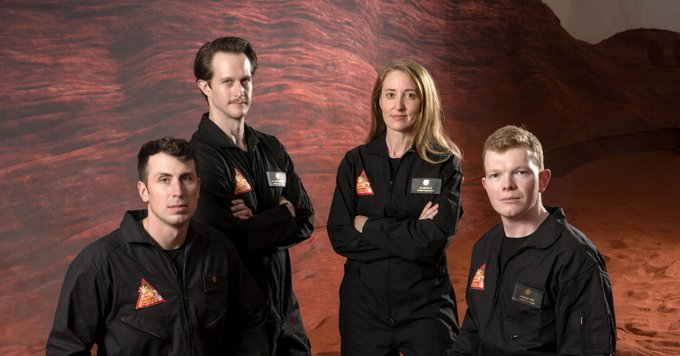
Four volunteers have completed a 378-day simulated Mars mission after stepping out of NASA’s habitat at the Johnson Space Center in Houston on Saturday, October 31.
The crew of the second Crew Health and Performance Exploration Analog (CHAPEA) mission entered the 3D-printed facility on October 19, 2025. They spent more than a year living and working in isolation under conditions designed to mirror those of a real mission to Mars.
The four crew members are Ross Elder, who served as mission commander, Ellen Ellis as medical officer, Matthew Montgomery as science officer, and James Spicer as flight engineer.
NASA streamed the exit ceremony live on its official channels. The crew delivered remarks after leaving the habitat, with Ellis describing the group as “analog astronauts living in captivity of our own free will.”
NASA Mars Simulation Crew Completes Marswalks, Research and 22-Minute Communication Delays in 3D-Printed Habitat
The crew lived inside Mars Dune Alpha, a 1,700-square-foot habitat built using 3D printing. The facility includes private crew quarters, a kitchen, medical and recreation areas, a fitness area, workspaces, crop-growing areas and two bathrooms.
During the mission, the crew carried out simulated spacewalks, known as “Marswalks,” in an adjoining area designed to resemble the Martian surface. They passed through an airlock to reach it but remained inside the building throughout the mission.
Their daily work included scientific research, habitat maintenance, exercise and growing plants. The crew had no cell phones, no internet access and no direct contact with other people during the mission.
Communication with mission control, family and friends came with delays of up to 22 minutes in each direction. The delay matches the time a message would take to travel between Earth and Mars. The crew also operated with limited resources, another condition NASA built into the mission to match those of deep space travel.
NASA CHAPEA Mission Data to Guide Future Moon and Mars Missions
NASA designed the CHAPEA program to collect data on how humans handle long periods of isolation, confinement and limited resources. According to NASA, the second mission focused on generating health and performance data to help improve food system design, crew time planning and the use of bandwidth on the agency’s Deep Space Network.
The findings will inform NASA’s planning for future missions to the Moon and Mars, including the challenges crews are expected to face far from Earth.
This was the second of three planned CHAPEA missions. The first crew, led by commander Kelly Haston, lived in the same habitat from June 25, 2023, to July 6, 2024. That mission also lasted 378 days.
Crew members for the CHAPEA program are selected from the public through a series of physical and mental tests. Applicants must hold a master’s degree in a science, technology, engineering or mathematics field, among other requirements.
Before entering the habitat, Ellis worked in space acquisition, while Spicer is a technical director in the aerospace and defense industry.
NASA has said it aims to send astronauts to Mars in the 2030s. The third and final CHAPEA mission will also take place inside Mars Dune Alpha at the Johnson Space Center.