

Divers and scientists are exploring a city that disappeared beneath Kyrgyzstan’s largest lake around 800 years ago.
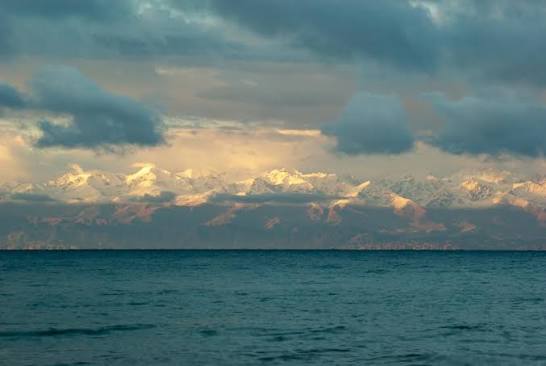
Beneath the clear waters of Lake Issyk-Kul in Kyrgyzstan lie the remains of a city that once stood on one of the busiest trade routes in history. A team of scientists and divers is now working to uncover what life looked like there before the water swallowed it, an estimated 800 years ago.
The submerged settlement, known as Toru-Aygyr, sits in the middle of the country’s largest lake. Researchers believe it may have covered as much as five square kilometers. Its original name and how many people lived there remain unknown.
The site was first rediscovered in the 19th century. But this project, which began in 2024 and involves around 20 scientists, is the first major systematic exploration of the ruins, AFP reported. It is funded by the Russian Academy of Sciences, with Russian and Kyrgyz teams working on the site in recent years.
What Divers Found in the Lost Silk Road City
Divers have brought up animal bones and fragments of pottery from the lakebed. The bones could reveal what people ate and how long they lived, while the pottery may help researchers date the settlement more precisely.
The team has also identified two cemeteries. Their features suggest the city was built during the early spread of Islam in the region, although an exact date has been difficult to pin down.
Among the most notable discoveries is a decorated public building. Researchers believe it may have served as a mosque, a public bath or a religious school.
One of the more personal finds is a child’s chamber pot, known as a tuvaq. Expedition director Maxim Menshikov said such pots are still used today in Central Asia and the Caucasus.
Menshikov compared the work to the excavation of Pompeii, the Roman city buried by the eruption of Mount Vesuvius in 79 AD. “They had a highly developed civilization and culture,” he said of the people who lived there.
Scientists have several theories about how the city ended up underwater. One points to a landslide. Another suggests a tectonic dam formed after an earthquake, which slowly flooded the area.
Geologist Andrei Strelnikov of the Russian Academy of Sciences considers a past seismic disaster the most likely cause.
The city’s location gives the discovery added weight. The Silk Road connected China with the Mediterranean from the second century BC until the middle of the 15th century, carrying goods, ideas and religions across continents.
The stretch of the route that passed the settlement is believed to have been controlled by the Karakhanids, a Turkic dynasty that ruled much of Central Asia from the ninth to the early 13th centuries.
Despite its central position, the region’s past is still poorly understood. “This is actually a blind spot in history, even though it is right in the centre of Central Asia,” Menshikov said. “The Silk Road is not merely the history of a single region, it is the history of Eurasia as a whole.”
The team plans to continue analyzing the recovered bones and pottery while searching for the outer edges of the settlement. Diver Elizaveta Bodrova said she hopes to “find the boundary of the settlement” as the work goes on.