

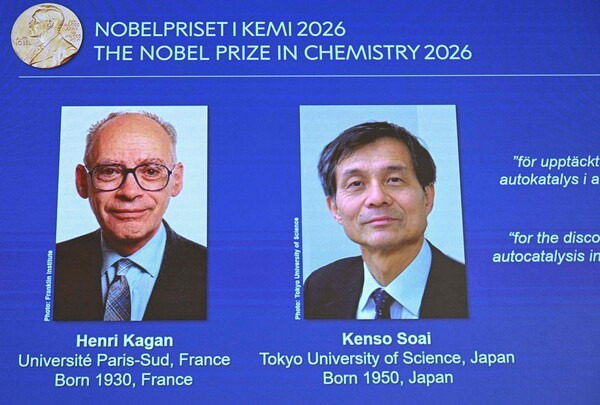
The 2026 Nobel Prize in Chemistry has been awarded to French chemist Henri B. Kagan and Japanese chemist Kenso Soai for discoveries that helped explain how chemical reactions can produce predominantly one of two possible mirror-image forms of a molecule. The Royal Swedish Academy of Sciences announced the award on October 7, recognizing the scientists “for the discovery of non-linear effects and autocatalysis in asymmetric organic synthesis.”
The research addresses a long-standing question in chemistry: why living organisms overwhelmingly use only one of two possible mirror-image forms of many molecules. This property is known as homochirality. The term refers to the “handedness” of molecules, which can exist in forms that are mirror images of each other but cannot be superimposed, much like a person’s left and right hands.
Amino acids provide one of the clearest examples. All amino acids have two mirror-image forms, known as enantiomers, but proteins in living organisms use predominantly one form. Sugars found in DNA also display this type of molecular selectivity. How this one-sided chemical arrangement emerged has been a scientific question for more than a century.
The history of the problem goes back to French chemist Louis Pasteur. In the 19th century, Pasteur studied tartaric acid and discovered that it could exist in two mirror-image forms. His experiments helped establish the concept of molecular chirality. Later observations showed that bacteria could distinguish between the two forms of tartaric acid, providing early evidence that biological processes could be sensitive to molecular handedness.
For many years, chemists struggled to reproduce the strong molecular asymmetry found in living systems. Chemical reactions that produced chiral molecules commonly generated roughly equal amounts of the two mirror-image forms. Earlier work, including research by German chemist Willy Marckwald, demonstrated that asymmetric reactions could produce a slight excess of one form, but a mechanism capable of strongly amplifying such an imbalance remained elusive.
Kagan made a major contribution to this problem in the 1980s. He investigated how catalysts containing both metal components and chiral molecules behaved during asymmetric reactions. He discovered that the relationship between the composition of the catalyst and the molecular handedness of the resulting product was not always proportional. Instead, interactions between different forms of the catalyst could create non-linear effects, allowing a small difference in the catalyst to produce a much larger difference in the products.
This finding addressed one of the conditions proposed in 1953 by theoretical physicist Charles Frank. Frank had suggested that homochirality could emerge if a chemical system could favor one molecular form, amplify that imbalance and produce the catalyst responsible for the process through autocatalysis. In an autocatalytic reaction, a product helps catalyze the same reaction that produces it, creating a self-reinforcing process.
Soai provided the crucial experimental demonstration. In research published in 1995, he reported an asymmetric autocatalytic reaction in which a starting imbalance of 2% in one enantiomer was amplified to an 87% excess. In 2003, Soai presented a reaction in which a chiral product could reproduce its own molecular handedness. Under the reaction conditions, a tiny initial imbalance could become dominant, with the final product reaching up to 99.99% of one enantiomer.
The Soai reaction itself is not a direct reproduction of the chemistry that created life. The Nobel committee notes that it is an artificial chemical system. However, it demonstrates that a small initial imbalance can be amplified through chemical processes into a strongly one-sided molecular composition, providing an important model for understanding how homochirality could arise.
The discoveries also have practical importance. Controlling molecular handedness is particularly significant in pharmaceutical manufacturing because different enantiomers of a compound can interact differently with biological systems. Kagan’s work has also contributed to methods used in the production of pharmaceuticals, flavours, fragrances, agricultural chemicals and other materials.
The 2026 Chemistry Nobel therefore recognizes both a fundamental advance in understanding molecular asymmetry and chemical tools that allow researchers to control which mirror-image molecules are produced. Together, Kagan’s work on non-linear effects and Soai’s work on asymmetric autocatalysis provided key experimental evidence for how strong molecular asymmetry can emerge from chemical reactions.