

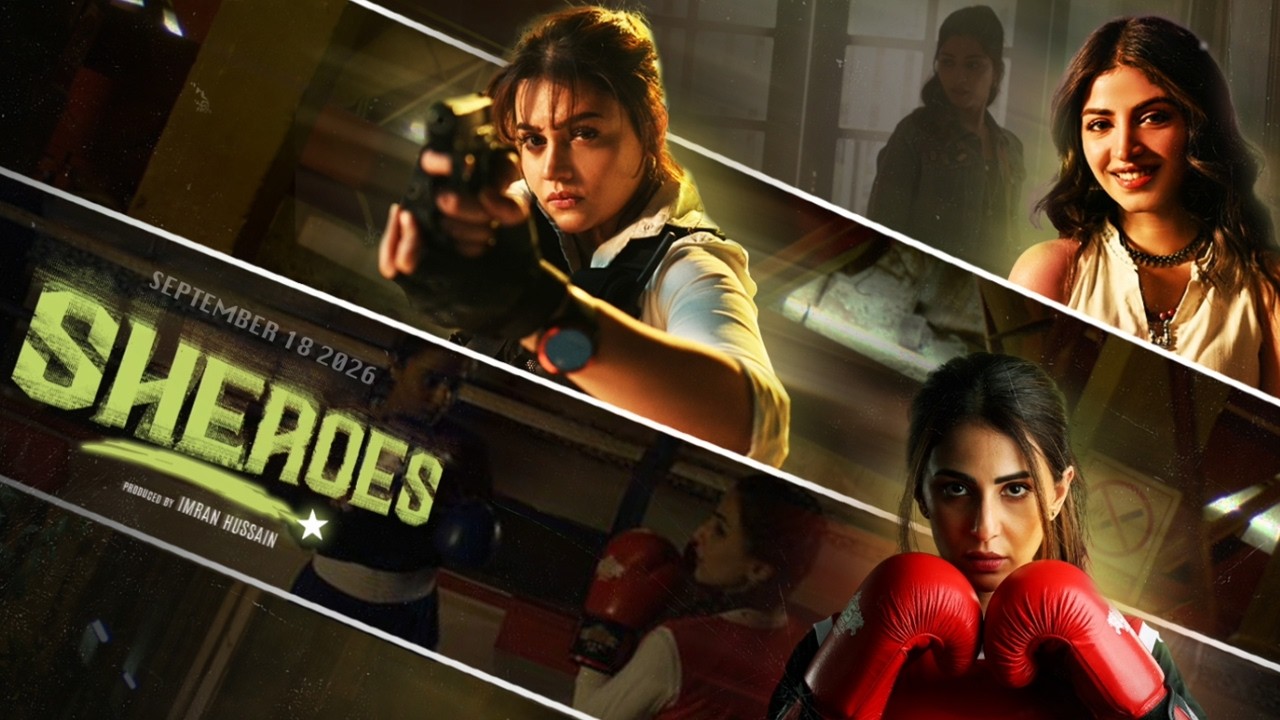
An anthology can tell three very different stories without being wrong. In fact, the format can be particularly effective when filmmakers use its limited running time to get straight to the point. Unfortunately, Sheroes feels less like three fully realized films and more like three ideas hastily turned into movies.
Featuring Gear Up, Artist, and Punch, the anthology brings together different genres, filmmakers, and performers, but the common thread isn’t necessarily quality. All three films feel rushed, and the characters, situations, and even the stories’ basic logic suffer. The result often looks and feels like a thesis film rather than a polished cinematic production.
There are flashes of potential, particularly in the performances and premises, but potential alone is not enough. A good idea needs a screenplay that knows where it is headed, a director who knows how to get there, and enough time to make the journey believable. Sadly, none of the three films is fully cooked; they’re all half-baked.
Gear Up: From the World of Dirty Harry!
Written by Hashim Nadeem and Saqib Khan and directed by Saqib Khan, Gear Up stars Zara Noor Abbas as a Bomb Disposal Squad officer who is seen as a weak link, especially after she takes the job following her legendary father’s death in the line of fire. A year later, she tries to do what he couldn’t, confronting the same villain as she attempts to rescue a hostage and defuse a bomb before it’s too late.
On paper, it’s an interesting premise, and with Asad Siddiqui and Rashid Farooqi in the cast, it looks solid. However, decisions such as making the hostage the boss’s son or portraying some of the fellow officers as more concerned with their own lives than with others’ made it comical.
Imagine Dirty Harry meeting Heath Ledger’s Joker, Jim Carrey’s The Riddler, and Naseeruddin Shah’s character in A Wednesday. That is roughly the territory Gear Up aims to occupy.
Unfortunately, that’s where the film also tests the limits of coincidence. One coincidence can be dramatic. Two can be convenient. When nearly every major character and event connects to another, the story begins to feel engineered rather than organic.
Zara Noor Abbas, however, is the biggest reason to watch. She brings enough personality and screen presence to make you wonder why the show hasn’t given her her own series. The character could work beautifully in a longer format, allowing you to explore her motivations, history, and relationship with her father.
But Gear Up is not that series. It is a half-cooked short film that introduces an interesting heroine and then fails to give her enough material to become one.
Asad Siddiqui does what he can with the villain, but the character is caught somewhere between menace and theatricality. The film wants him to be larger than life, yet the writing doesn’t always give him the material to feel genuinely threatening. Veteran actor Rashid Farooqi is wasted in a role that could have easily gone to another actor, offering nothing beyond looking worried, even more worried than before.
The biggest problem is that the film seems built around the characters rather than their development. The story is potentially compelling, but it needed more time, more writing, and far fewer coincidences.
Artist—Con gone wrong!
Written by Amna Mufti and directed by Saqib Khan, Artist stars Kinza Hashmi, Ahmed Hassan, Nazarul Hasan, Hammad Siddiqui, and Nayyar Ijaz. It is neither a con film nor a heist film, and it never qualifies as entertaining; its only contribution is making Sheroes look extremely weak in many ways.
The first scene alone is so long and boring that it would frustrate you, even if you were trying hard not to look disappointed, especially since it could have been wrapped up in about ten seconds. The next few scenes largely focus on extreme close-ups of Kinza Hashmi, trying to make her look like Bollywood star Kirti Sanon. The reason? I don’t know.
By the time the story actually begins, patience has already become part of the viewing experience. The film seems to set up a con, but it isn’t constructed well enough for the audience to understand what is happening. Instead of making us admire the characters for outsmarting someone, it makes us wonder whether we missed something. That’s not the same thing.
If you’re making a film about a con, the audience should ideally be one step behind the con artists—not completely lost because the screenplay hasn’t explained the rules of the game. Films such as The Sting and TV shows such as Leverage and Hustle capture the pleasure of a con. They establish the deception, let the audience follow enough of it to appreciate the reveal, then pull the rug out from under us. Artist seems to pull the rug without first giving us a floor.
What makes this even more disappointing is Saqib Khan’s previous work. Having directed Dar-i-Nijaat and worked on projects featuring performers such as Saba Qamar, Zahid Ahmed, and Syed Jibran in Ghabrana Nahi Hai, he clearly can create stronger material. It’s difficult to understand what went wrong here.
Kinza Hashmi looks fresh and beautiful, but she maintains essentially the same expression throughout the film, no matter what happens around her. The rest of the actors don’t get much to work with; they perform their characters as written, with no soul, heart, or mind. The short film wants to be clever and taken seriously. Unfortunately, the audience shouldn’t have to work this hard to tell whether the film knows what it is doing.
Punch—the strongest of ‘em all!
Written by Mohsin Ali and directed by Badar Mehmood, Punch stars Ushna Shah, Gohar Rasheed, Parveen Akbar, Ehteshamuddin, and a child actor who, unfortunately, is more irritating than endearing.
Of the three films, Punch is by far the most professionally made. It looks like a film rather than a haphazard collection of scenes. There is greater control over the performances, framing, and overall presentation. However, the story has its own problems.
The now-famous “Pawri” line feels especially misplaced. It’s beyond me why such an experienced writer felt this reference belonged in the film. It immediately dates the material and reads as an attempt to manufacture a moment rather than to serve the story.
The film also bears an uncomfortable resemblance to Panga, the Kangana Ranaut-starrer about a woman’s sporting comeback. The parallels aren’t inherently a problem, but Punch doesn’t do enough to distinguish itself from that familiar template.
Punch follows a former champion boxer (Ushna Shah) who returns to the spotlight after knocking out a dacoit on camera. Her former coach (Ehteshamuddin) desperately wants her back, but after meeting her again after ten years, he shames her for quitting to raise a family and mocks her slow reflexes. Her husband (Gohar Rasheed) finally helps her train, and when she wins her first match, the coach celebrates in the corner. The question is: What did he actually do to help her come back? Nothing.
A comeback story needs a comeback. It needs to show us the struggle, the training, the setbacks, and the moment when the protagonist earns the right to stand victorious. That is why the absence of an Eye of the Tiger-style training montage isn’t just about wanting a familiar cinematic cliché. It is about seeing the transformation the story asks us to believe in.
Punch tells us the character has overcome something, but it doesn’t provide enough evidence of how she did it. Still, compared with the other two films, this one feels closest to a finished product. The only song in the whole anthology appears in Punch, but it needed more ‘punch’ to survive.
The bigger problem
The most striking thing about Sheroes is not that all three films have problems. Every anthology will have a weak link. The bigger issue is that all three seem to have been made in such a short period that the production process compromised them before they could become what they could have been.
They are shot like thesis films: functional, occasionally interesting, but rarely polished enough to feel fully cinematic. The brief seems to be to make a film in which a woman is first ridiculed and then, when she excels, hailed as a ‘shero’; that would have worked for a student thesis on Women’s Day, but not in a cinema, especially in 2026.
The film has good actors and experienced writers. Some directors have shown they can deliver stronger work. Some premises could have worked with more development. Instead, all three fall short.
That is perhaps the most frustrating thing about Sheroes. It isn’t an anthology without ideas. It is an anthology that doesn’t give its ideas enough time to breathe. It has the ingredients; what it lacks is time to cook.