

From light switches for brain cells to ghostly particles from deep space, here is who has won a Nobel Prize so far this year and what their work means.
Every October, the world turns its attention to Stockholm, where a handful of phone calls can change a scientist’s life overnight. Some winners hear the news in the middle of the night, half asleep, while others find out from reporters before the official call even reaches them. This year has been no different.
The 2026 Nobel Prize announcements began on October 5 and run until October 12, with one prize named each day across the week. Each prize comes with 12 million Swedish kronor, or about $1.2 million, which is shared when there is more than one laureate.
So far, two prizes have been announced, both honoring discoveries that took decades to build and have reshaped their fields. One gave scientists a way to control individual brain cells with light. The other turned a block of Antarctic ice into a telescope for the universe.
Here is a look at who won, and why.
Nobel Prize in Medicine 2026 Goes to the Pioneers of Optogenetics
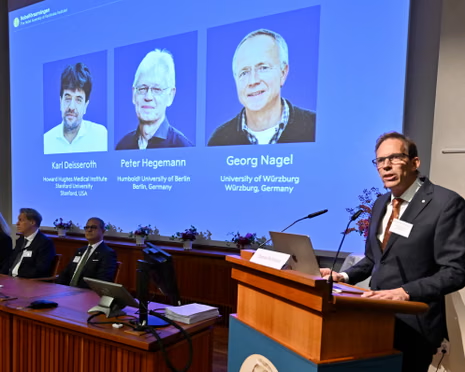
The first prize of the week went to Karl Deisseroth, Peter Hegemann and Georg Nagel “for their discoveries concerning light-gated ion channels and optogenetics.”
Their work began with tiny green algae that swim toward light. Hegemann and Nagel studied a light-sensitive protein in these algae called channelrhodopsin, which opens like a gate when light hits it. They found the protein kept this ability even when placed in other kinds of cells.
Deisseroth took the next step by placing the protein inside nerve cells from rats. When he shone blue light on them, the cells fired. The method, published in 2005, became known as optogenetics, and it now lets scientists switch specific brain cells on or off in living animals.
That has transformed brain research. Scientists use it to study how nerve cells shape memories, feelings and behavior, and to understand the cells involved in psychiatric and neurological disorders. It is also being explored in early clinical research, including efforts to restore some vision in people with certain types of blindness.
Deisseroth is a professor at Stanford University in the United States and still works as a psychiatrist. Hegemann is based at Humboldt University of Berlin and Nagel at the University of Würzburg, both in Germany.
Nobel Prize in Physics 2026 Honors the Hunt for Cosmic Neutrinos
The physics prize went to a single winner, Belgian-born physicist Francis Halzen, “for decisive contributions to the IceCube Neutrino Observatory and the discovery of high-energy neutrinos of astrophysical origin.” It is the first time since 1992 that the physics prize has gone to only one person.
Neutrinos are among the most elusive particles in the universe. They are so tiny and interact so rarely with matter that trillions pass through the human body every second without leaving a trace, which is why they are often called ghost particles.
In the 1980s, Halzen had an unusual idea. He realized that the clear, deep ice beneath the South Pole could be used to detect the faint flashes of light produced when a neutrino occasionally collides with something. He first proposed the project in 1988, and after researchers spent seven Antarctic summers drilling holes kilometers deep into the ice, the IceCube Neutrino Observatory was completed in 2011.
The result is a detector made from a cubic kilometer of ice. It has captured high-energy neutrinos coming from far beyond our solar system and traced some of them back to their sources, including the disk of our own Milky Way. Scientists say it has opened the door to a new kind of astronomy, one that studies the universe through neutrinos as well as light.
“It was a great surprise and I obviously didn’t expect it,” Halzen, 82, said at the Nobel press conference. He has been on the physics faculty at the University of Wisconsin–Madison since 1972.
Remaining Nobel Prizes Announced This Week
The Nobel Prize in Chemistry is scheduled to be announced on October 7 by the Royal Swedish Academy of Sciences. The prize in literature follows on October 8, the Nobel Peace Prize on October 9 and the prize in economic sciences on October 12.
The laureates will receive their medals, diplomas and prize money at ceremonies on December 10, the anniversary of Alfred Nobel’s death. The peace prize is presented in Oslo, Norway, and the other prizes in Stockholm, Sweden.
2026 Nobel Prize Winners at a Glance
- Physiology or Medicine went to Karl Deisseroth, Peter Hegemann and Georg Nagel for discoveries leading to optogenetics, a method that uses light to control nerve cells in the brain.
- Physics went to Francis Halzen for his work on the IceCube Neutrino Observatory and the discovery of high-energy neutrinos from space.
- Chemistry will be announced on October 7.
- Literature will be announced on October 8.
- Peace will be announced on October 9.
- Economic Sciences will be announced on October 12.