



Rescue teams in Nepal are intensifying efforts to locate hundreds of workers believed to be missing or trapped inside hydropower project tunnels following devastating floods and landslides in the Himalayan country.
Nepali authorities said on Monday that 933 workers from 11 hydropower projects were among those reported missing after the disaster. The rescue operations are concentrated mainly in the Rasuwa and Nuwakot districts, where several hydropower facilities were severely affected by the floods.
The disaster struck on August 26, when a massive flow of water, ice, rock, mud and other debris swept through valleys in Nepal and across the border into China’s Tibet region. Authorities believe a glacier collapse triggered the destructive flood. The resulting torrents damaged villages, roads, bridges and critical infrastructure along the affected river systems.
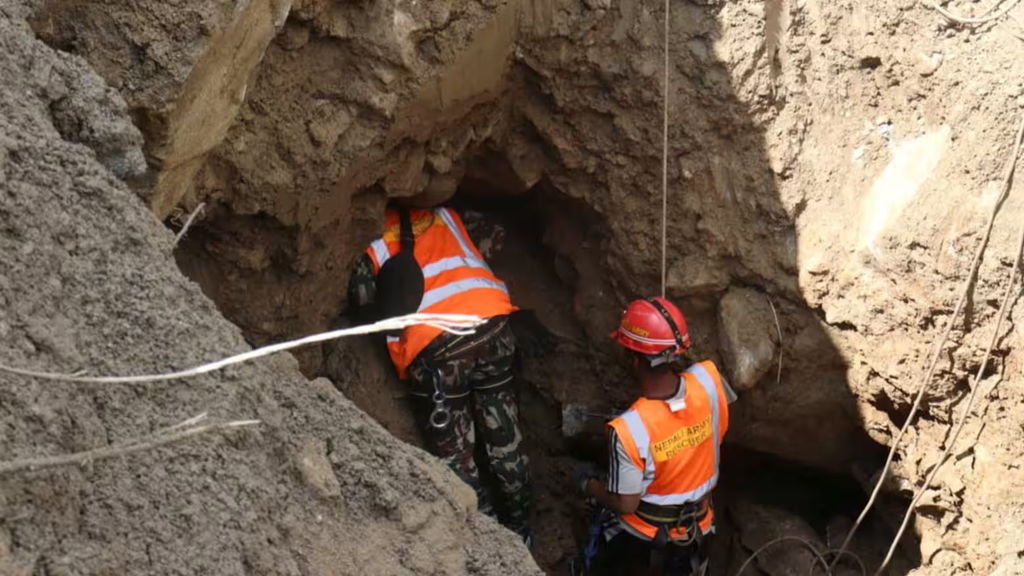
Many of the missing hydropower workers are believed to be inside tunnels that were blocked by mud and debris. Rescue teams have been working to locate tunnel entrances and clear pathways so that personnel can enter and search for survivors.
The Nepalese Army has deployed soldiers and engineers for the operation, while heavy equipment has been transported to difficult-to-reach locations. Rescuers have used excavators, drilling machines, hydraulic equipment and other machinery to remove debris and reach the tunnels. At the Upper Trishuli-3A Hydropower Project, rescuers located part of a tunnel entrance and worked to widen the opening. Officials said oxygen supplies and cameras would be sent into the tunnel once access was established to assess conditions and search for people who may still be inside.
Another major focus is the Upper Trishuli-3B project, where more than 100 people have been reported missing. Other affected hydropower facilities include the Chilime, Langtang Khola and Mailung Khola projects. The scale and difficulty of the rescue operation has prompted assistance from neighboring countries. India and China have sent specialized personnel and equipment to support Nepal’s efforts to reach the affected tunnels.
India has provided tunnel-rescue specialists, while Chinese teams have also been assisting with operations at hydropower sites. Indian authorities have additionally supplied humanitarian equipment and other materials for the wider disaster response.
Nepal has deployed thousands of security personnel across the wider rescue operation. According to authorities cited by Reuters, approximately 21,000 security personnel have been involved in rescue and relief efforts. More than 10,000 people have been rescued from areas affected by the disaster.
Rescuers face significant obstacles because of the terrain and continuing risks from flooding and landslides. Large quantities of mud and rocks have blocked access routes, while damaged roads and bridges have made it difficult to transport heavy machinery to some locations.
Bad weather and rising water levels have also interrupted rescue work. Authorities have warned of additional dangers from water accumulating behind debris and from unstable areas created by the floods.
The wider disaster has resulted in a rapidly changing casualty and missing-person count. Nepalese authorities reported 903 deaths and 4,247 missing people on Monday. In neighboring China’s Gyirong County, authorities reported 16 deaths and 546 missing people.
The disaster has also affected foreign nationals. Nepal’s Foreign Ministry said approximately 590 foreign nationals from 39 countries remained missing, while hundreds of foreign nationals had already been rescued from the affected region. Search and rescue operations remain underway as teams continue working to clear blocked hydropower tunnels and determine the whereabouts of the missing workers. Authorities are continuing to assess the extent of damage across the affected areas while rescue teams prioritize locations where people may still be trapped underground.


